
The Magazine That Made Americans Face Pearl Harbor Again
Admiral Halsey's unflinching 1947 memoir refused to let a nation forget who was really to blame
July 5, 1947. Two summers after victory. While most Americans were learning to forget the war, Admiral William F. "Bull" Halsey was forcing them to remember it—and to admit what they'd done wrong.
His memoir landed in living rooms across the country that week, serialized in The Saturday Evening Post. Part Four carried a message nobody wanted to hear: Pearl Harbor wasn't just the fault of two scapegoated officers. It was America's fault. Congress's fault. Your fault.
And readers couldn't put it down.
The Nation That Wanted to Move On
By the summer of 1947, the United States was desperate for normalcy. The Marshall Plan was just weeks old, designed to rebuild a shattered Europe. The Truman Doctrine had committed America to defending democracy worldwide—a promise that would define the next half-century. Rationing had finally ended. Veterans were flooding into colleges on the G.I. Bill, starting families, buying homes in new suburbs that hadn't existed three years earlier.
But Pearl Harbor refused to fade.
December 7, 1941 wasn't ancient history. It was six years ago—close enough to taste. Most Americans remembered exactly where they were when the news came crackling over the radio, when the frantic headlines hit the streets. Investigations had already dissected the disaster. Admiral Husband Kimmel and General Walter Short had been publicly blamed, careers destroyed, reputations shredded.
And then Halsey spoke.
Not with the measured language of official reports. Not with the careful euphemisms of military bureaucracy. He spoke with the bluntness of a man who'd watched the Pacific burn and had no patience left for comfortable lies.
The Saturday Evening Post didn't just publish his words. They gave them a stage.
Archive Details
Historical Figure: Admiral William F. "Bull" Halsey Jr.
Publication: The Saturday Evening Post
Issue Date: July 5, 1947
Feature: "Admiral Halsey Tells His Story" (Part Four)
Cover Artist: Stevan Dohanos
Context: Published two years after V-J Day, during the early Cold War transition
The Magazine That Shaped How America Saw Itself
The Post wasn't merely popular—it was the nation's conscience. For over a century, it had delivered more than entertainment. It delivered identity. Norman Rockwell painted its covers. Great fiction ran alongside hard journalism. Humor mixed with commentary. Middle-class America saw itself reflected in those pages, week after week, and trusted what it saw.
Publishing Halsey's memoir was an act of national reckoning disguised as summer reading.
The July 5, 1947 issue gave readers the days before Pearl Harbor, the desperate movements of the carrier Enterprise, the Navy's first retaliatory strikes on the Marshall and Gilbert Islands. But more than tactics or timelines, it gave them Halsey's anger—controlled, simmering, undeniable. His voice carried the weight of someone who'd been there, who'd fought back, and who refused to let two men take the fall for a nation's complacency.
The article didn't comfort. It accused.
And Americans read every word.
The Cover That Said Everything Was Fine
Stevan Dohanos painted the cover for that issue, and the contrast was deliberate. A woman in an apron greets returning soldiers on a front porch, one carrying a rolled flag, another leaning casually on the rail. The Stars and Stripes hangs proudly across the siding. The scene is warm, domestic, safe.
This was The Saturday Evening Post in perfect balance: reassurance on the outside, hard truth on the inside.
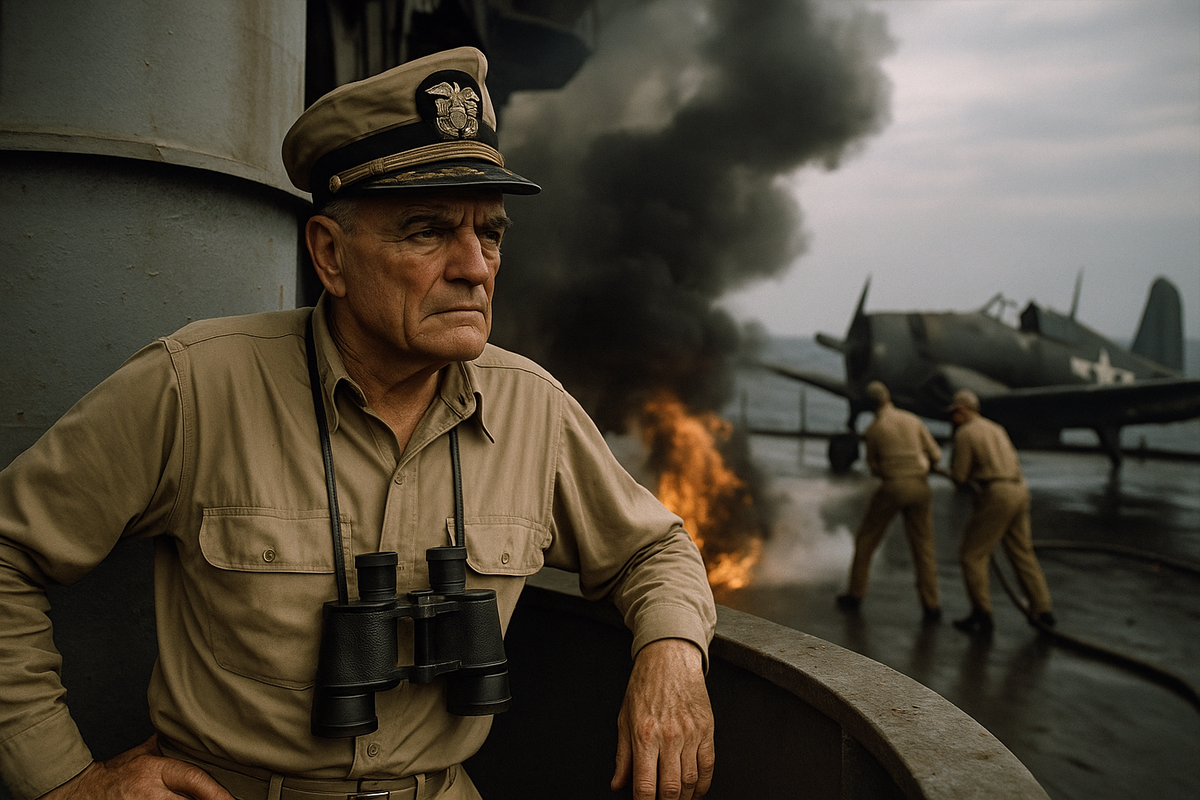
Inside, photographs pulled readers back into the war they thought they'd left behind. Crewmen fighting fires aboard the Enterprise, smoke choking the sky. Sailors unfolding fighter plane wings, preparing for another strike. Halsey himself—stern, binoculars around his neck, framed by the steel geometry of his ship.
These weren't illustrations. These were witnesses.
What Halsey Said
The memoir didn't bury its lead. Halsey recounted the moment the dispatch arrived: "Air Raid on Pearl Harbor X This Is No Drill." The shock. The disbelief. The sickening realization that everything had changed.
He walked readers through the Enterprise's movements—always on the knife's edge of disaster, always central to America's survival in those first desperate months. He detailed the counterattacks on the Marshall and Gilbert Islands, strikes that were militarily modest but psychologically crucial. Americans needed to believe they could hit back.
But the memoir's real power was in Halsey's refusal to comfort his audience. He insisted—bluntly, repeatedly—that scapegoating Kimmel and Short was wrong. Washington shared the blame. Congress shared the blame. The American people, who'd demanded peace at any price and refused to prepare for war, shared the blame.
He described life on the flight deck with unsentimental clarity: the crews who unfolded planes, braved fire, carried the nation's hopes on their backs while most Americans still slept safely. And he ended with a warning that cut through the postwar optimism like a klaxon: Never again. Never this unprepared. Never this blind.
For readers in 1947—still adjusting to peace, still counting their dead, still wondering if they could have prevented it all—Halsey's voice must have felt like a hand gripping their shoulder.
Historical Proximity
Published just two years after V-J Day, while the war's memory was still raw and veterans were still finding their footing in civilian life.
Unfiltered Voice
Halsey's account carries an immediacy that later polished memoirs can't match—real-time processing before mythology set in.
National Reckoning
The memoir forced Americans to confront collective responsibility rather than accepting comfortable scapegoating.
Cultural Balance
Dohanos' optimistic cover paired with Halsey's sobering account captured postwar America's dual mood perfectly.
The Magazine as Time Machine
The Saturday Evening Post endures because it was never disposable. Unlike today's digital ephemera, these issues were built to last—physically and culturally. They documented American life as it happened, without the revisionist polish of hindsight.
From the 1930s through the 1970s, the Post captured decades of transformation: Depression, war, prosperity, upheaval. Each issue is a window into a specific moment, complete with the advertisements, the illustrations, the fiction, the commentary that shaped how people understood their world.
This is primary source material. This is what history looked like before it became history.
Why This Issue Matters Now
Historical Timing
Published just two years after V-J Day, this issue captures America processing the war in real time, not retrospectively. The memory was still fresh, the questions still urgent.
Unfiltered Voice
Halsey's serialized account preserves what he wanted Americans to know immediately—before the war could be tidied up and mythologized for textbooks.
Dual Collectibility
Military historians prize it for Halsey's firsthand testimony. Art collectors prize it for Dohanos' cover. Magazine enthusiasts prize it as a flagship issue from the Post's golden era.
Cultural Memory
This issue sat on coffee tables in 1947. Families saved it, understanding they were holding something important—a direct link to how America grappled with its recent past.
Why This Issue Still Speaks
The July 5, 1947 Saturday Evening Post remains one of the most significant postwar publications of its era—not because it celebrated victory, but because it refused to let Americans off the hook.
Admiral Halsey's unflinching account of Pearl Harbor, paired with Dohanos' warm vision of homecoming, captured a nation caught between comfort and caution, between moving forward and looking back.
This isn't just paper. This is Halsey's voice, still urgent after eight decades. This is America's reckoning with itself, preserved in ink and photographs and memory.
And it's still asking the same question: Are we paying attention this time?
Explore the Archive
Whether you're a collector tracking down specific issues, a historian researching postwar American culture, or someone honoring a relative who lived through those years, these magazines offer something irreplaceable: unmediated access to the past.
Browse The Saturday Evening Post Magazines Collection