
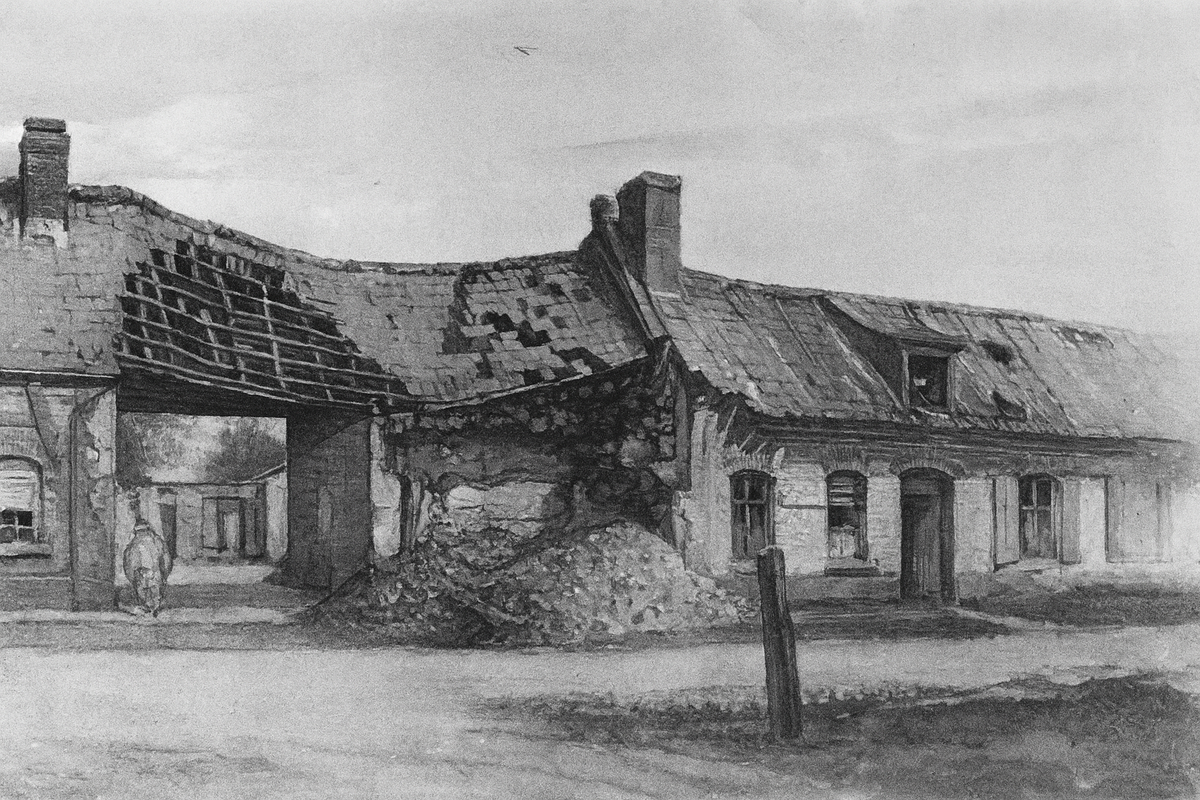
The Paintbrush Before the Storm
When Life Magazine Published Hitler's Watercolors
On November 30, 1936, American families opened the second issue of a bold new magazine and found themselves staring at something unexpected: watercolors by Adolf Hitler. Not propaganda. Not political cartoons. Actual paintings—ruined abbeys, empty cottages, desolate landscapes—created by the Führer's own hand during the First World War.
It was neither endorsement nor exposé. It was something stranger: an attempt to understand the dictator as an artist, three years before the invasion of Poland, six years before the Final Solution. Life Magazine had given its readers a portfolio of Hitler's creative output at the precise moment when his political ambitions were reshaping Europe. The dissonance is almost unbearable now.
This wasn't curiosity for curiosity's sake. It was Henry Luce's new editorial formula in action: show the world, don't just describe it. And what Life showed that autumn was a man whose failed paintings had outlived his imperial dreams—at least on paper.
Archive Details
Historical Figure: Adolf Hitler
Issue Date: November 30, 1936 (Life Magazine, Issue #2)
Feature Title: "Paintings by Adolf Hitler"
Archive Source: Original Life Magazine Collection
1936: The Year the World Still Wondered
When Life published Hitler's watercolors, the full horror of the Nazi regime remained unimaginable to most Americans. Germany had violated the Treaty of Versailles by reoccupying the Rhineland that March. The Berlin Olympics had just concluded, a spectacle of pageantry and propaganda. Fascism was metastasizing—Mussolini in Ethiopia, Franco in Spain—but the scale of what was coming remained hidden.
Americans viewed Hitler through a glass darkly: menacing, yes, but also enigmatic. A demagogue, certainly. But a genocidal architect? That revelation lay ahead.
Life's feature, "Paintings by Adolf Hitler," was not political commentary. It was cultural archaeology. The magazine reminded readers that this man—now commanding armies and crowds—had once been rejected by the Vienna Art Institute. Twice. That failure had condemned him to selling postcard sketches on street corners before the Great War pulled him into the trenches and, eventually, into politics.
The watercolors in Life were relics of that other life. Evidence of the path not taken. Quiet, competent renderings of war-torn buildings and empty fields, painted between dispatch runs on the Western Front. They were also, as the article noted, the last serious works Hitler completed before abandoning art for power.
Luce's Vision: Show the Story
Life Magazine had launched only weeks earlier, in November 1936. Henry Luce's vision was revolutionary: combine photojournalism with narrative urgency. Make history visible. Make it intimate.
The Hitler portfolio embodied that philosophy. Life devoted multiple full-color pages to his wartime works:
"Haubourdin, February 1916" – Peasant houses near the French front, painted while Hitler served as a corporal carrying messages between trenches.
"Fromelles Dressing Station" – A ruined building repurposed for medical aid, its walls scarred by artillery.
"House with White Fence" – A pastoral scene, unnervingly devoid of human presence.
"Old Abbey at Messines" – Medieval ruins in Belgium, another casualty of the war.
The magazine noted that these paintings displayed "remarkable flow and feeling" compared to Hitler's earlier, rigid Vienna postcards. Critics acknowledged technical competence—but they also observed what was absent. No soldiers. No civilians. No faces. Just architecture and emptiness, painted amid the worst human catastrophe Europe had ever known.
Life didn't editorialize. It simply placed these images before its readers and let them draw their own conclusions. In living rooms across America, families studied the brushstrokes of the man who was, at that very moment, preparing Europe for another war.
What the Paintings Reveal
The Permanence of Print
Life Magazine operated on a principle that separated it from newspapers: permanence. While dailies were discarded, Life was kept. Re-read. Passed down. Its photo essays became the visual memory of generations.
The Hitler portfolio exemplifies this. It preserved a moment of ambiguity—when the world still wondered about the man behind the mustache, when his paintings seemed worth examining, when his future crimes remained unwritten.
Looking back now, the article feels like evidence from a trial that hasn't ended. Not because the watercolors themselves reveal anything monstrous—they don't. But because they show us what was lost when Hitler chose power over paint. And what the world lost when it failed to see what was coming.
Why Collectors Covet This Issue
For collectors of wartime memorabilia, political history, or vintage photojournalism, this issue is more than a magazine. It's a time capsule. A document of the world's last innocent glance at Adolf Hitler, before innocence became impossible.
Epilogue
The November 30, 1936 issue of Life Magazine remains one of the most unsettling artifacts of pre-war journalism. Its feature on Hitler's watercolors captured him not as the world would remember him, but as he once imagined himself: an artist.
These pages are a study in roads not taken. They're also a window into how America consumed the world in 1936—through Luce's revolutionary fusion of image and narrative, through the dangerous intimacy of seeing a dictator's brushwork reproduced in full color.
For anyone who believes that objects hold memory, this issue holds more than most. It's not just reading material. It's evidence. A fragment of the moment before the fall, preserved in ink and paper, still speaking across the decades.
Explore the Archive
Thousands of original Life magazines from the 1930s through the 1970s are available in our collection. Each issue documents the people, events, and cultural shifts that built the modern world—preserved exactly as readers first encountered them.
Browse Life Magazine Collection