
When Einstein Became a Household Name
The New Yorker's 1933 Portrait of Science as Spectacle
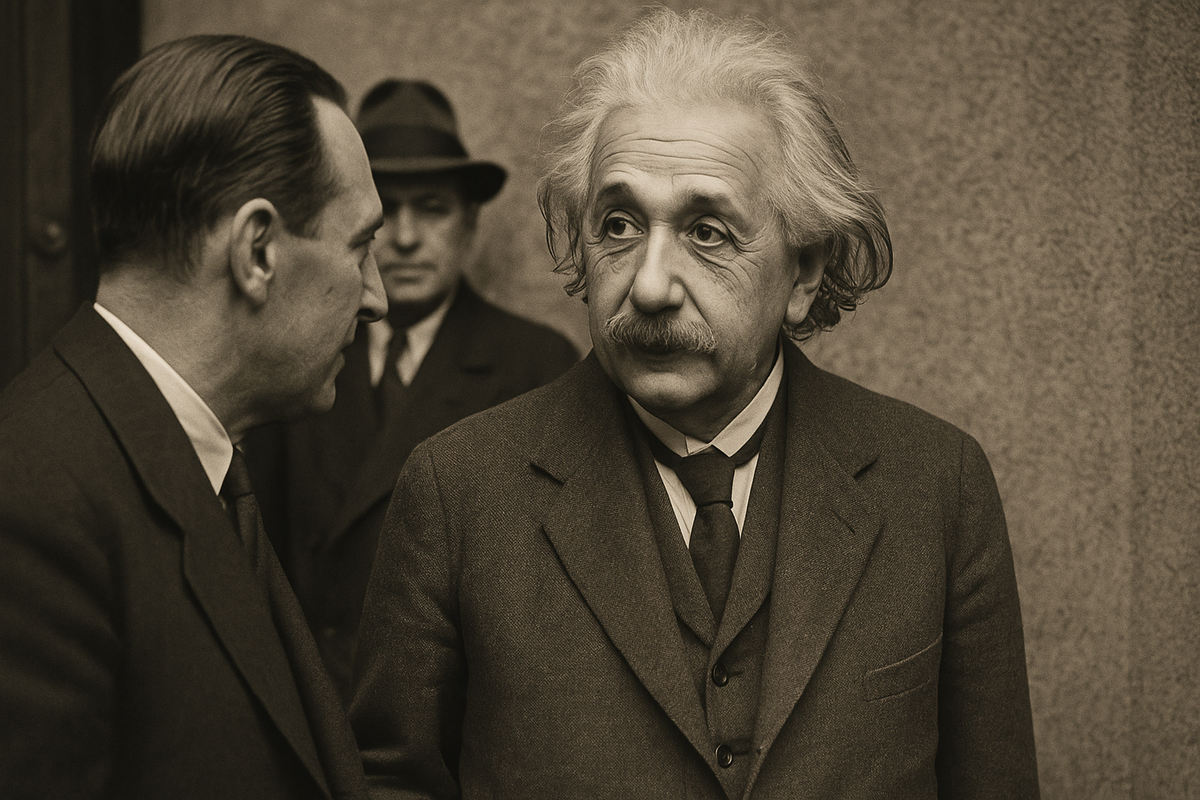
The man with the unruly hair had fled Nazi Germany only months earlier. His theories had rewritten the laws of physics. And now, in December 1933, The New Yorker was trying to explain something even stranger than relativity: how Albert Einstein had become the world's first celebrity scientist.
Open the December 2, 1933 issue, and you'll find "Scientist and Mob Idol"—a profile that captured the precise moment when genius stopped being an abstraction and became a marketable identity. This wasn't science journalism. It was cultural anthropology, examining how a man whose work baffled the public could simultaneously mesmerize it.
Ninety years later, this magazine remains one of the sharpest artifacts of how the 20th century invented the modern celebrity intellectual.
Archive Details
Historical Figure: Albert Einstein
Issue Date: December 2, 1933
Archive Source: The New Yorker Magazine
Featured Profile: "Scientist and Mob Idol"
Cover Artist: Constantin Alajalov
The Year Everything Shifted
Nineteen thirty-three was a hinge point in history. Roosevelt's New Deal was reshaping American economics. Hitler's rise was reshaping European politics. And The New Yorker, in its ninth year of publication, was reshaping how magazines could think.
Einstein arrived in America that October, an exile from a continent turning hostile to reason itself. He carried nothing but his violin, his mathematics, and a fame that preceded him like a shockwave. Newspapers tracked his movements. Crowds gathered wherever he lectured. His casual observations—on music, on politics, on the shape of the universe—became front-page copy.
The media had discovered something unprecedented: a scientist whose ideas were incomprehensible to most readers, yet whose name sold papers. Relativity might as well have been written in hieroglyphics, but Einstein himself was box office.
The New Yorker saw the paradox and leaned into it.
The Profile: Irony Meets Intellect
"Scientist and Mob Idol" dissected Einstein's fame with the magazine's signature blend of skepticism and admiration. The piece didn't attempt to explain relativity—it examined why millions cared about a man whose work they couldn't understand.
The profile captured Einstein as a study in contradictions: brilliant yet accessible, revolutionary yet humble, globally famous yet personally uncomfortable with adulation. He gave interviews reluctantly. He deflected praise. He seemed genuinely puzzled that his equations had made him into something approaching secular prophecy.
The New Yorker understood what other publications missed: Einstein's celebrity wasn't about science. It was about what science symbolized in Depression-era America—proof that human intellect could transcend chaos, that brilliance could flourish even as the world fractured.
The article positioned Einstein not as a distant genius but as a mirror reflecting society's hunger for heroes who thought rather than fought. His fame was a social phenomenon, a case study in how modernity transformed abstract ideas into public theater.
The tone was vintage New Yorker: lightly ironic, skeptical of mob worship, yet genuinely respectful of Einstein's substance. Where other magazines sensationalized, The New Yorker analyzed. Where they mythologized, it observed.
The Magazine as Cultural Document
Constantin Alajalov's cover illustration sets the scene with characteristic understatement: shoppers preparing Christmas decorations beneath a sign announcing "Only 19 Shopping Days Until Christmas." It's wry commentary on American commercialism, rendered with elegance rather than cynicism—visual shorthand for The New Yorker's entire editorial philosophy.
Inside, the Einstein profile shares space with the magazine's signature cartoons, including one memorable panel: a servant holding an umbrella indoors before a lounging woman, captioned "Wilcox, sometimes I question your sanity." The juxtaposition is deliberate—domestic absurdity alongside intellectual celebrity, wit in conversation with gravitas.
This was The New Yorker's genius in the 1930s: the refusal to separate high culture from everyday observation, science from satire, sophistication from humor. While other magazines offered either news or entertainment, The New Yorker fused both into something unprecedented—a chronicle of how Americans thought about thinking.
What the Profile Revealed
The Einstein article illuminated several truths about fame, intellect, and media in the early 1930s:
The Scientist as Reluctant Idol
Einstein tried to avoid publicity, yet his every gesture became news. His discomfort with fame only deepened his mystique.
The Public's Appetite for Genius
Readers who couldn't comprehend relativity still revered Einstein's name. He became shorthand for intelligence itself—a walking metaphor for human potential.
Media as Myth-Maker
Newspapers transformed Einstein's theories into secular scripture, his pronouncements into revelation. The press didn't just report on Einstein; it created Einstein the icon.
The Human Beneath the Headlines
The profile captured Einstein's quirks—his love of music, his rumpled clothing, his humor—reminding readers that genius inhabited a person, not a pedestal.
The Cultural Moment
In Depression America, Einstein's success offered reassurance. If brilliance could thrive amid global turmoil, perhaps intellect itself was an act of defiance.
The New Yorker wasn't just profiling a scientist. It was documenting how the 20th century was redefining what it meant to be famous, and what it meant to be smart.
The Enduring Resonance
The December 2, 1933 New Yorker matters because it captured a transformation: science becoming spectacle, intellect becoming celebrity, genius becoming brand. Einstein would live another twenty-two years, but the cultural machinery that made him into "Einstein"—that turn of fame into mythology—was already fully operational by this issue's publication.
The New Yorker saw it happening in real time and documented it with wit, precision, and just enough irony to avoid reverence. The magazine understood that Einstein's fame revealed as much about America as it did about relativity.
Nearly a century later, we still live in the world this issue chronicles—where scientific achievement is measured partly by public recognition, where intellectuals become brands, where understanding matters less than fascination.
The magazine captured the birth of a phenomenon we now take for granted: the celebrity scientist, the genius as icon, the mind as spectacle.
Why Collectors Seek This Issue
Historical Convergence
This issue captures Einstein at a pivotal moment—months after fleeing Nazi Germany, at the height of his cultural influence, before the atomic age would forever complicate his legacy.
Editorial Milestone
"Scientist and Mob Idol" represents The New Yorker's Profiles series at its sharpest—the magazine doing what it did best, examining how culture shapes fame and fame shapes culture.
Visual Appeal
Alajalov's holiday cover has become iconic among collectors of vintage seasonal illustrations, embodying the magazine's aesthetic sophistication.
Scarcity
Original 1930s issues of The New Yorker grow rarer each year. Issues featuring figures of Einstein's stature command particular attention.
Cultural Archaeology
This magazine doesn't just discuss Einstein—it preserves the specific way Depression-era America understood genius, celebrity, and science.
To own this issue is to hold an artifact from the moment when modern celebrity culture was being invented, when magazines were learning to make ideas themselves into news.
For Collectors and Cultural Historians
If you're drawn to the intersection of science, media, and 20th-century culture—if you recognize that magazines are time capsules, not just reading material—the December 2, 1933 issue of The New Yorker belongs in your collection.
From the Jazz Age through postwar prosperity, from the Space Race to the digital revolution, The New Yorker chronicled American intellectual life with unmatched sophistication.
Browse The New Yorker Magazine CollectionThese aren't reproductions or reprints. They're the actual artifacts—the paper, the ink, the advertisements, the cartoons, the cultural commentary—that shaped how generations understood their world.
Holding a vintage New Yorker means holding a conversation between past and present, a record of how Americans once thought about art, politics, science, and celebrity.
The December 2, 1933 issue remains particularly resonant: the moment when Einstein's relativity became American mythology, when The New Yorker captured lightning in a bottle, and when a magazine proved that analyzing culture could be as vital as creating it.
For anyone who values history preserved in its original form—printed, bound, and alive with the texture of its era—these magazines aren't collectibles. They're evidence. They're witnesses. They're invitations to see the 20th century as it saw itself.