
The 4 A.M. Call From Frankfurt
Inside the Zero-Sum Battlefield of 1970s Currency Trading
Horst Duseberg's phone rang in the dark.
It was 4:00 a.m. in his quiet New Jersey home, and Frankfurt was already awake. On the other end of the line, a voice delivered the kind of news that could move billions—a political statement, a central bank announcement, a shift in sentiment that would ripple through every major trading desk before most Americans had poured their first cup of coffee. Duseberg, a German-born trader with twenty years of instinct honed into reflex, was already calculating. By the time the sun rose over Manhattan, fortunes would be made. And fortunes would be lost.
This was foreign exchange in 1975, and Forbes Magazine had a front-row seat.
When the July 1, 1975 issue of Forbes hit newsstands, it carried a feature that read like a thriller: "Foreign Exchange Trading: A Loser for Every Winner." The title was not hyperbole. In the four years since President Richard Nixon severed the dollar's tie to gold and dismantled the Bretton Woods system, currency trading had transformed from a technical backwater into a gladiatorial arena where $2 million trades were made on instinct, where a single miscalculation could vaporize $150,000 in an afternoon, and where even the most powerful banks operated in a state of controlled terror.
Forbes didn't just report on the foreign exchange markets—it profiled the men who lived inside them, the institutions that dominated them, and the wreckage left behind by those who failed. Nearly fifty years later, the article remains a masterclass in financial journalism and a collector's artifact that captures a singular moment in economic history: the birth of the modern currency wars.
Archive Details
Historical Figure: Horst Duseberg, Foreign Exchange Trading Director
Issue Date: July 1, 1975
Archive Source: Forbes Magazine
Featured Article: "Foreign Exchange Trading: A Loser for Every Winner"
The End of Certainty
The world Forbes documented in 1975 was unrecognizable from the one that preceded it. For nearly three decades, the Bretton Woods agreement had kept global currencies tethered to predictable bands, anchored by the dollar's convertibility to gold. Exchange rates moved in fractions. Risk was managed. Volatility was contained.
Then, in August 1971, Nixon ended it all.
Suddenly, currencies floated. The Deutsche Mark, the Japanese yen, the British pound—all of them subject to speculation, sentiment, and the unforgiving logic of the market. Fixed bands gave way to wild swings. Traders who had spent careers executing routine conversions now faced a landscape where fortunes turned on geopolitical headlines and central bank whispers.
By 1975, the stakes had grown exponential. Oil shocks hammered the global economy. Stagflation gripped the United States. Governments struggled to manage currencies they no longer fully controlled. And into this chaos stepped a new breed of financial professional: the foreign exchange trader, part mathematician, part gambler, part geopolitical analyst.
Horst Duseberg was one of the best.
The Man in the Middle of the Storm
Forbes built its narrative around Duseberg, then heading the foreign exchange operation at European-American Bank (E-A Bank), a joint venture backed by six European institutions controlling over $112 billion in combined assets. Duseberg's department was among the largest FX operations in the world, and the numbers alone convey the scale:
Daily trading volume: $150 million. Typical trade size: tens of millions of dollars. Profit margins: often just 0.01%. Cost of a bad call: $115,000 in a single session.
But the article's power came not from the figures—it came from the portrait of a man who understood that foreign exchange demanded more than technical skill. Duseberg required his traders to apprentice for at least four years before acting independently. Why? Because the market punished hesitation and rewarded a kind of intuition that couldn't be taught, only earned. Forbes called it a "sixth sense." Duseberg knew it was survival instinct.
The 4:00 a.m. calls from Frankfurt were not interruptions—they were the rhythm of the job. News didn't wait for New York to wake up. By the time American markets opened, European traders had already repositioned, and London had moved billions. Duseberg's edge was his willingness to meet the market where it lived: in the pre-dawn calls, the rapid recalculations, the split-second decisions that separated profit from catastrophe.
The Big Five and the Wreckage They Left Behind
Forbes identified the institutions that controlled the game. Five American banks dominated foreign exchange in 1975:
Bankers Trust
Continental Illinois
Morgan Guaranty
Citibank
Chase Manhattan
Together, they handled over $1.5 billion in daily FX trades. Other banks—Chemical, Marine Midland—participated, but not at this altitude.
The rewards justified the risk. Morgan Guaranty earned $36 million in foreign exchange profits in 1974 alone, representing 13% of its total earnings. For successful traders, salaries climbed to $100,000 annually—an extraordinary sum in 1975, reserved for those who could navigate volatility without flinching.
But Forbes didn't let readers forget the cost of failure. Franklin National Bank's $30 million foreign exchange disaster was still fresh, a collapse so catastrophic it contributed directly to the bank's implosion. The lesson was unambiguous: foreign exchange was a zero-sum battlefield. Every winner required a loser. Every profit came from someone else's miscalculation.
The Political Reckoning
By mid-decade, politicians were watching. Representative Henry Reuss (D-Wisconsin), chairman of the House Banking Committee, warned publicly about the dangers of unchecked foreign exchange speculation. Banks, reluctant to reveal their exposure limits, operated in a fog of secrecy—part competitive advantage, part institutional anxiety.
Forbes captured this tension with clarity: the same market forces that allowed Morgan Guaranty to print tens of millions in profit also created conditions where a single misjudgment could sink an institution. No one wanted to admit how much they had at stake. And no regulator had yet figured out how to contain a market that moved faster than oversight.
The article's conclusion carried a warning that would prove prophetic: foreign exchange was not a sustainable strategy for every bank. The risks were simply too great. Some institutions would thrive. Others would be destroyed.
Why This Issue Endures
The July 1, 1975 Forbes is not just a magazine—it's an artifact of transformation. The collapse of Bretton Woods rewrote the rules of global finance, and Forbes documented that shift in real time, not with abstract theory but through the lived experience of traders like Duseberg and the institutions that employed them.
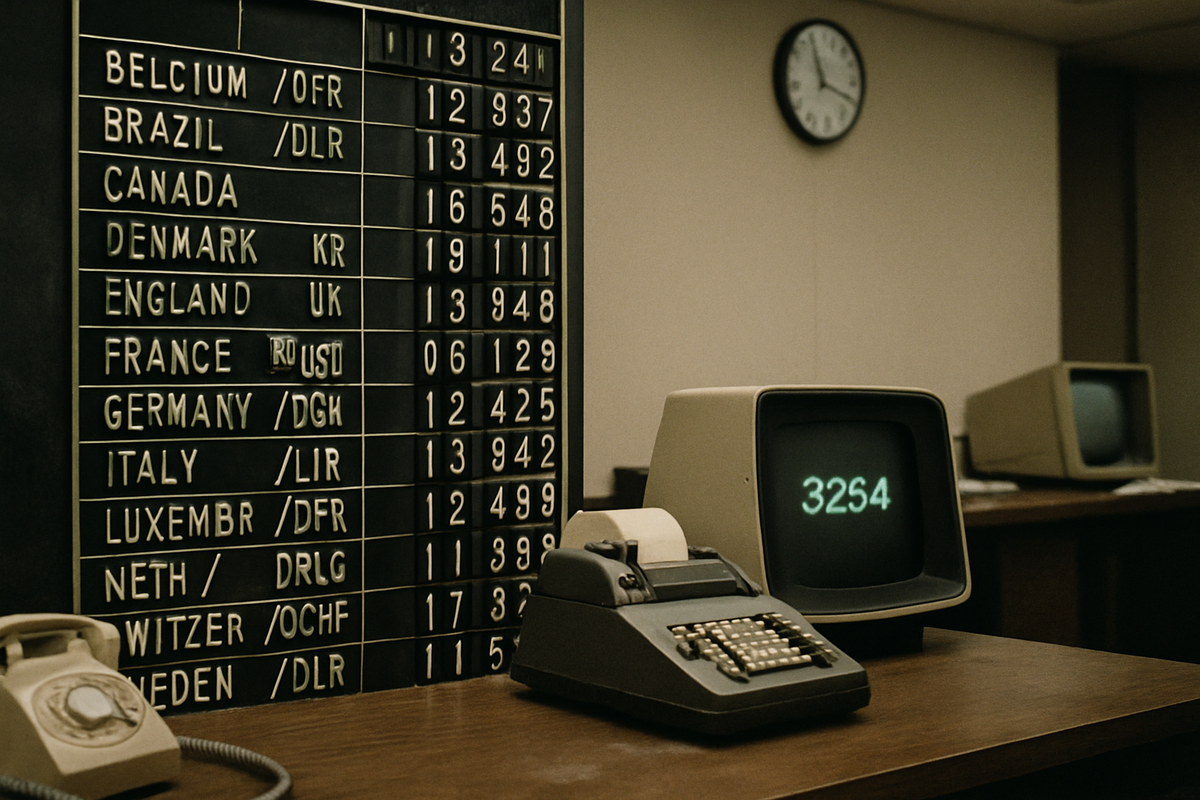
What makes this issue collectible is its specificity. This was not a broad survey of economic trends. It was a narrow, high-stakes examination of one corner of finance—foreign exchange—at the exact moment it became central to modern banking. The photography reinforced the gravity: Duseberg photographed against a trading board filled with rates and symbols, a visual reminder that behind every number was a decision, and behind every decision was risk.
The Legacy of the Zero-Sum Game
Nearly five decades later, the dynamics Forbes described have not disappeared—they have simply grown in scale. Currency markets now turn over $7 trillion daily. Algorithms execute trades in microseconds. Yet the fundamental truth remains: foreign exchange is still a zero-sum contest where every winner requires a loser, where instinct still matters, and where banks still grapple with how much exposure is too much.
What separates vintage journalism from archival noise is its ability to hold relevance across time. "Foreign Exchange Trading: A Loser for Every Winner" endures because it documented not just what happened, but how people thought, acted, and adapted to a world suddenly unmoored from certainty. The 4:00 a.m. calls still come. The calculations still matter. The risks still destroy.
Forbes understood this in 1975, and the article remains essential reading for anyone trying to understand how modern finance actually works—not in theory, but in practice, under pressure, at 4:00 a.m.
Collector Significance and Availability
Explore the Archive
Whether you collect for research, investment, or fascination with the intersection of money and power, vintage Forbes issues remain what they have always been: artifacts of economic history, preserved in ink and paper.
Browse Forbes Magazine Collection