
The Saturday Evening Post That Changed America
How One 1941 Article Launched Alcoholics Anonymous Into History
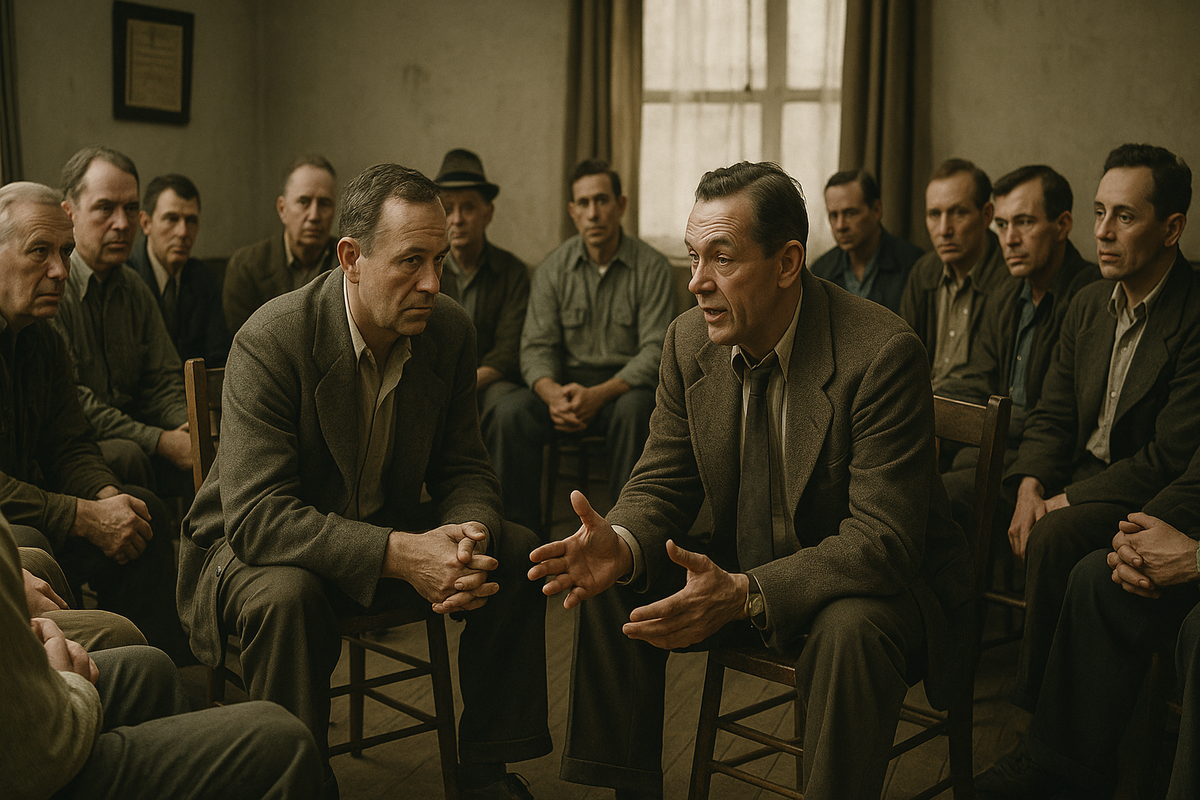
The men in the photographs looked ordinary. Too ordinary, perhaps, for what they represented.
They sat in hospital dayrooms and modest clubhouses, faces turned toward the camera with something between defiance and relief. The caption beneath one image was almost clinical: these were alcoholics—former slaves to the bottle—who had found sobriety not through medicine, punishment, or willpower, but through each other. When Jack Alexander's feature "Alcoholics Anonymous: Freed Slaves of Drink, Now They Free Others" appeared in the March 1, 1941 issue of The Saturday Evening Post, it did something American journalism had never done before: it told the nation that alcoholism could be conquered.
The response was immediate and overwhelming. Within weeks, letters flooded AA offices from every corner of the country. Membership exploded from a few hundred to thousands. What had been an obscure fellowship operating in the shadows of Akron, Cleveland, and New York became, virtually overnight, a national movement. This single magazine article—8,000 words of clear-eyed reporting in a publication known for Norman Rockwell covers and middle-American sensibility—proved more effective than any public health campaign, any medical initiative, any temperance sermon ever delivered.
For collectors and historians today, the March 1, 1941 Saturday Evening Post represents something rare: the precise moment a social revolution entered the American mainstream.
Historical Context
Featured Article: "Alcoholics Anonymous: Freed Slaves of Drink, Now They Free Others" by Jack Alexander
Issue Date: March 1, 1941
Publication: The Saturday Evening Post
Historical Significance: First mass-media coverage of Alcoholics Anonymous, triggering the movement's national expansion
Cultural Impact: Transformed American understanding of addiction from moral failure to treatable condition
When Alcoholism Was a Death Sentence
To understand why Alexander's article mattered, you must first understand what America believed about alcoholics in 1941.
They were moral failures. Weak men (and occasionally women) who lacked character, discipline, and self-respect. Medical science had no answer for them. Families hid them. Employers fired them. Communities expelled them. The choices were grim: institutionalization in asylums where they were warehoused alongside the mentally ill, incarceration in jails where they dried out only to drink again upon release, or slow death on the margins of society while loved ones watched helplessly.
The Great Depression had only deepened the crisis. Men who had lost jobs, homes, and purpose often lost themselves in bottles. As Europe burned and America inched toward war, the private battles fought in living rooms and back alleys seemed unsolvable. Alcoholism was a shameful secret, whispered about but never discussed openly—certainly never in the pages of the nation's most widely read magazine.
Then came Akron, Ohio, 1935. Bill Wilson, a failed Wall Street speculator and hopeless drunk, met Dr. Bob Smith, a surgeon whose hands shook too badly to operate. What emerged from their meeting was radical in its simplicity: alcoholics helping alcoholics, one conversation at a time, with no doctors, no fees, no institutional apparatus. Just two men who understood, because they had lived it.
By 1941, this fellowship—Alcoholics Anonymous—had spread quietly to several cities, with success rates that defied medical expectations. But outside these small circles, almost no one knew it existed.
Why The Saturday Evening Post Mattered
The Saturday Evening Post was not just popular in 1941—it was essential. With circulation in the millions, it occupied a unique position in American culture: serious enough to shape opinion, accessible enough to reach kitchen tables from Maine to California. The Post published F. Scott Fitzgerald, William Faulkner, and Agatha Christie alongside coverage of current events, humor columns, and advertisements for Pepsodent and Studebakers. It was the mirror in which middle America saw itself.
When the Post assigned Jack Alexander to investigate Alcoholics Anonymous, it granted the movement something more valuable than publicity—it granted legitimacy. Alexander spent months researching, attending meetings, interviewing members, and observing the fellowship in action. His resulting feature treated alcoholism not as a moral scandal or sensational curiosity, but as a solvable problem. The prose was direct, the reporting thorough, the tone respectful without being reverent.
The photographs that accompanied the text were equally important. They showed real people in real spaces—hospital wards, clubhouse meetings, domestic settings—engaged in the work of recovery. These were not statistics or case studies. They were fathers, workers, neighbors. Americans.
What Made AA Revolutionary
Alexander's article succeeded because it explained, with remarkable clarity, why Alcoholics Anonymous worked when everything else had failed:
Sobriety Through Fellowship
Alcoholics helped each other not as doctor and patient, but as equals. The slurring drunk of last week became this week's sponsor, guiding someone else through withdrawal. Experience, not credentials, was the currency that mattered.
No Institutional Barriers
There were no fees, no intake forms, no waiting lists. Anyone who wanted to stop drinking could walk into a meeting. The absence of financial or bureaucratic obstacles was itself revolutionary.
Spiritual Transformation
AA's program emphasized reliance on a Higher Power—loosely defined, non-denominational, but central. This was not religion, exactly, but it offered something medicine could not: meaning, purpose, and a reason to stay sober beyond mere physical survival.
The End of Stigma
By publishing the personal stories of men who had recovered—who had jobs, families, and dignity—the article demolished the notion that alcoholics were irredeemable. They were sick people who could get well, not bad people who needed to become good.
Alexander documented AA's expansion from Akron and New York to Philadelphia, Chicago, and beyond. This was not an isolated experiment. It was a movement with momentum.
The article gave Americans a new vocabulary for thinking about addiction. It replaced shame with hope, punishment with mutual aid, isolation with community.
The Cultural Artifact
For serious collectors, the March 1, 1941 issue occupies a category of its own.
This was the first time Alcoholics Anonymous reached a mass audience—the inflection point that transformed a small fellowship into a global institution now operating in more than 180 countries. Without the Saturday Evening Post, AA might have remained a regional curiosity, its insights lost to history.
The timing compounds its significance. Published as America prepared for war, the article appeared at a moment when the nation needed models of resilience, redemption, and collective action. AA offered precisely that: ordinary citizens solving an intractable problem through cooperation rather than coercion.
The magazine itself—with its Norman Rockwell cover depicting scenes of wholesome domesticity—symbolized the very stability AA members sought to reclaim. Rockwell's art and Alexander's reporting worked in tandem, even unintentionally: this was a publication that took American life seriously, and it was taking addiction seriously too.
Issues tied to watershed moments in social history command premium attention from collectors. This is not ephemera. This is the documentary record of an idea that changed millions of lives.
The Turning Point
Just as Life magazine's wartime photography brought distant battlefields into American living rooms, the Post's feature on Alcoholics Anonymous brought the battlefield of addiction out of the shadows. It made the invisible visible. It gave language to suffering that had been unspeakable. And it demonstrated that recovery was not a miracle—it was a method.
The article's impact extended far beyond those first weeks of letters and new members. It established a template for how America would discuss addiction for decades to come: as a disease, not a sin; as treatable, not terminal; as something that happened to people like us, not just people like them.
Today, that March 1941 issue endures as both historical document and cultural touchstone. It marks the moment when Alcoholics Anonymous entered the national conversation—and when America began, slowly, to change its mind about what addiction meant and who could recover from it.
For Collectors & Historians
Historic Timing
The first mass-media coverage of Alcoholics Anonymous. This article triggered membership growth from hundreds to thousands within weeks and laid the foundation for AA's global expansion.
Cultural Watershed
A turning point in American thought when addiction began its transition from moral failure to treatable medical condition—a shift that would reshape public health policy for generations.
Magazine Legacy
The Saturday Evening Post wielded unmatched influence in 1941. Its endorsement granted legitimacy and reach that no other publication could provide, ensuring the article shaped national opinion.
Archival Significance
Issues documenting pivotal social movements—especially those tied to Norman Rockwell covers and groundbreaking journalism—represent the most sought-after items in vintage magazine collecting.
Explore the Archive
Original copies of the March 1, 1941 Saturday Evening Post remain available to collectors, historians, and members of the recovery community seeking a tangible connection to AA's foundational moment.
Browse The Saturday Evening Post Magazine CollectionThe March 1, 1941 Saturday Evening Post is not just reading material. It is the artifact that marks when a fellowship became a movement, when stigma began to crack, and when America learned that alcoholics could be saved—by each other. In the history of American journalism, few single articles have carried such weight or changed so many lives.
This is the magazine that launched a revolution. And you can still hold it in your hands.