
When Candice Bergen Opened Her Door, America Walked Into a New Dream
Vogue, June 1971, and the moment style became personal
June 1, 1971. A woman picks up her copy of Vogue at a newsstand in Manhattan, another in a suburb of Los Angeles. They flip past the cover—Lauren Hutton, gap-toothed and gorgeous—and land on something unexpected: not a fashion spread, but a home. Candice Bergen's home. And it looks nothing like the sterile showrooms they've been trained to admire.
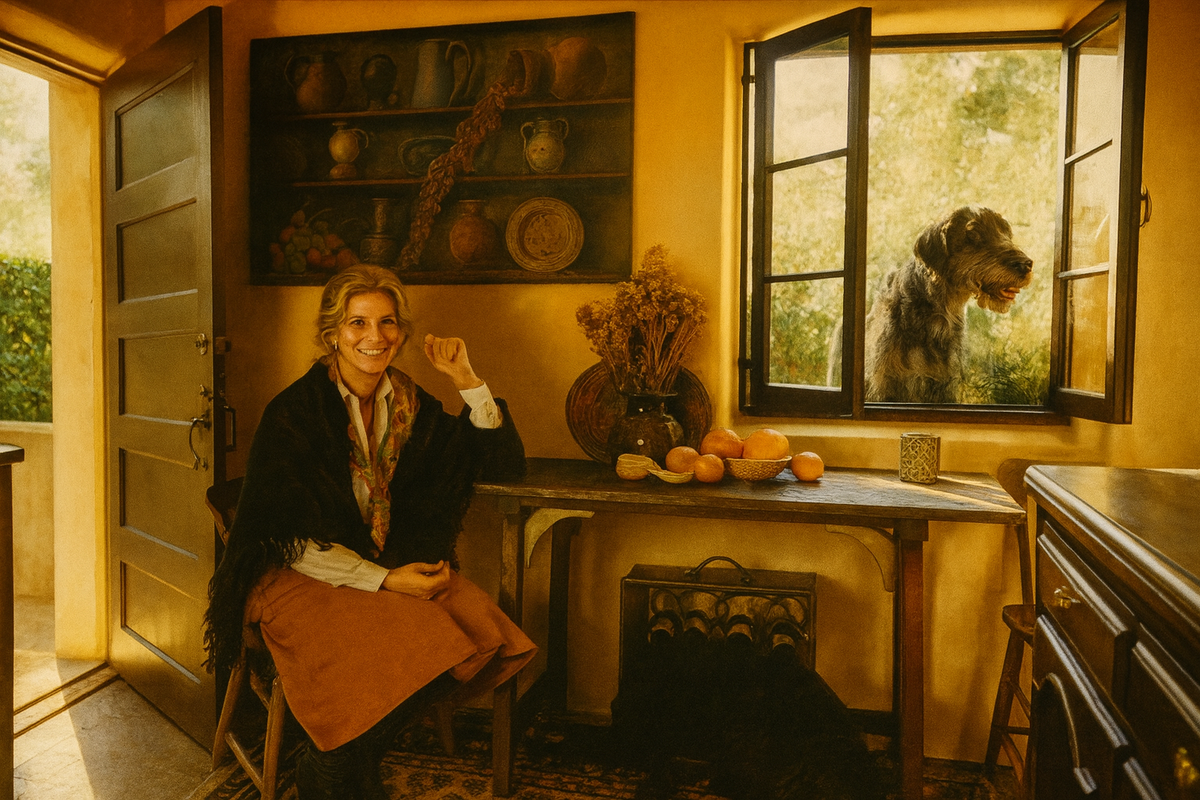
There are tapestries that belong in a castle. A kitchen painted the color of a Vermeer sunrise. A bedroom that once housed John Barrymore's birds, now Bergen's "Rainbow Room—the happiest room of all." The actress herself sprawls across the photographs with her dog Leonard, grinning, unguarded, surrounded by medieval ironwork and Mexican folk art in gleeful collision.
This wasn't just a celebrity house tour. It was a manifesto.
Archive Details
Featured Subject: Candice Bergen
Publication: Vogue Magazine
Issue Date: June 1, 1971
Cover Model: Lauren Hutton
Photographer: Henry Clarke
Feature Title: "Things I Love to Look At, Things That Make Me Smile"
The Cultural Hinge of 1971
The United States in 1971 stood at a crossroads. The convulsions of the previous decade—civil rights battles, the women's movement, Vietnam—had shattered old certainties. Americans were no longer asking what they should want. They were asking what they actually wanted. And the answer, increasingly, was freedom: to live differently, dress differently, be differently.
Vogue understood the assignment. The magazine had long since evolved beyond its origins as a Paris couture gazette. By 1971, it functioned as a cultural engine, synthesizing fashion with photography, literature, and lifestyle into a vision of modern American identity. The Bergen feature—titled "Things I Love to Look At, Things That Make Me Smile"—proved that style had migrated from the runway into daily life. Your kitchen could be a statement. Your living room could be theater.
Bergen herself embodied this new ideal. Daughter of ventriloquist Edgar Bergen, she had carved out her own path as a serious actress, earning acclaim for Carnal Knowledge that same year. But she was more than her filmography. She represented the woman who refused to choose between beauty and brains, between Hollywood glamour and irreverent wit. When she opened her California home to photographer Henry Clarke, she wasn't performing. She was revealing.
Vogue's Gamble: Personality as Editorial Strategy
What Henry Clarke captured in those pages was revolutionary, though it wore its revolution lightly. Traditional shelter magazines presented homes as static perfection—rooms to admire, not inhabit. Clarke and Vogue did something else entirely. They made Bergen's home a character study.
The photographs vibrated with life. Sunlight poured through windows. Tapestries softened stone walls. Bergen appeared not as a hostess posing in her domain, but as a woman genuinely delighted by her surroundings. She compared her living room to a "tapestried train." She joked that one den resembled "the home of an elderly Arab." Her voice—playful, self-aware, unafraid of absurdity—threaded through the layouts.
This was the new glamour: not flawless, but authentic. Not aspirational because it was unattainable, but because it was imaginative. Readers didn't need Bergen's budget or her pedigree. They needed her permission to trust their own taste, to mix high with low, to let their homes reflect joy rather than just good breeding.
Inside the House That Refused the Rules
Walk through Bergen's home as Vogue presented it, and you encounter a woman constructing her own aesthetic universe:
The Living Room
A tapestried fantasy that Bergen described as a train car, dense with texture and European romance. Wrought-iron chandeliers. Stone walls. The kind of space that invited guests to sink into velvet and lose track of time.
The Rainbow Room
Once John Barrymore's aviary in the glory days of old Hollywood, Bergen transformed the bedroom into a sanctuary of color. The name alone—"the happiest room of all"—signaled her philosophy. Homes should elevate mood, not just status.
The Vermeer-Yellow Kitchen
Bright, warm, unapologetically cheerful. Not the cold white laboratories that dominated design magazines, but a space that celebrated light and hospitality.
The Medieval Touches
Tapestries, Gothic ironwork, Renaissance-inspired details. Bergen wasn't playing it safe with mid-century modern or colonial revival. She was ransacking history for whatever sparked joy.
The Animals
Leonard the dog and other pets appeared throughout Clarke's photographs, grounding Bergen's glamour in domesticity. She wasn't a star posing in a set. She was a woman who lived here.
Eclectic Harmony
What unified these disparate elements? Bergen's refusal to follow a single script. She understood that eclecticism, when rooted in genuine affection rather than anxiety about trends, creates coherence. Her home didn't match. It harmonized.
The Enduring Lesson
Nearly five decades later, the Bergen feature resonates because it solved a problem we still face: How do you create a home that feels like you in a world that constantly prescribes what you should want?
Bergen's answer was bracingly simple. Fill your space with things that make you smile. Trust your instincts over trends. Let your surroundings tell your story, even if—especially if—that story doesn't match anyone else's.
Vogue in 1971 gave Bergen a platform to broadcast that philosophy, and in doing so, gave readers permission to reject the tyranny of good taste in favor of something better: genuine pleasure.
The issue remains a masterclass in how fashion magazines can transcend their commercial origins to become cultural documents. It shows us not just what people wore or bought, but who they wanted to be.
Why This Issue Became a Grail
For collectors of vintage Vogue, the June 1, 1971 issue occupies sacred territory. Several factors converge to make it indispensable:
The Double Icon Factor
Lauren Hutton on the cover, Candice Bergen inside. Two women who redefined American beauty and style, captured at the peak of their cultural influence.
The Photographic Record
Henry Clarke's work stands among the finest lifestyle photography of the era. His images don't just document Bergen's interiors—they interpret them, translating three-dimensional space into visual narrative.
The Historical Pivot
This issue arrived precisely when American culture shifted from conformity to individuality as the highest value. It's not just a magazine; it's evidence of a turning point.
The Design Archive
Few celebrity home features from this period survive with such vivid detail. For historians of interior design, this issue is primary source material—proof of how the early 1970s aesthetic rebellion looked when it walked through an actual door.
The magazine didn't just report on style. It made style, giving readers a blueprint for living that felt both aspirational and achievable.
For Collectors and Cultural Historians
If your passion runs toward vintage fashion, cultural history, or the evolution of American lifestyle, the June 1, 1971 issue of Vogue belongs in your collection. It represents a moment when the boundaries between fashion, interior design, and identity collapsed into something new—a vision of style as self-expression rather than social performance.
Browse Vogue Magazines CollectionOwning this issue means holding a piece of the early 1970s in your hands—the moment when Lauren Hutton's natural beauty replaced artificial perfection, when Candice Bergen's rainbow bedroom proved that happiness could be a design principle, when Americans decided that individuality mattered more than keeping up with the Joneses.
This isn't just a magazine. It's a window into the moment American style learned to smile.