
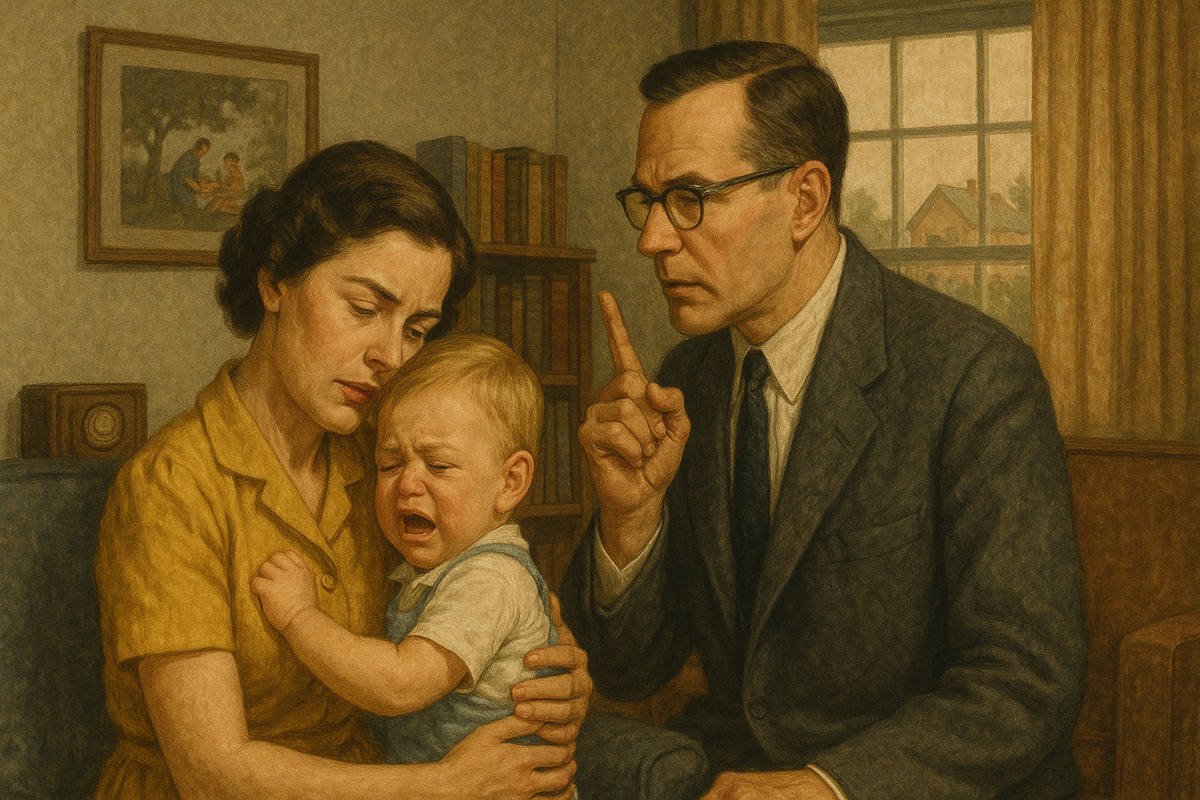
What "Spoils" a Child?
The 1954 Article That Rewrote American Parenting
When Dr. Benjamin Spock's face appeared in the December 1954 issue of Ladies' Home Journal, mothers across America didn't just see a pediatrician. They saw permission.
Permission to hold their babies. Permission to trust their instincts. Permission to believe that love—messy, abundant, unscheduled love—wouldn't ruin their children.
This wasn't merely another parenting column. It was a quiet revolution, printed on glossy paper and delivered to kitchen tables during the height of the baby boom. The article, "What 'spoils' a child — and when?", arrived at a moment when millions of American mothers were caught between the iron discipline of the previous generation and a dawning psychological understanding of childhood itself.
What Spock wrote that winter would help dismantle decades of rigid childrearing doctrine. And the magazine that carried his message would become one of the most significant cultural artifacts of mid-century family life.
Archive Details
Historical Figure: Dr. Benjamin Spock
Issue Date: December 1954
Publication: Ladies' Home Journal
Archive Source: OriginalMagazines.com Collection
The Baby Boom Needed Answers
By 1954, the United States was drowning in diapers. Four million babies were being born each year—more than at any point in American history. Pediatricians' waiting rooms overflowed. Nurseries were built as additions to modest suburban homes. And mothers, many of them raising children in isolation from extended family networks, were desperate for guidance.
But the advice they'd inherited was punishing.
Just a decade earlier, the prevailing wisdom had been unambiguous: babies required schedules, not sentiment. Feed them at fixed intervals. Let them cry. Never pick them up outside appointed times. Affection, experts warned, bred dependency. Comfort created weakness.
Then came Spock.
His 1946 bestseller, The Common Sense Book of Baby and Child Care, had already begun to crack the foundation of authoritarian parenting. He told mothers something radical: "Trust yourself. You know more than you think you do." He advocated warmth. Responsiveness. The idea that babies were not small tyrants to be controlled, but human beings who needed connection.
By December 1954, Spock's philosophy had gained enough traction that Ladies' Home Journal—with its circulation in the millions—gave him a platform to address the question that haunted every new mother: Am I spoiling my baby?
The Magazine That Shaped Middle America
Ladies' Home Journal was not a niche publication. It was the voice of mainstream American womanhood—blending fiction, fashion, recipes, and expert columns into a single editorial package that reflected and molded domestic life.
The December 1954 issue exemplified this synthesis. Holiday recipes sat alongside Christmas decorating guides. Fiction shared space with Spock's column. The magazine understood that women didn't compartmentalize their lives into "homemaker" and "intellectual"—they lived all of it at once.
Spock's article was presented with his photograph: a warm, grandfatherly smile that projected authority without condescension. The caption beneath his portrait captured his philosophy in a single line, though the phrasing seems slightly garbled in the archived text: "A child needs to feel that his mother and father, however much they are spoken, still love him. When he rejects, know how he feels; be firm. He likes them better that way."
The message was clear even if the syntax faltered: firmness and love were not enemies. They were partners.
What made the column extraordinary was its format. Spock included letters from real mothers—women asking whether responding to their babies' cries would create lifelong dependence. He answered each with scientific clarity and human empathy. Readers didn't just consume advice; they saw their own fears reflected and validated in print.
For a generation of mothers reading alone in suburban kitchens, this was as close as they'd come to having a pediatrician at the table.
The Five Principles That Changed Everything
Spock's December 1954 column crystallized ideas that would define postwar American parenting:
Affection Does Not Spoil Infants
In the first six months of life, responding to a baby's needs builds trust and security. Holding, comforting, and soothing an infant doesn't create weakness—it creates confidence.
Structure Emerges Gradually
As babies grow, gentle routines help them develop patience and resilience. But structure serves the child's development, not the parent's convenience.
Crying Has Nuance
Brief episodes of fussiness may be part of a baby learning to self-soothe. Prolonged distress, however, should not be ignored. The difference matters.
The Costs of Rigidity
Spock referenced medical evidence suggesting that the strict feeding schedules of earlier decades had contributed to health crises in bottle-fed infants—a sobering reminder that cultural dogma could have deadly consequences.
Love and Limits Coexist
Children thrive when parents offer both warmth and boundaries. Discipline without affection creates fear. Affection without discipline creates chaos. Balance was the answer.
These weren't abstract theories. They were practical instructions for navigating daily life with small children—and they represented a seismic shift in how Americans understood childhood itself.
The Permanence of Print
Ladies' Home Journal endures because it was never just a magazine. It was a record of American domesticity—a monthly snapshot of how women thought, what they valued, and how they navigated the demands of family life.
Today, when parenting advice streams endlessly online and vanishes just as quickly, these printed magazines offer something rare: permanence. They are physical witnesses to the 20th century, preserving debates and ideas that shaped how generations raised their children.
That durability is what makes vintage Ladies' Home Journal issues so valuable. They don't just document history—they are history.
Why This Issue Matters to Collectors
Historical Timing
Published at the apex of the baby boom, this issue documents the anxieties and aspirations of the largest generation of parents in American history.
Spock's Enduring Legacy
His columns remain among the most sought-after content in mid-century women's magazines. He didn't just advise a generation—he reshaped one.
Cultural Watershed
This issue captures the moment when American parenting turned from Victorian strictness toward psychological warmth. That shift would define family life for the next half-century.
Seasonal Appeal
As a December issue, it carries the additional charm of vintage holiday content—recipes, decorations, and advertisements that evoke mid-century Christmas traditions.
Explore the Archive
Thousands of original Ladies' Home Journal magazines available from the 19th and 20th centuries
Browse Ladies’ Home Journal Magazines Collection