
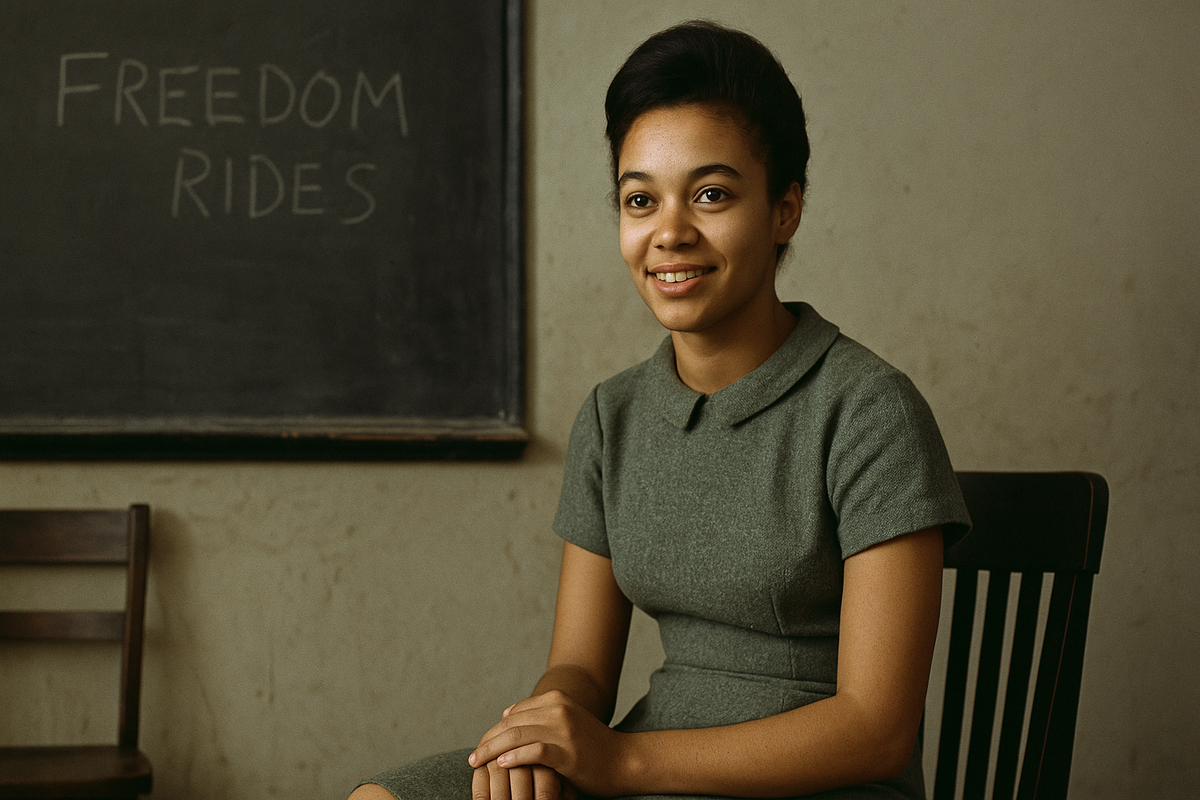
When a 22-Year-Old Refused to Let History Stop
How Diane Nash and Jet Magazine Changed the Course of the Freedom Rides
The riders knew what was coming. Firebombs. Baseball bats. Mobs that would beat them unconscious while police turned away. By May 1961, the first wave of Freedom Riders had been brutalized so badly that even the Congress of Racial Equality—the organization that launched the campaign—considered stopping.
Then Diane Nash made a phone call.
At 22 years old, the Fisk University student told movement leaders that halting the rides would be a catastrophic victory for white supremacy. If violence could stop them in Alabama, it could stop them anywhere. Her conclusion was unambiguous: new riders would board the buses immediately, even if it meant their deaths.
When readers opened the June 29, 1961 issue of Jet Magazine, they found Nash on the cover—not as a footnote to male leadership, not as a brave participant, but as the architect of what would become one of the civil rights movement's defining campaigns.
This issue didn't just report history. It documented the moment when student activists seized control of the freedom struggle from their elders.
Archive Details
Historical Figure: Diane Nash
Issue Date: June 29, 1961
Archive Source: Jet Magazine
Historical Context: Freedom Rides, Student Nonviolent Coordinating Committee (SNCC)
The Campaign That Refused to Die
The legal groundwork had been laid a year earlier. In Boynton v. Virginia (1960), the Supreme Court ruled that segregated bus terminals violated interstate commerce law. But across the Deep South, the decision was treated as a suggestion to be ignored. Black passengers were still forced to use separate waiting rooms, separate restrooms, separate lunch counters—backed by the threat of arrest or violence.
The Freedom Rides were designed to make the contradiction unbearable. Interracial groups would board commercial buses, travel into the heart of Jim Crow territory, and deliberately use whites-only facilities at every stop. The strategy was simple: force federal authorities to choose between enforcing the Constitution or openly abandoning it.
What the riders got instead was annihilation.
In Anniston, Alabama, a mob firebombed a Greyhound bus and beat passengers as they fled the flames. In Birmingham, Klansmen attacked riders with metal pipes while the police commissioner—who had promised the mob fifteen minutes of uninterrupted violence—kept his officers away. In Montgomery, a crowd of over a thousand surrounded the riders, beating them with bricks and axe handles while law enforcement watched.
The original CORE organizers, battered and traumatized, decided to suspend the campaign.
Diane Nash decided otherwise.
The Student Who Outmaneuvered Fear
Nash had already proven herself in Nashville, where she'd helped lead the sit-in campaign that desegregated the city's lunch counters in 1960. But the Freedom Rides demanded something different: the willingness to organize others into a situation where death was not just possible but likely.
Operating through the Student Nonviolent Coordinating Committee and the Nashville Christian Leadership Council, Nash recruited waves of new riders—most of them students who understood exactly what they were volunteering for. When authorities arrested them, she sent more. When those were beaten, she sent more.
Jet quoted her rationale with characteristic directness: "We can't let the Freedom Ride stop now. We must go on… or everything we have worked for is gone."
The logic was strategic, not sentimental. Nash understood that the movement's credibility depended on demonstrating that violence would not deter it. If segregationists could halt the rides through brutality, they would use the same tactics against every future campaign. The only response was escalation—not of violence, but of commitment.
By September 1961, after hundreds of riders had been arrested and dozens hospitalized, the Interstate Commerce Commission issued the order that should have been unnecessary: immediate and complete integration of interstate bus travel and terminals. The Supreme Court's ruling would finally be enforced.
Diane Nash had refused to let history stop, and history moved.
Why Jet Mattered
In 1961, if you were Black in America and wanted to know what was actually happening in the civil rights movement, you read Jet. The pocket-sized weekly had become essential precisely because mainstream outlets treated the struggle for constitutional rights as a regional disturbance rather than a moral crisis.
Jet didn't editorialize around the violence—it showed it. It didn't soften the stakes—it named them. And critically, it recognized leadership where it actually existed, not where institutional hierarchy said it should.
The June 29, 1961 issue's treatment of Nash was radical in its simplicity. The magazine presented her as the campaign's "brain trust"—the strategist managing logistics, recruitment, and the political pressure campaign that kept the rides in national headlines. It detailed her sacrifice: she had left Fisk University, abandoning her degree to work full-time for a movement that couldn't pay her.
For a young Black woman to receive cover placement in 1961—over elected officials, over clergy, over celebrities—was an editorial statement. Jet was declaring that the most important person in Black America that week was a 22-year-old who had chosen the freedom struggle over everything else.
What the Issue Reveals
The coverage distills several truths that were becoming undeniable by mid-1961:
Students Had Become the Tactical Vanguard
While established civil rights organizations debated strategy, Nash and her peers were already on the buses. Their willingness to act without institutional permission forced older leaders to either support them or become irrelevant.
Women Were Leading, Not Supporting
The movement's public face was often male ministers, but the organizing infrastructure depended heavily on women like Nash, who handled coordination, recruitment, and the unglamorous work of keeping campaigns operational under constant threat.
Nonviolence Required More Courage Than Violence
The riders absorbed beatings without fighting back, making the moral clarity of their cause impossible to obscure. Nash's genius was recognizing that their suffering—broadcast through magazines like Jet—was the most powerful weapon they had.
The Federal Government Needed to Be Forced Into Action
The rides succeeded not by appealing to authorities' better nature but by creating a crisis that made federal intervention less costly than continued inaction.
Jet gave readers the information to understand these dynamics as they unfolded, transforming the magazine into both historical record and organizing tool.
The Collector's Perspective
Temporal Precision
Published during the Freedom Rides' most dangerous phase, the issue captures the campaign while its outcome was still uncertain. It's a primary source from inside the crisis, not a retrospective.
Rarity of Female Leadership Coverage
Magazines from this era that feature women as primary subjects rather than supporting figures are substantially less common. Issues that profile young Black women directing national campaigns are rarer still.
Documentation of Student Organizing
The issue provides detailed reporting on SNCC's operations and the Nashville movement's tactical evolution—information that becomes increasingly valuable as fewer participants remain to provide firsthand accounts.
Cultural Artifact Status
Jet's role as the movement's unofficial newspaper of record makes each issue a snapshot of how events were understood by Black readers at the time, unfiltered by the decades of narrative revision that followed.
For collectors focused on civil rights documentation, this issue represents the intersection of several significant threads: the Freedom Rides, student activism, women's leadership, and the media infrastructure that made the movement visible to its own participants.
Why It Endures
Most weekly magazines become disposable the moment the next issue arrives. Jet from 1961 remains relevant because the questions it covered are unresolved: Who has the authority to lead? What level of sacrifice is required for structural change? When institutional power refuses to act, who forces it?
Diane Nash's answer—offered at 22, backed by her willingness to organize others into mortal danger—was that ordinary people could create crises that made justice inevitable.
The magazine that recognized this at the time, rather than decades later, did something journalism rarely accomplishes: it identified the future while it was still the present.
Own a Piece of the Record
For those building collections around 20th-century social movements, civil rights documentation, or Black media history, vintage Jet issues offer direct access to how these events were covered as they happened.
These aren't reproductions or digital archives. They're the physical objects that readers carried, shared, and preserved—the same pages that made Diane Nash's face familiar to thousands before most history books acknowledged her existence.
Browse Jet Magazines CollectionThe Voice That Still Carries
The June 29, 1961 issue of Jet Magazine remains significant not because it predicted Nash's importance but because it recognized it immediately. While other outlets were still framing the Freedom Rides as a student protest gone wrong, Jet understood it was witnessing a generational transfer of power within the movement.
Nash's leadership proved that the civil rights struggle would be shaped by those willing to act, not those waiting for permission. Jet's coverage ensured that understanding reached the people who needed it most.
Decades later, her challenge still resonates: "We can't let the Freedom Ride stop now."
The magazine that amplified that voice is still here. So is the question of what we're willing to risk when history demands movement.