
American Revolution 1969: When Rolling Stone Became a Weapon
Inside the April 5, 1969 issue that transformed music journalism into revolutionary documentation
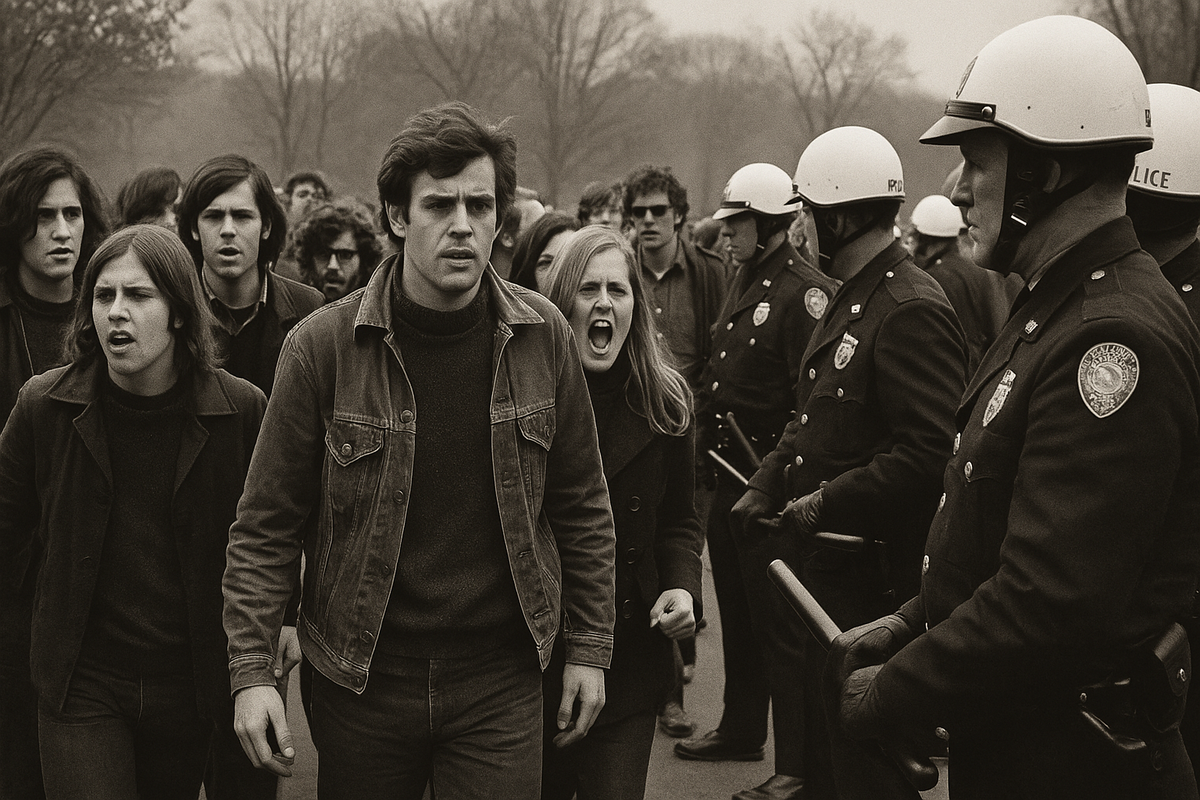
April 5, 1969. A college student opens Rolling Stone and finds his campus staring back at him—blood on a protester's face, tear gas hanging in Berkeley air, Tom Hayden's profile sharp against a crowd of thousands. This wasn't music journalism anymore. This was a mirror held up to a generation at war with itself.
The feature inside—"American Revolution 1969: The Sound of Marching, Charging Feet"—didn't report on the youth revolt. It was the youth revolt, printed on newsprint, photographed in black-and-white urgency, written by people who'd choked on the same tear gas they were now documenting.
For collectors and historians, this issue represents the moment Rolling Stone stopped being a music magazine and became something far more dangerous: a chronicle of American power under siege.
Archive Documentation
Publication: Rolling Stone Magazine
Issue Date: April 5, 1969
Feature: "American Revolution 1969: The Sound of Marching, Charging Feet"
Historical Figures: Tom Hayden, Jerry Rubin, David Harris, Carl Oglesby
Archive Source: Original Magazines Collection
The Campuses Were Burning
By spring 1969, over 500,000 U.S. troops were deployed in Vietnam. The body count climbed weekly. At home, the draft turned every 18-year-old male into a potential casualty, and college deferments made universities both sanctuaries and targets.
The campuses exploded.
Berkeley. San Francisco State. Columbia. Harvard. Hundreds of schools erupted in coordinated fury—sit-ins against military recruitment, strikes demanding Black Studies programs, occupations protesting tuition hikes and administrative complicity in the war machine. Students weren't asking for reform. They were demanding revolution.
Rolling Stone sent its photographers and writers into the center of it. What they brought back was documentary evidence of a generational fracture:
Stop the Draft Week in Oakland: Police batons connecting with student bodies, the sickening crack of wood on bone captured in freeze-frame.
Berkeley under siege: Silhouettes running through clouds of CS gas, faces wrapped in wet bandanas, the National Guard's rifle barrels visible in the haze.
San Francisco State: Black students, fists raised, demanding not just inclusion but structural transformation—courses taught by Black faculty, admission policies that reflected reality, an end to institutional racism masquerading as meritocracy.
The photographs were raw, unpolished, intimate. No staged portraits. No editorial distance. The camera was in the crowd, and so was the magazine.
The Faces of Defiance
Rolling Stone understood something other outlets missed: this movement had architects. The April 5 issue gave them space, dignity, and dimension.
Tom Hayden, photographed in profile addressing masses—former SDS president, intellectual force behind the Port Huron Statement, soon to be one of the Chicago Eight. His presence in these pages signaled that student protest had evolved beyond spontaneous rage into organized resistance.
Jerry Rubin, captured in an unflinching close-up that revealed both charisma and menace. Co-founder of the Youth International Party, master of political theater, proof that revolution could be performed as well as fought.
David Harris, ex-Stanford student body president turned draft resister. His story arc—from campus politician to federal prisoner—embodied the stakes. Harris would marry Joan Baez, refuse induction, and serve nearly two years in prison while Rolling Stone chronicled every step.
Carl Oglesby, former SDS president, photographed with his guitar. The image said everything about 1969: you could write position papers and folk songs, organize strikes and record albums, challenge the Pentagon and play Woodstock. Politics and culture weren't separate spheres—they were the same revolution sung in different keys.
These weren't celebrities. They were comrades, and Rolling Stone treated them as such.
Inside the Revolution
The issue's architecture reflected its subject matter—sprawling, interconnected, refusing simple narrative:
Conflict at the Colleges
Documented the ground war: San Francisco State's five-month strike, Berkeley's tension, Michigan students occupying administration buildings while negotiating demands.
Black Student Movements
Serious treatment of hundreds of campuses with Black student unions demanding Black Studies departments, Black faculty, Black representation in administration.
The Gathering Repression
Analysis of the state's response—not just police violence but sophisticated counterinsurgency. University administrators, FBI infiltration, legislative crackdowns.
Vietnam & The Draft
The moral obscenity that transformed middle-class college students into radicals willing to risk everything. The body bags. The draft lottery. The stakes.
And threading through it all: Vietnam. The draft. The body bags. The moral obscenity that transformed middle-class college students into radicals willing to risk everything.
The Sound Still Echoes
More than fifty years later, these pages retain their electrical charge. You can almost hear the chants, smell the tear gas, feel the adrenaline surge of thousands of students realizing they had power and weren't afraid to use it.
The raised fists. The guitar strings. The bullhorns and the batons. Tom Hayden's steady gaze. Jerry Rubin's wild grin. David Harris's principled defiance. Carl Oglesby's folk songs scored to revolution.
Rolling Stone didn't just report this moment. It amplified it, preserved it, weaponized it.
Why This Issue Matters Now
The April 5, 1969 Rolling Stone is valuable because it captured a hinge moment in American history—when youth counterculture and political resistance fused into something the establishment couldn't ignore or co-opt.
Timing
Released months before Woodstock, the same year as Stonewall, during the nationwide Moratorium to End the War. This issue sits at the convergence point of every major late-'60s upheaval.
Visual Record
These photographs—Oakland police beating protesters, tear gas at Berkeley, Hayden and Rubin in the full intensity of their power—are now iconic. They appear in documentaries, textbooks, museum exhibitions.
Editorial Bravery
While Life and Look covered campus unrest from a distance, Rolling Stone embedded itself in the movement. The difference shows in every paragraph, every photograph.
Cultural Prophecy
This issue proved music journalism could document revolution without losing its soul. It established the template Rolling Stone would follow for decades—Hunter S. Thompson, Watergate, and beyond.
For collectors, this is museum-grade material. For historians, it's primary source evidence. For anyone who believes print journalism once had courage, it's proof.
Start Your Collection
If you collect 1960s counterculture, student protest movements, or the evolution of music journalism into political force, the April 5, 1969 issue of Rolling Stone is essential. Not recommended. Essential.
Browse Rolling Stone Magazine CollectionFrom the birth of the counterculture through punk's explosion and beyond, Rolling Stone documented the moments when American culture cracked open and rebuilt itself. These aren't just magazines—they're artifacts of transformation, printed records of the times that forged modern America.