
Moscow Before the Storm
Life in the Soviet Capital on the Eve of Invasion
Margaret Bourke-White had perhaps three weeks.
In late July 1941, she roamed Moscow with her cameras—photographing children in butterfly costumes, students cramming in lecture halls, citizens queuing to view Lenin's tomb. She captured cocktail bars and soccer matches, war games and wedding dresses. On August 11, when Americans opened their copies of Life Magazine, these images arrived as both revelation and requiem: Moscow in its last days of peace.
Within weeks, Hitler's armies would reach the city's outskirts. But Bourke-White's lens had already preserved what was about to burn.
Archive Details
Photographer: Margaret Bourke-White
Issue Date: August 11, 1941
Feature: "Moscow Before Invasion"
Archive Source: Life Magazine
A City Caught Between Two Dictators
The summer of 1941 was history's hinge point. Two years earlier, the Molotov-Ribbentrop Pact had divided Eastern Europe between Stalin and Hitler—a cynical bargain that left the West watching two totalitarian powers carve up nations like spoils. Many Americans viewed the Soviet Union not as a potential ally but as Hitler's accomplice.
Then came June 22, 1941.
Operation Barbarossa shattered the pact with more than three million German soldiers—the largest invasion force ever assembled. Hitler's war of annihilation turned eastward, and suddenly the geopolitical chessboard flipped: Stalin's Soviet Union became the West's reluctant, necessary partner against fascism.
Just before the invasion, Bourke-White had secured rare permission to photograph Moscow. For Americans accustomed to Soviet propaganda posters and Cold War rhetoric, her images offered something unprecedented: an unfiltered view of daily life behind the Iron Curtain.
What she captured was a city preparing for war without quite admitting it. A capital both modern and militarized, cultivated and controlled.
Life Magazine's Mission: History in Real Time
By 1941, Life had become America's visual conscience. Founded on the principle that photographs could carry more truth than editorials, the magazine sent its photographers to capture history as it unfolded—not weeks later, but now.
The Moscow feature exemplified this urgent realism. Across multiple spreads, Bourke-White's photographs placed readers inside Red Square, Moscow University, state nurseries, Dynamo Stadium, and luxury shops. The captions delivered context without editorializing: students received government stipends but faced mandatory attendance; a single cocktail at Moscow's only cocktail bar cost nearly a tenth of a worker's monthly rent; children played war games with toy rifles while genuine war approached.
These weren't propaganda images. They were anthropological evidence—proof that Soviet citizens lived recognizable human lives even under Stalin's totalitarian state. For American readers in August 1941, this mattered. If the Soviet Union was about to become an ally, Americans needed to see who they were allying with.
The Cover: Lenin's Tomb and the Cult of Power
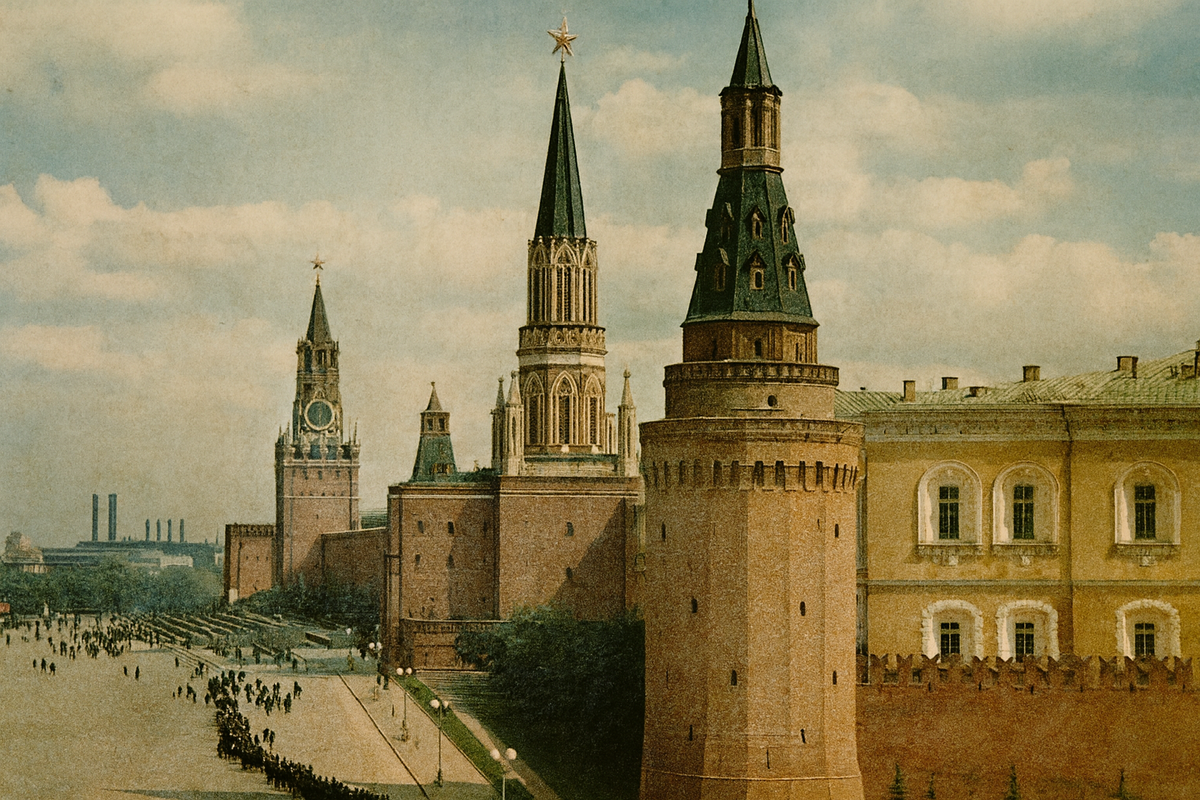
Life's August 11, 1941 cover made no attempt at subtlety. Bourke-White's photograph showed the Kremlin's spires rising above Red Square, with long queues of Muscovites waiting to pay respects at Lenin's tomb. The image captured both architectural grandeur and ritual obedience—the visual grammar of Soviet power.
Unlike the painted illustrations favored by The Saturday Evening Post, Life chose photographic realism. What readers saw was what existed. No romantic gloss. No artistic interpretation. Just Moscow as it was: magnificent, oppressive, and utterly human.
Inside the Feature: Ordinary Lives, Extraordinary Control
Bourke-White's photographs balanced intimate human portraits with monumental state architecture. She moved between scales—from a child's butterfly costume to Stalin's towering statues—creating a composite portrait of a society where nothing was purely personal and nothing was purely political.
Gorky Street — Moscow's commercial artery, lined with department stores including the city's largest grocery, capable of serving 60,000 customers daily. Shoppers bought bread, meat, and frozen fruit—modest luxuries in a command economy.
Moscow University — Students climbing grand staircases beneath statues of Lenin and Stalin. Lecture halls packed with young people studying history and science, supported by government stipends but bound by strict academic discipline. Miss too many classes, lose your funding.
Children's World — Kindergartens where kids played "The Butterfly Game." Nurseries where toddlers sang beneath Lenin's portrait. Schoolyards where boys staged mock battles with toy rifles, rehearsing for a war they didn't yet know was coming.
Public Spectacle — Soccer matches at Dynamo Stadium, where Red Army teams in bright blue and red uniforms played before thousands. Agricultural exhibitions showcasing Soviet productivity. Statues of Stalin dominating public squares, unavoidable reminders of who ruled.
Private Contradictions — Married student couples balancing studies with child-rearing. Women shopping for fabrics in state stores where bargains sat alongside custom gowns costing 600 rubles—a year's wages for many workers. The Cocktail Hall, Moscow's single Western-style bar, where elites sipped egg-yolk cocktails and expensive liqueurs.
Together, these scenes revealed a society both ordinary and surreal—one where children played games while adults prepared for catastrophe.
What the Photographs Captured
Each photograph functioned as both document and argument: This is who the Soviets are. They are not so different. They will bleed when Hitler comes.
Why Wartime Life Magazines Endure
Wartime issues of Life function as time capsules. Every page carries the urgency of its moment—not nostalgia, but lived history. In August 1941, Americans saw Moscow not through generals' briefings or politicians' speeches but through the faces of people about to endure extraordinary suffering.
Today, when digital news vanishes in hours, vintage Life magazines remind us of a time when history was absorbed slowly. Issues sat on coffee tables for weeks. Photographs were studied, debated, clipped, and saved. That permanence is why collectors and historians continue seeking them—not as antiques, but as primary sources that refuse to fade.
Why Collectors Prize the August 11, 1941 Issue
For those who collect vintage magazines, this issue of Life ranks among the most historically significant. Several factors elevate its value:
Owning this issue means holding a cultural artifact from the moment the Soviet Union entered the deadliest conflict in human history. It is not memorabilia. It is evidence.
Explore Decades of History Through Original Life Magazines
If this glimpse of Moscow on the eve of invasion resonates with you, consider the archive that awaits: Life Magazine documented every major cultural shift, political crisis, and artistic movement from the 1930s through the 1970s in real time.
Browse Life Magazine CollectionWhether you're a serious collector, a historian seeking primary sources, or someone preserving family memories, vintage Life magazines remain unmatched in their ability to connect us directly to the past.
Holding Moscow's Last Days of Peace
The August 11, 1941 issue of Life Magazine—featuring Margaret Bourke-White's "Moscow Before Invasion"—stands as one of the most extraordinary publications of the wartime era. Through her photographs, Americans saw the Soviet Union not as ideology but as lived experience: children in war games, students in lecture halls, citizens shopping on Gorky Street.
These images preserve a vanished moment. Within weeks of publication, Nazi armies besieged Moscow. The city Bourke-White photographed—orderly, functioning, almost serene—became a battlefield.
For collectors, this issue is not reading material. It is testimony. Hold it, and you hold Moscow's last quiet summer, frozen in black-and-white, forever on the edge of fire.