
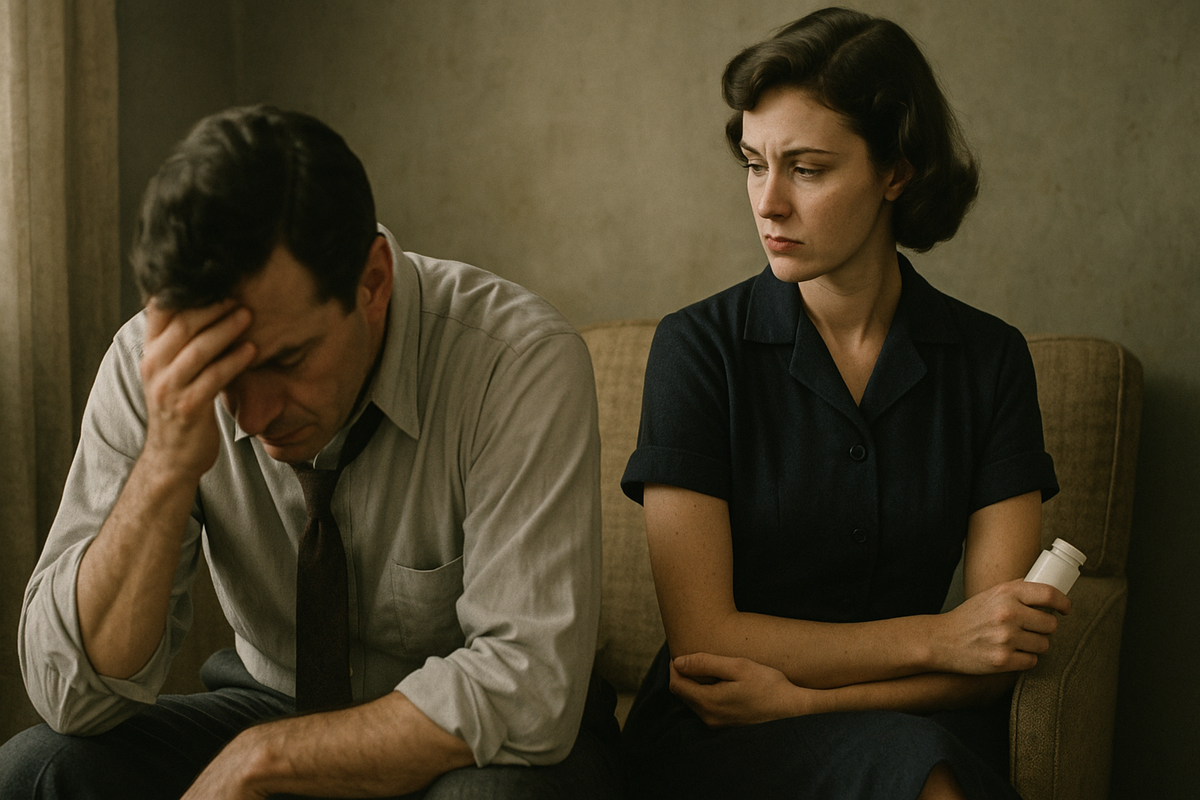
Pills, Fragility, and the Struggle for Maturity in 1950s Marriage
When Ladies' Home Journal exposed the hidden despair behind suburban perfection
A woman sits across from a marriage counselor in 1953 and confesses: "I recently tried to kill myself." Her name is Sylvia. She's 28 years old, a mother of two, and she describes herself as "a spoiled, irresponsible child" who never learned how to be a wife. She takes sleeping pills constantly. She screams at her daughter. She admits she never wanted children at all.
This wasn't a private therapy session. This was the April 1953 issue of Ladies' Home Journal, read by millions of American women over breakfast tables and in beauty parlors across the country.
The fourth installment of the magazine's groundbreaking column "Can This Marriage Be Saved?" didn't offer recipes or fashion tips. It offered something far more dangerous: the truth about what happened behind suburban doors when the cameras weren't rolling and the husbands left for work.
Archive Details
Publication: Ladies' Home Journal
Issue Date: April 1953
Featured Column: "Can This Marriage Be Saved?" (Fourth installment)
Counselor: Dr. Paul Popenoe, Institute of Family Relations
Archive Source: OriginalMagazines.com Collection
The Facade Cracks Open
Postwar America in 1953 was selling a specific dream. Soldiers were home. Suburbs sprawled across former farmland. The baby boom was reshaping the nation. Television, magazines, and advertisements projected an image of domestic perfection: tidy homes, cheerful wives, well-behaved children, and husbands who came home to dinner at six o'clock sharp.
Ladies' Home Journal knew better.
By the time this issue hit newsstands, the magazine had built its reputation on a peculiar contradiction: it celebrated the ideal of American womanhood while simultaneously documenting its failures. The April 1953 installment of "Can This Marriage Be Saved?" pushed this tension to its breaking point.
Mental health was a whispered subject in 1953, relegated to euphemisms and locked wards. Women who sought psychiatric help risked being labeled "hysterical" or "unfit." Yet here was Sylvia, admitting to suicidal despair in print, her story accompanied by staged photographs of a marriage in collapse.
Sleeping pills and tranquilizers were already flowing into American medicine cabinets. What would later be called the "mother's little helper" culture—the casual prescription of sedatives to exhausted, anxious housewives—was taking root. Sylvia's reliance on pills wasn't an aberration. It was a preview of an epidemic.
Divorce carried profound stigma, yet divorce rates were climbing. Ladies' Home Journal had found a formula: show marriages in crisis, offer the possibility of redemption through counseling, and never quite condemn divorce while never quite endorsing it either. The result was a space where women could see their own struggles reflected without facing moral judgment.
This wasn't activism. Second-wave feminism was still a decade away. But women like Sylvia—fragile, resentful, desperately unhappy—gave voice to the gap between what society demanded and what individual women could deliver.
Two Testimonies, One Broken Marriage
Sylvia's Confession
The marriage counselor—Dr. Paul Popenoe, whose Institute of Family Relations in Los Angeles provided the cases for the column—recorded Sylvia's testimony in devastating detail.
She had swallowed sleeping pills and been rushed to the hospital. She described her inner state as childlike, immature, incapable of adult responsibility. "Can you tell me how to act like a grown-up woman?" she asked. The question wasn't rhetorical. She genuinely didn't know.
Her relationship with her children was fractured. She shouted at her daughter Joan. She felt disconnected from both children. She admitted, with brutal honesty, that she had never wanted them in the first place.
The pills were constant. They dulled her emotions but deepened her fragility. She existed in a fog of sedation and despair.
Her social isolation was complete. "Most people seem to dislike me," she told the counselor. "I lose friends and true friends drift away." She was alone in a crowded suburban world.
Everett's Frustration
Everett, Sylvia's husband, offered a competing narrative. He described his wife as selfish, immature, and dependent—a woman who had never learned to function as an adult and resented being asked to try.
He admitted he had married her when she was fleeing another relationship, convinced she needed rescue. It was a setup for disaster: he cast himself as savior, she cast herself as victim, and neither role left room for partnership.
Intimacy had vanished. Sylvia refused him with constant "headaches" and emotional withdrawal. He felt burdened by family responsibility while his wife retreated into pills and silence.
Yet Everett wasn't blameless. He escaped through work, drinking, and nights out with friends. His absences deepened Sylvia's isolation. His criticisms confirmed her sense of failure.
His expectations reflected the era's rigid scripts: a wife should love, admire, and obey her husband while maintaining cheerfulness and domestic competence. When Sylvia failed to perform this role, Everett saw it as a character defect rather than an impossible standard.
The Counselor's Verdict
Dr. Popenoe's analysis was clinical and unsparing. Sylvia was emotionally stunted, trapped in childlike patterns, unable to shoulder adult responsibility. Everett was harsh and distant, his frustrations feeding his wife's despair.
The diagnosis reflected broader cultural anxieties: young women in the 1950s were often raised in sheltered environments that left them unprepared for marriage and motherhood. They were expected to transition overnight from daughter to wife without the tools, knowledge, or emotional development the role demanded.
The prescription was mutual transformation. Sylvia had to develop maturity. Everett had to cultivate patience and tenderness. Both had to abandon cycles of blame, resentment, and avoidance.
Whether the marriage was actually saved, the column never revealed.
Visual Contradictions and Editorial Choices
The April 1953 cover of Ladies' Home Journal likely emphasized springtime optimism—fashion, beauty, seasonal renewal. It was the magazine's standard approach: promise inspiration and aspiration on the cover, deliver complexity inside.
The "Can This Marriage Be Saved?" feature appeared alongside staged photographs that captured the couple's emotional distance. Everett slumped in defeat. Sylvia looked away. The images were theatrical but effective, translating private pain into visual drama.
The juxtaposition with advertising was jarring. A full-page promotion for the Revised Standard Version of the Bible appeared in the same issue. Easter imagery and consumer goods crowded around Sylvia's confession of suicidal despair. The contrast—spiritual renewal versus psychological collapse—was stark.
This was Ladies' Home Journal's editorial genius. It blended advice, fiction, advertising, and visual storytelling into a package that educated, entertained, and unsettled. By 1953, the magazine claimed millions of readers. It shaped how women understood their roles, their marriages, and their inner lives.
Resonance Across Decades
The themes Sylvia and Everett's story raised haven't disappeared: mental health crises among women, medication as a coping mechanism for systemic problems, emotional unpreparedness for marriage, the collision between social expectations and individual capacity.
What makes the April 1953 installment powerful is its refusal to simplify. The Journal gave Sylvia and Everett equal space to present their grievances. It acknowledged that both were trapped—by immaturity, by rigid gender roles, by cultural scripts neither had written but both were forced to perform.
Marriage wasn't presented as an ideal to be celebrated or a prison to be escaped. It was shown as a negotiation—messy, painful, sometimes impossible—between love, duty, and identity.
Why Collectors Seek This Issue
The Ladies' Home Journal April 1953 issue has become a sought-after artifact for specific reasons:
Cultural Documentation
It preserves one of the earliest and most dramatic installments of "Can This Marriage Be Saved?", a column that ran for decades and became a touchstone of American popular psychology.
Mental Health History
Sylvia's suicide attempt, pill dependency, and emotional fragility appear in raw, unfiltered language rarely seen in mainstream women's magazines of the era.
Advertising Archaeology
The pairing of a Bible advertisement with a story of marital crisis captures the tension between consumer optimism and private despair that defined postwar America.
Visual Storytelling
The staged photographs represent mid-century editorial style at its most theatrical—manufactured authenticity designed to convey psychological truth.
Series Continuity
Collectors assembling the first year of "Can This Marriage Be Saved?" consider this issue foundational.
These magazines aren't mere nostalgia. They're primary sources for understanding how gender, marriage, and mental health were constructed and contested in mid-century America.
Explore This Historic Issue
The April 1953 Ladies' Home Journal stands as a landmark issue in women's magazine history—a document that dared to expose the fragility beneath the façade of postwar domesticity.
Browse decades of fashion, fiction, advice, and cultural history preserved in the pages of vintage women's magazines that shaped generations.
Browse Ladies' Home Journal Magazine CollectionThese aren't just magazines. They're artifacts of women's history—evidence of how families loved, fought, and survived in a changing America.