
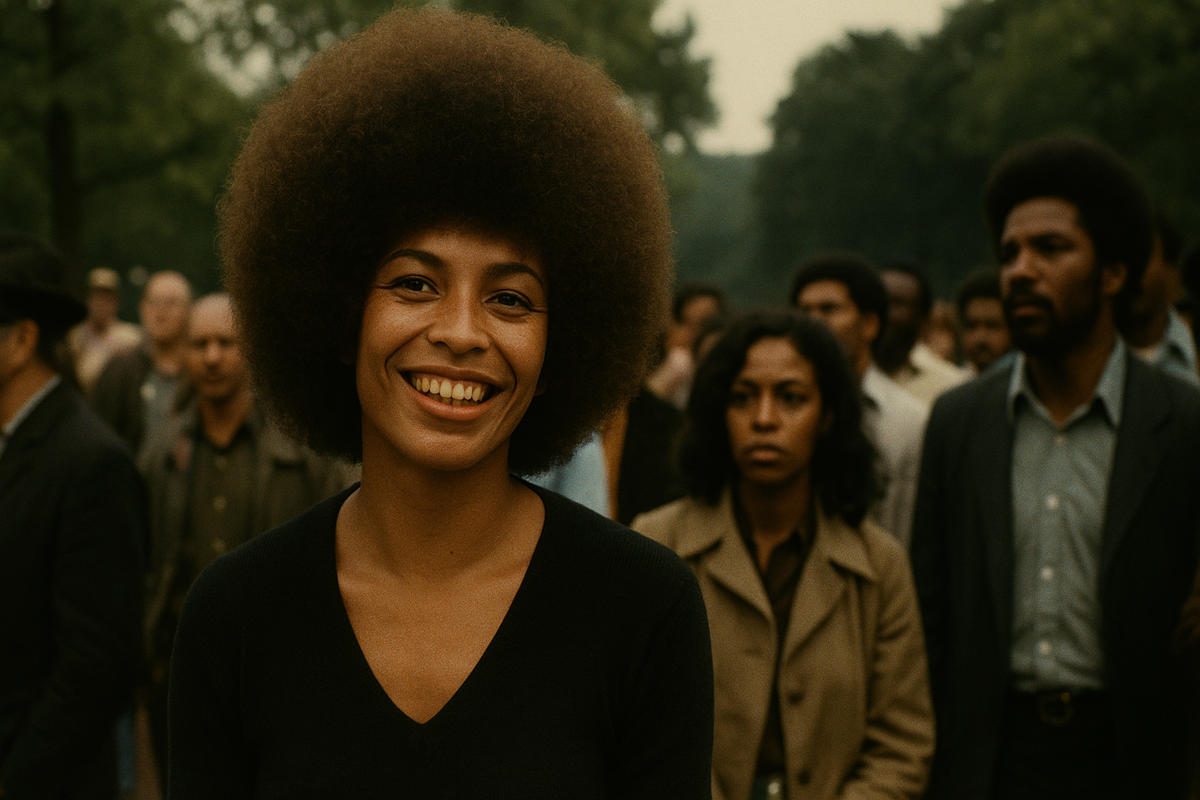
The Day Freedom Made the Cover
Angela Davis, Jet Magazine, and the Revolutionary Issue of July 27, 1972
On a summer morning in 1972, a photograph stopped America in its tracks.
Angela Davis—philosopher, revolutionary, fugitive, prisoner, and now free woman—smiled from the cover of Jet Magazine. Her Afro was unapologetic. Her gaze was direct. And for the hundreds of thousands of Black Americans who picked up that July 27th issue, the message was unmistakable: they had not broken her.
This wasn't celebrity gossip. This was survival documentation. The headline—"Angela Davis Talks About Her Future and Her Freedom"—offered something rare in that fractured moment of American history: a Black woman telling her own story, in her own words, mere weeks after walking out of a California courtroom victorious.
For a nation still mourning Martin Luther King Jr., watching the Black Panthers hunted by COINTELPRO, and wrestling with the wreckage of Vietnam, this issue of Jet was more than journalism. It was proof of concept. Proof that the movement could endure. Proof that the state could be defeated. Proof that freedom, however fragile, was still worth fighting for.
Archive Details
Historical Figure: Angela Davis
Issue Date: July 27, 1972
Archive Source: Jet Magazine
Context: Published six weeks after Davis's acquittal on June 4, 1972
A Nation on Trial
The America of 1972 was a country at war with itself.
King's assassination four years earlier had ignited uprisings in more than 100 cities. The FBI's counterintelligence program was systematically dismantling radical Black organizations through surveillance, infiltration, and outright violence. Women were marching for reproductive rights. Students were shutting down campuses to protest the war. Prisons were becoming battlegrounds—most notably at Attica, where 43 men had died just months before Davis's trial began.
Into this chaos stepped Angela Davis: a young UCLA philosophy professor, outspoken communist, and member of the Black Panther Party's political education wing. In August 1970, she was accused of providing firearms used in a Marin County courthouse escape attempt that left four people dead, including a judge. The FBI placed her on the Ten Most Wanted list. She fled. She was captured two months later in New York City.
For sixteen months, Davis sat in jail awaiting trial. Her case became a global cause célèbre—"Free Angela" rallies filled stadiums from Harlem to East Berlin. When the verdict came on June 4, 1972, it was delivered by an all-white jury in San Jose, California: not guilty on all counts.
Her defense team—anchored by veteran civil rights attorneys Howard Moore Jr. and Leo Branton Jr.—had mounted one of the most sophisticated political defenses in American legal history. They didn't just argue innocence. They put the justice system itself on trial.
Six weeks later, Jet gave Davis the floor.
Why Jet Mattered
By 1972, Jet Magazine had spent two decades doing something revolutionary: treating Black life as the main story.
Founded in 1951 by John H. Johnson, Jet was never meant to be an alternative voice. It was meant to be the voice—compact, portable, unapologetically Black. Its pocket-sized format made it easy to slip into a purse, pass between neighbors, read on a bus. Its bright covers and bold photography made it instantly recognizable on any newsstand in Black America.
Where mainstream outlets framed Davis as a dangerous radical or courtroom curiosity, Jet presented her as what she was: a thinker, an organizer, a woman with a future. The magazine didn't editorialize her into a symbol. It let her speak. And what she said mattered.
The cover itself was a statement. Against a dark backdrop, Davis smiled—not the tight, defensive smile of someone still carrying trauma, but the open expression of someone who had stared down the state and won. Her Afro, which prosecutors had tried to use as evidence of militancy during trial, was now simply part of her face. Style and politics collapsed into a single image.
Inside, the feature combined courtroom analysis, rally photography, and Davis's own reflections on imprisonment, solidarity, and what comes after acquittal. Unlike the wire service reports that reduced her story to crime-and-punishment melodrama, Jet understood context. Its readers didn't need the Black Power movement explained to them. They were living it.
What Davis Said
The interview revealed a woman with no illusions and no interest in retreat.
On her time in prison, Davis was blunt. Incarceration wasn't an aberration in American life—it was central to how the country controlled Black people, political dissidents, and anyone who threatened the status quo. Her sixteen months behind bars had only deepened her analysis. "I will never be more passionate in my pursuit for those things," she told Jet, referring to justice, liberation, and the dismantling of the prison system itself.
She spoke about political prisoners still locked away, linking her freedom to their continued captivity. She praised Moore and Branton, but also credited the international movement that had made her case impossible to ignore. And she made clear what came next: she wasn't leaving. Exile was not an option. The fight for justice had to happen on American soil, where the oppression was sharpest and the stakes were highest.
This was not the language of gratitude or relief. This was the language of someone who understood her acquittal as tactical, not final. The trial was over. The struggle was not.
Deep Dive: The Key Themes
Prison and Liberation
Davis reflected on her nearly two years behind bars, emphasizing that prisons were not isolated spaces but deeply tied to the oppression of African Americans.
Commitment to the Struggle
She vowed to continue fighting for justice with unwavering passion, declaring her dedication to liberation would only intensify.
The Role of Lawyers
Jet highlighted the importance of Black lawyers like Howard Moore Jr. and Leo Branton Jr., whose skill and courage in the courtroom helped secure her acquittal.
A Future in the Movement
Rejecting exile, Davis insisted on staying in the United States, saying that the struggle for justice had to be fought on American soil, where the oppression was deepest.
The Archive That Refuses to Disappear
Jet Magazine ceased print publication in 2014, but its archive remains one of the richest documentary records of 20th-century Black life in America.
From the 1950s through the 2000s, Jet chronicled everything: the Memphis sanitation strike, Muhammad Ali's draft resistance, the election of Black mayors, the AIDS crisis, hip-hop's emergence, and thousands of quieter stories about achievement, grief, celebration, and survival. It covered funerals and weddings, scientific breakthroughs and political corruption, beauty pageants and police brutality.
The Angela Davis issue is a perfect example of why these magazines endure. They weren't designed to be archived—they were designed to be read quickly, passed around, and discarded. But because they documented moments mainstream media ignored or distorted, they became irreplaceable. Today, when most news dissolves into the scroll, Jet's physical pages force a different encounter with history. You have to hold them. You have to turn them. You have to read them at the speed they were written.
This is history as it was first drafted—raw, immediate, and unrevised by hindsight.
Why Collectors Seek This Issue
Historical Timing
Published just weeks after Angela Davis's acquittal, this issue captured one of the most important moments in Black radical history at its precise inflection point.
Iconic Imagery
The bold cover of Davis smiling in freedom is among the most striking Jet covers of the 1970s—a visual document of resistance and survival.
Primary Source Material
Davis's own words, unfiltered and unedited, weeks after her release. This is not retrospective analysis—this is history in real time.
Cultural Significance
Owning this issue connects collectors directly to the era of civil rights, Black Power, and women's liberation—a tangible link to movements that reshaped America.
The Last Word
The July 27, 1972 issue of Jet Magazine is more than a collector's item. It's a transmission from a moment when Black America was rewriting the rules of survival, resistance, and power.
Angela Davis had walked into that California courtroom facing the death penalty. She walked out free. And then she walked directly back into the struggle. Jet didn't just report that story—it amplified it, preserved it, and made sure the people who needed to hear it did.
To hold this issue today is to hold evidence of what was possible then—and what remains possible now. The fight for justice didn't end with Davis's acquittal. Neither did Jet's mission to document it. Both continue, in different forms, whenever someone picks up one of these magazines and reads what was written when history was still unfolding.
That's the power of the archive. And that's why this issue matters.
Explore the Archive
Thousands of original Jet magazines from the 1950s through the 2000s are available in our collection—each one a time capsule of Black American history, culture, and resistance.
Browse Jet Magazine Collection