
Apollo 8 and the Triumph of 1968
When Three Men Carried Humanity Beyond Earth
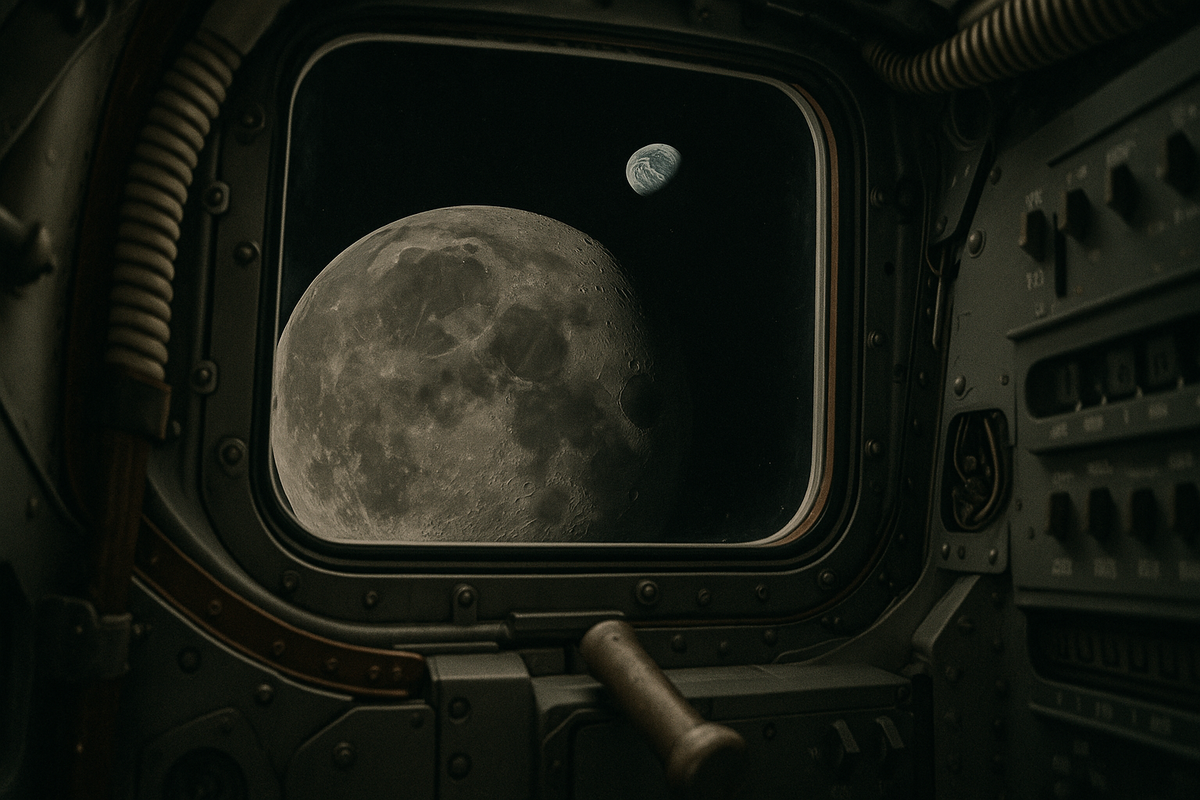
On Christmas Eve 1968, as Frank Borman, James Lovell, and William Anders orbited the Moon, they looked back at Earth—a fragile blue marble suspended in the void—and read from the Book of Genesis to a television audience of half a billion people.
Two weeks later, Americans opened the January 3, 1969 issue of Time Magazine and saw those three faces staring back: the astronauts who had just rewritten the limits of human possibility.
This wasn't just another cover story. It was Time's answer to the year that nearly broke America.
Archive Details
Historical Figures: Frank Borman, James Lovell, William Anders
Issue Date: January 3, 1969
Archive Source: Time Magazine
Recognition: "Men of the Year" 1968
The Year That Demanded Redemption
1968 had savaged the American spirit. Martin Luther King Jr. fell to an assassin's bullet in April. Robert F. Kennedy was gunned down in June. The Democratic Convention in Chicago descended into violence as police beat protesters in the streets. Soviet tanks crushed Prague's brief taste of freedom. The Vietnam War ground on, claiming lives and fracturing the nation.
By December, despair hung over the country like smoke.
Then Apollo 8 lifted off from Cape Kennedy on December 21st, carrying three men on a mission that seemed almost reckless in its ambition: to leave Earth's gravitational embrace entirely, travel 240,000 miles through the vacuum of space, and become the first humans to orbit another world.
When Borman signed off that Christmas Eve broadcast with "Good night, good luck, a Merry Christmas, and God bless all of you—all of you on the good Earth," he wasn't just speaking to Americans. He was speaking for humanity itself, reminding a fractured world that greatness was still within reach.
Time Captures Lightning in a Bottle
By 1969, Time Magazine had spent four decades perfecting the art of capturing not just events, but the meaning behind them. The January 3rd issue—the first of the new year—demonstrated exactly why the magazine had become essential reading for millions.
The editors didn't treat Borman, Lovell, and Anders as mere pilots or engineers. They positioned them as inheritors of an ancient tradition: explorers who expanded the boundaries of the known world. The coverage drew explicit parallels to Columbus, Magellan, and Lewis and Clark, suggesting that Apollo 8 marked "the dawn of a new heaven and a new earth."
This was Time at its most powerful—blending hard reporting with cultural analysis, transforming a technical achievement into a narrative about human destiny.
The magazine understood something crucial: Apollo 8 mattered not just because it was a victory in the Cold War space race (though it was), but because it changed how humanity saw itself. For the first time, we had witnesses who could describe Earth from the outside—who could see our planet whole, borderless, impossibly beautiful against the darkness.
Inside the Issue: Poetry Meets Precision
The cover itself commanded attention with stark simplicity: a lunar landscape in dramatic black and white, the three astronauts' names positioned like a mission manifest. No frills. No hyperbole. Just the facts and the faces of the men who made history.
Inside, Time's coverage balanced technical precision with something approaching poetry. Readers found detailed mission timelines alongside lyrical descriptions of what Anders, Lovell, and Borman experienced as they watched Earth rise above the Moon's desolate horizon.
That moment produced the "Earthrise" photograph—shot by Anders with a Hasselblad camera—which would become one of the most reproduced and influential images of the 20th century. The picture crystallized something the environmental movement had been struggling to articulate: Earth's isolation, its fragility, the razor-thin atmosphere that separates life from the void.
Time's layout reinforced the gravity of the moment. The typography was sober, almost austere. The page design created space for reflection. This was journalism that understood it was documenting a hinge point in human history.
What Made Apollo 8 Unprecedented
The Enduring Power of Primary Sources
What separates a collector's item from mere nostalgia is authenticity. Anyone can read about Apollo 8 on Wikipedia. But holding the January 3, 1969 issue of Time means holding the pages that your parents or grandparents might have read at their kitchen table, still processing what had just happened, still arguing about what it all meant.
These magazines are time capsules in the most literal sense. The advertisements alone—for cars, cigarettes, appliances—reconstruct the material culture of 1969. The editorial voice reflects assumptions and perspectives that have since evolved. Even the paper stock and printing quality are artifacts of a specific technological moment.
For anyone building a collection of 20th century cultural history, space race magazines represent a category that combines broad appeal with genuine scarcity. Unlike modern publications, these weren't saved en masse. Most copies were read and discarded. What survives are the copies that someone, somewhere, recognized as worth preserving.
Why Collectors Prize This Issue
Published just days after Apollo 8's safe splashdown, this issue captures the raw emotion and real-time analysis of the moment. Nothing has been filtered through decades of hindsight.
This isn't just space news. It's about what Apollo 8 meant to a nation desperate for hope, published at the precise moment when that meaning was being forged.
The issue preserves not just the Earthrise photograph, but the original editorial presentation—the captions, the layout choices, the way Time's designers framed history for their readers.
Apollo 8 issues sit alongside Apollo 11 and John Glenn's first orbit as the most sought-after space milestone magazines. Collectors building comprehensive space race archives consider this issue essential.
After 56 years, finding intact copies without musty odors, torn covers, or address labels becomes increasingly difficult. Clean copies command premium prices.
Final Thoughts
The January 3, 1969 issue of Time Magazine did what great journalism is supposed to do: it helped readers understand not just what happened, but why it mattered. At the end of a year soaked in blood and anger, Apollo 8 proved that human beings were still capable of extraordinary things.
Borman, Lovell, and Anders didn't just orbit the Moon. They gave a broken world permission to hope again.
This magazine is the record of that moment—the week when three names became synonymous with human courage, when Earth became a photograph, and when the future suddenly seemed possible again.
For collectors who understand that history lives in objects as much as in words, this issue isn't just paper and ink. It's proof that we once looked up and decided the stars were within reach.
Building Your Collection
The Apollo 8 issue is a cornerstone, but it's one piece of a larger story. Whether you're assembling a comprehensive archive or searching for a specific milestone, these magazines offer something digital reproductions cannot: the physical object that connected millions to humanity's greatest adventure.
Browse Time Magazine Collection