
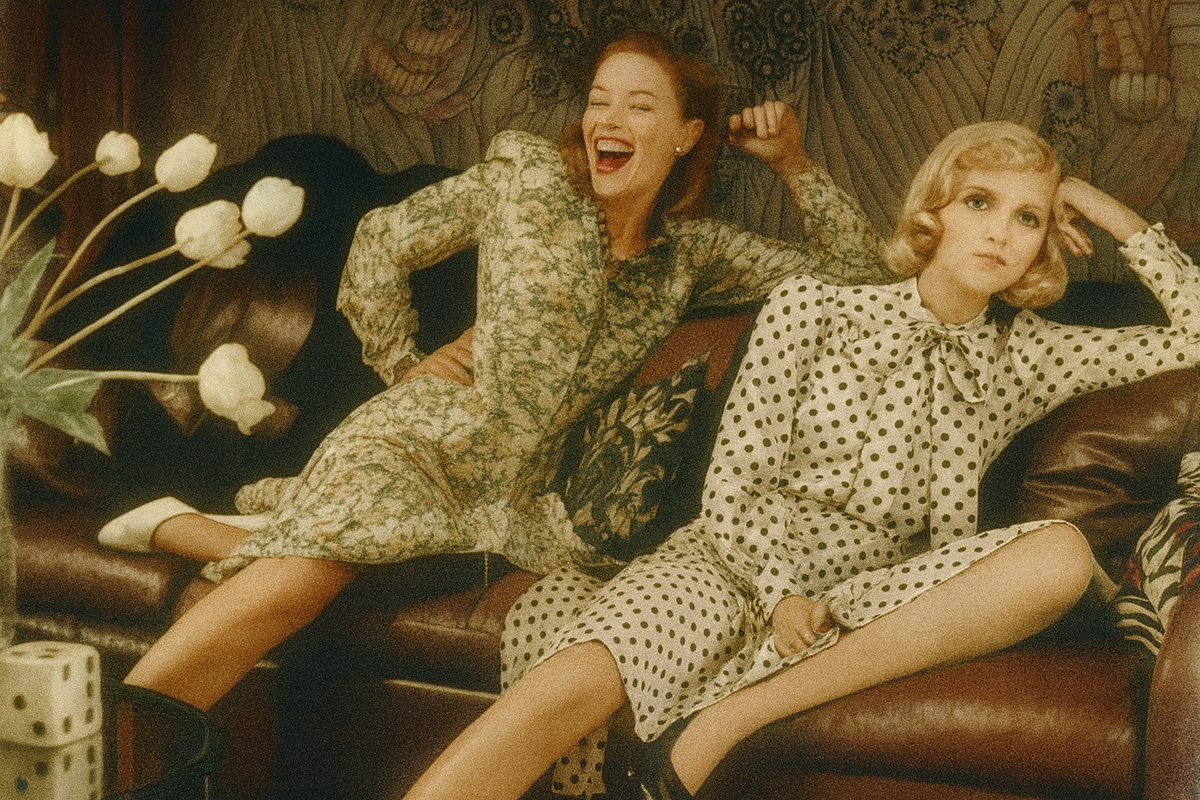
The Night Paris Couture Became Dangerous
How Vogue's March 15, 1972 issue transformed high fashion into a weapon of liberation
When Vogue's March 15, 1972 issue landed on American doorsteps, it arrived with the force of a manifesto. Between its covers lay something more volatile than fashion reporting: evidence that the old rules had been incinerated.
This wasn't couture as coronation gown. This was couture as weapon—sleek, sensual, and designed for women who no longer asked permission.
The feature titled "The Couture Look: Paris" reads today like a dispatch from the exact moment high fashion stopped genuflecting to tradition and started speaking the language of liberation. For anyone who studies how culture pivots, this issue is a Rosetta Stone. For collectors, it's the original artifact of that pivot.
The Cultural Detonation of Spring 1972
The timing was seismic. Just weeks earlier, Congress had passed the Equal Rights Amendment. Women's liberation wasn't theoretical anymore—it was legislative, visceral, unavoidable. In Paris, the couture houses faced an existential question: how do you dress a revolution?
Marc Bohan at Dior had an answer: pajama suits in silk, worn from boardroom to ballroom. Ungaro's reply: suede jackets over bare skin and explosive prints, the uniform of a woman who controlled every contradiction in her wardrobe. Grès and Lanvin responded with capes and halter tops that moved like armor and breathed like nothing at all.
These weren't clothes. They were negotiations with power.
Vogue understood the assignment. Its editors didn't document the collections—they staged them as theater. The magazine cast Paris itself as the set, couture as the script, and a new kind of woman as the star.
Archive Details
Publication: Vogue Magazine
Issue Date: March 15, 1972
Featured Editorial: "The Couture Look: Paris"
Designers: Marc Bohan for Dior, Ungaro, Grès, Lanvin, Mila Schön, Yves Saint Laurent
Photography: Helmut Newton (Saint Laurent closing sequence)
Celebrity Feature: Sylvie Vartan
The Sylvie Vartan Gambit
Here's where Vogue made its most radical move: it put pop star Sylvie Vartan in the couture spread.
Not a duchess. Not an heiress. A singer—standing in Lanvin and Grès at what appears to be an actual party, glass in hand, halter top catching the light, embodying the idea that high fashion now belonged to the famous, the young, the magnetic. Celebrity culture and couture weren't flirting anymore. They were consummating the relationship on the page.
This was Vogue declaring that the future of luxury wasn't locked in ateliers. It lived wherever energy and glamour intersected.
Helmut Newton's Dark Vision
The feature closes with Helmut Newton's photographs of Yves Saint Laurent's designs, and the shift in atmosphere is immediate. Newton didn't shoot fashion—he shot psychological states. His images are moody, cinematic, unsettling in their beauty. The accompanying text declared these were "the clothes the world had been waiting for."
Bold claim. But Newton's lens made it credible. His pictures turned garments into totems, women into archetypes. In his frame, Saint Laurent wasn't selling dresses. He was selling a philosophy: that elegance could be dangerous, that femininity could unsettle.
For photography collectors, Newton's work in this issue alone justifies acquisition. For fashion historians, it's the moment editorial photography stopped illustrating and started arguing.
What Made This Issue Structurally Brilliant
Vogue's March 15, 1972 editorial wasn't organized like a trunk show. It was architected like a night out:
The Party Ignition
Opening scenes dripping with nightlife, establishing that couture now lived in real time, real rooms, real celebrations.
The Ungaro Disruption
Sharp tailoring colliding with raw skin and wild patterns. This wasn't balance; it was deliberate dissonance.
The Dior Redefinition
Marc Bohan's pajama trousers under structured coats, demolishing the boundary between intimate and public dress.
The Cape as Statement
Grès and Bohan positioned outerwear not as protection but as transformation—garments that changed the body's silhouette and the woman's presence.
The Newton Finale — A visual argument that couture had transcended craft and entered the realm of art.
Every choice reinforced the central thesis: this was fashion for women who moved through the world on their own terms.
Why Collectors Hunt This Issue
Vintage Vogue magazines from the early 1970s aren't just back issues. They're primary sources.
Historical Convergence
Published during the most volatile period of second-wave feminism, capturing fashion's response in real time.
Designer Density
Dior, Ungaro, Grès, Lanvin, Mila Schön, and Saint Laurent documented at their creative peaks.
Celebrity Fusion
Sylvie Vartan's presence marking the moment pop culture infiltrated haute couture.
Newton's Lens
His photographs command auction prices independently; here they exist in original editorial context.
Vogue's Authority
When Vogue said something mattered in 1972, it mattered. The magazine didn't report cultural shifts—it certified them.
Physical Permanence
Owning this issue means possessing the moment couture became modern in the fullest sense: unafraid, contradictory, built for movement.
What These Magazines Preserve
Digital archives capture images. They don't capture texture—the weight of glossy stock, the smell of decades-old ink, the tactile experience of turning pages the way millions of readers did when these ideas were urgent and new.
Vintage Vogue magazines are time capsules with heft. They force you to read at the pace culture once moved: deliberately, repeatedly, with the understanding that what appeared on these pages would shape how people lived for months or years to come.
That permanence is why they endure as collectibles. History preserved in pixels feels provisional. History you can hold feels irrefutable.
Explore the Archive
Thousands of original Vogue magazines spanning the 1930s through the 1970s are available for exploration. Each decade tells a different story. Each issue contains its own argument about what mattered when it mattered most.
Browse Vogue Magazine CollectionMore than fifty years later, the March 15, 1972 issue of Vogue remains a masterclass in editorial vision. "The Couture Look: Paris" didn't just report on spring collections—it narrated a cultural inflection point with the confidence of a publication that knew it was writing the first draft of fashion history.
The clothes it featured were designed for a woman who was finding her power. The photography framed her as already possessing it. The magazine itself became proof that she existed.
That's why serious collectors pursue these issues. Not for nostalgia, but for evidence. Evidence that at certain moments, fashion wasn't decoration—it was documentation of who we were becoming.
And in 1972, through Vogue's eyes, we were becoming dangerous.