
The Future Was Published on July 1, 1969—And Wall Street Missed It
How Forbes Magazine documented AT&T's pivot from voice to data and captured the exact moment the information age became visible
Twenty-one days before Neil Armstrong set foot on the moon, Forbes Magazine published something almost as prophetic: a feature predicting that the world's largest corporation was about to stop being a telephone company.
The headline was modest—"A Whole New Market." The implications were not. American Telephone & Telegraph, the industrial giant known as "Ma Bell," was making a bet that would have sounded absurd to most investors in 1969: within a decade, data transmission would eclipse voice calls as the company's primary business. Computers talking to computers would generate more revenue than humans talking to humans.
It didn't happen quite that fast. But Forbes had captured the exact moment when telecommunications began its transformation into something we didn't yet have a name for: the information age.
For anyone holding that July 1, 1969 issue today, they're holding more than a magazine. They're holding the blueprint.
When Ma Bell Discovered She Could Be Sexy
AT&T in 1969 was a study in contradictions. It was the world's largest corporation—$14.1 billion in revenues, a regulated monopoly, the infrastructure backbone of American life. It was also, in the words of Forbes, "a hard-working, slightly overweight, graying lady" with zero glamour and enormous predictability.
Then came data.
Forbes reported that AT&T earned less than 10% of its revenues from data communications in 1968. But the company's internal projections were staggering: by 1980, half of its anticipated $35.5 billion in revenues could come from transmitting not voices, but information. The same copper wires that carried a telephone conversation at 120 words per minute could carry computer transmissions at speeds that made voice look glacial.
This wasn't incrementalism. This was AT&T announcing it intended to rewire itself—and by extension, the American economy—for a digital future most executives couldn't yet envision.
The metaphor Forbes chose was deliberate: Ma Bell was gaining "sex appeal." Telecommunications was no longer a staid utility. It was suddenly the sector where computing, communication, and capital were colliding to create something entirely new.
Archive Context
The Invisible Revolution Hiding in Plain Sight
What made the Forbes feature so valuable wasn't just the prediction—it was the precision. The magazine understood that data transmission required a fundamentally different infrastructure than voice calls. Computers demanded reliability at a level human conversation never needed. They required new regulatory frameworks. They required new thinking about what a telephone line actually was.
Forbes laid it out in terms business readers could grasp: every telephone was now a potential computer input station. The network that had been built to connect people was about to connect machines—and the machines would have far more to say.
The context made it inevitable. IBM and mainframe computing were creating demand for fast, reliable data links. Government and university research networks were experimenting with information-sharing systems that would eventually become ARPANET, the internet's direct ancestor. And the Federal Communications Commission was already questioning whether AT&T's monopoly should extend into these new markets.
Forbes captured all of it—the technology, the economics, the regulatory tension—in a single feature. It was journalism as industrial archaeology, documenting the birth of an industry in real time.
What the Future Actually Looked Like
The photographs in the July 1, 1969 issue are worth the price of admission alone.
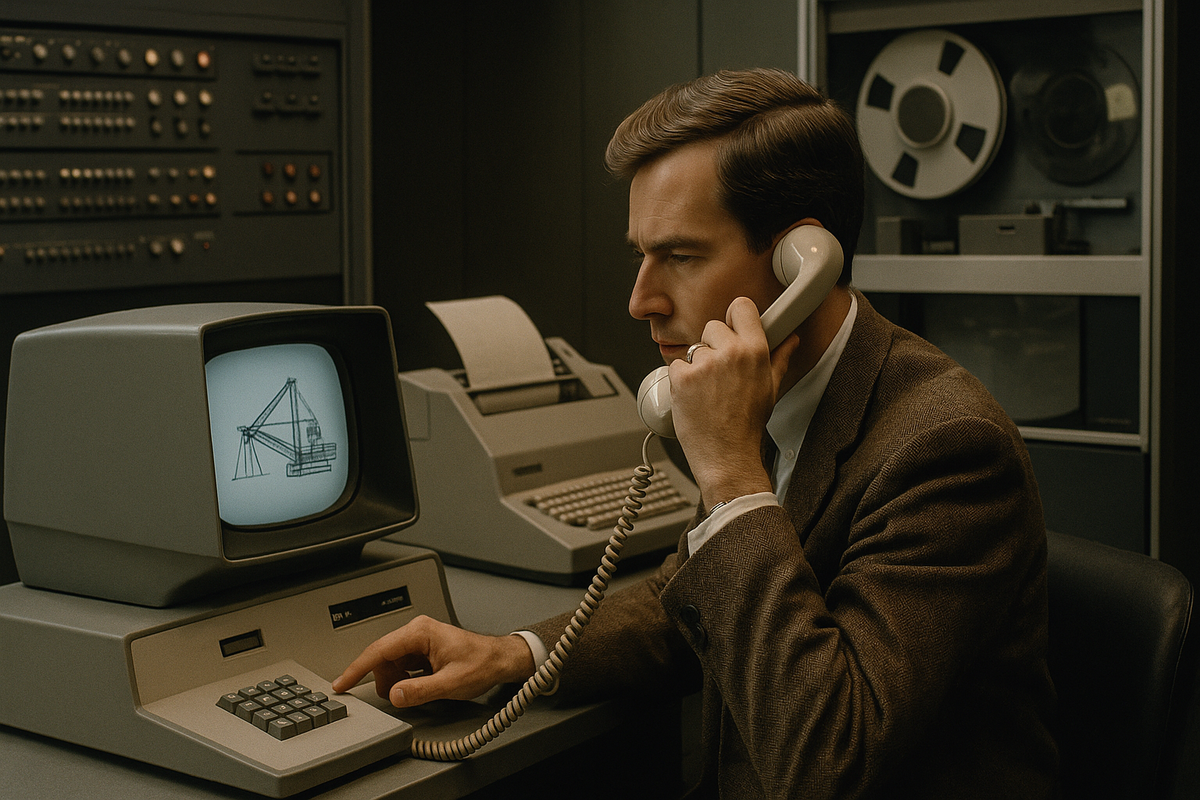
An AT&T engineer transmits a drawing through data lines—an early glimpse of digital file sharing. A clerk sends information to a computer via keypad, prefiguring every data entry system that would follow. An executive reviews lists and data on a Picturephone screen.
The Picturephone. That device alone makes this issue a collector's artifact. It was AT&T's attempt at video telephony—clunky, expensive, commercially unsuccessful. But it was also a direct ancestor of every Zoom call, FaceTime conversation, and Teams meeting happening right now. In 1969, Forbes documented a technology that was fifty years early.
The magazine also included a bold bar graph comparing revenues from 1960, 1968, and projected 1980 figures. A striking red block showed data transmission poised to overtake voice. For readers in 1969, this wasn't just a chart—it was a challenge to imagination. Could the telephone business really become something else entirely?
Why Wall Street Wasn't Buying It
Forbes didn't just sell the vision. It documented the skepticism.
A sidebar titled "The Waiting Game" made clear that investors weren't convinced. AT&T's stock traded at 25 times earnings—expensive unless the data revolution actually materialized on schedule. Analysts worried about FCC regulation limiting the company's monopoly power. They questioned the slow rollout of microwave and satellite systems. They doubted the profitability of computer leasing and experimental new services.
In short, the smart money was waiting for proof.
This is what makes the issue so fascinating. Forbes was covering not just a technological shift but a failure of imagination. The magazine could see what AT&T's engineers saw. The market couldn't—or wouldn't—yet.
It's a dynamic that repeats constantly in technology investing: the gap between what's technically possible and what Wall Street will value. This issue captures that tension perfectly, right down to the stock price and analyst commentary.
Forbes as Industrial Chronicler
By 1969, Forbes had established itself as something distinct in business journalism: a publication that could blend hard financial reporting with forward-looking cultural analysis. It profiled executives and balance sheets, but it also tried to explain what shifts in technology and regulation actually meant.
This mix of detail and vision gave the magazine unusual authority. When Forbes said AT&T was pivoting to data, it wasn't speculation—it was reporting backed by interviews with Bell Labs engineers, FCC documents, and Wall Street analysis.
That credibility is why vintage Forbes issues remain valuable research materials. They captured not just the facts but the thinking of their moment—how executives understood risk, how investors valued innovation, how journalists translated complexity for mainstream readers.
The July 1, 1969 issue is a perfect example: a feature that took a sprawling, technical subject and made it urgent, legible, and even exciting.
Why This Issue Matters to Collectors
Historical Timing
Published at the dawn of the data revolution, just weeks before the moon landing, it documents the moment when computers began moving out of labs and into the commercial mainstream.
Technological Prescience
The Picturephone coverage, the revenue forecasts, the discussion of data vs. voice—this is one of the earliest mainstream business analyses of what we now call digital transformation.
Cultural Artifact
The "Ma Bell" metaphor, the investor skepticism, the regulatory tension—it captures the optimism and anxiety of late-1960s America with precision.
Primary Source Value
Collectors prize issues like this because they preserve the exact language, charts, and photographs that framed how an entire society understood change—not what happened, but how people talked about what was happening.
The July 1, 1969 Forbes Magazine sits at a rare intersection: it's both historically significant and immediately recognizable as a turning point. For anyone interested in the history of technology, telecommunications, or the information economy, this is a primary source. It's the rough draft of the future, written in real time.
Holding the July 1, 1969 issue means holding a specific kind of artifact: the moment when the future became visible but not yet believable. AT&T saw it. Forbes reported it. Wall Street doubted it.
And then, of course, it happened.
Explore the Archive
From the 1920s through the late 20th century, Forbes chronicled decades of economic transformation: booms, recessions, technological breakthroughs, and the rise of global business empires. Each issue is a tangible link to the decisions, risks, and ideas that shaped modern life.
Browse Forbes Magazine Collection