
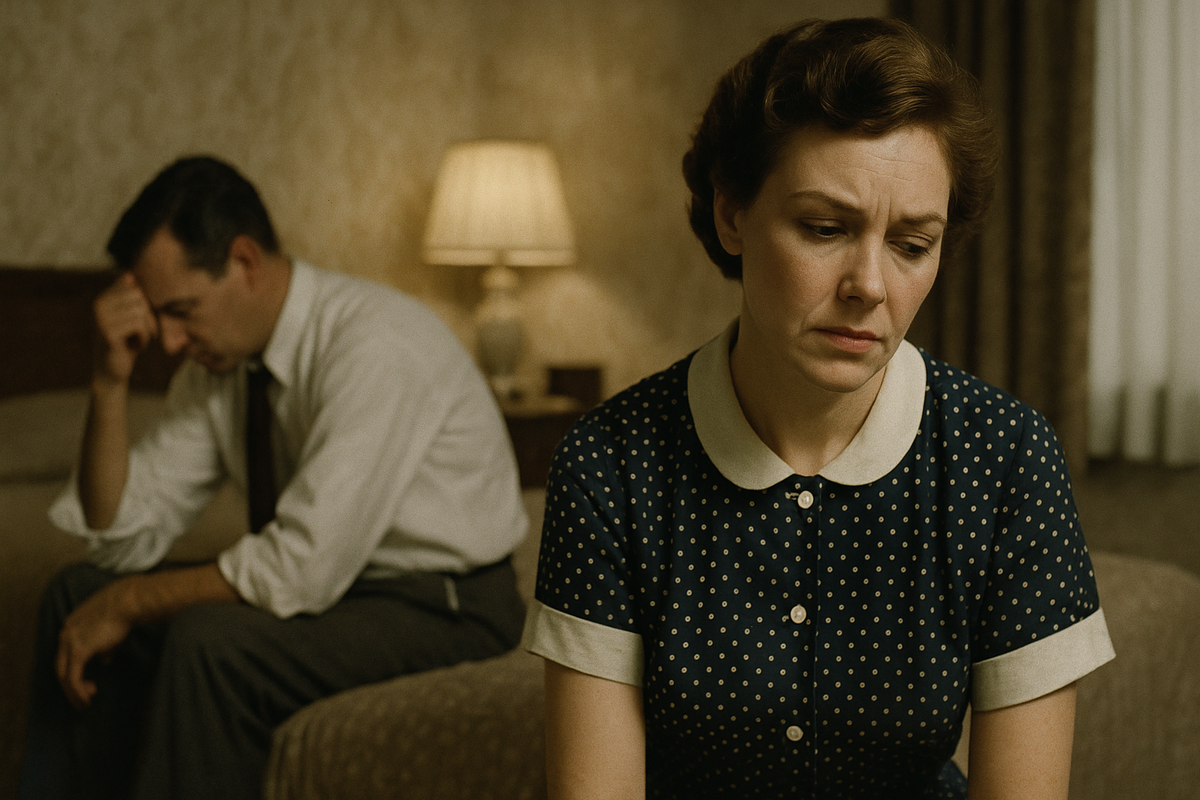
The Marriage Counselor Blamed the Wife
In May 1953, Ladies' Home Journal published something extraordinary: a marriage counseling case where the husband's infidelity was declared his wife's fault.
Amy had discovered her husband Joe's affair with a woman she described as "older, heavier, and married three times." The humiliation was complete. But when America's leading marriage counselor delivered his verdict, it wasn't Joe who bore the blame—it was Amy, for failing to provide the "warmth and affection" her husband required.
The counselor's words were unsparing: "Amy was largely responsible for Joe's infidelity. She never took time to be a wife."
This was the fifth installment of "Can This Marriage Be Saved?"—a feature that would run for six decades and become one of the most influential advice columns in American publishing history. But this particular case, with its brutal assignment of blame and its stark reflection of 1950s gender expectations, captured something darker: the impossible burden placed on postwar wives to maintain not just their homes, but their husbands' egos.
Archive Details
Publication: Ladies' Home Journal
Issue Date: May 1953
Feature: "Can This Marriage Be Saved?" (Fifth Installment)
Marriage Counselor: Dr. Paul Popenoe's Institute
Circulation: 4+ Million Readers
Archive Source: OriginalMagazines.com Collection
The Cultural Moment: 1953 America
The Second World War had ended less than a decade earlier. America was in the grip of a baby boom, and the cultural machinery—magazines, advertisements, television—promoted a singular vision: the breadwinning father, the homemaking mother, the cheerful children in the suburban house.
But beneath this glossy ideal, private realities were fracturing. Women who had worked in factories during the war were now expected to find fulfillment in domesticity. Men returning from combat were supposed to slip seamlessly into corporate jobs and family life. The pressure was immense, and the cracks were starting to show.
Ladies' Home Journal was perfectly positioned to exploit this tension. With a circulation exceeding 4 million, it reached middle-class women across America—and it understood that readers craved both aspiration and honesty. The magazine delivered recipes and fashion alongside frank discussions of marital discord, financial stress, and emotional exhaustion.
Marriage counseling itself was still experimental. Dr. Paul Popenoe, whose team contributed the "Can This Marriage Be Saved?" series, was pioneering the idea that troubled marriages could be rescued through professional intervention. But his approach was prescriptive and gendered: wives bore primary responsibility for marital happiness. If a husband strayed, a wife had failed her duty.
This wasn't fringe thinking—it was mainstream wisdom in 1953. What made the Amy and Joe case remarkable was how starkly it illustrated the double standard. Joe's affair was framed not as betrayal, but as a predictable consequence of Amy's emotional withholding.
Amy's Testimony: Efficiency Without Warmth
Amy was 34, married fifteen years. She and Joe ran a tailoring business together—he managed customers and deliveries, she handled the books. The marriage had become transactional, more partnership than romance.
When she discovered the affair, Amy's fury was laced with contempt. The other woman wasn't glamorous or young—she was "older, heavier, and married three times." The betrayal wasn't just about sex; it was about dignity. "I'll never understand what Joe saw in that woman. Never," she told the counselor.
Amy was brutally self-aware about her own failings. She admitted she was stern, rarely affectionate, often dismissive. She called Joe weak, unambitious, "not clever." She treated him less like a husband and more like an underperforming employee.
But her bitterness revealed something deeper: Amy resented the cultural script she'd been handed. She was intelligent, capable, financially astute—and yet her marriage was collapsing because she couldn't perform the emotional labor required of a 1950s wife. The article captured her exhaustion and anger, even as it framed these feelings as her fundamental flaw.
Joe's Defense: The Hunger for Admiration
Joe admitted the affair but insisted it had been meaningless. What he craved wasn't sex—it was validation. "That woman meant nothing to me, but it sounded good to be told I was a big shot."
At home, Amy's efficiency made him feel small. She was smarter, sharper, more competent—and she never let him forget it. He longed for tenderness, for admiration, for the sense that his wife saw him as more than a disappointing business partner.
"All I want is my wife back," he told the counselor.
Joe's vulnerability was real, but so was his abdication of responsibility. He hadn't communicated his needs; he'd sought comfort elsewhere and then blamed Amy for driving him to it. The affair became, in his telling, a justified response to her coldness.
This framing—that men's infidelity was women's failure—was central to mid-century marital advice. Wives were expected to manage not just households but their husbands' emotional needs, their sexual satisfaction, their sense of masculine identity. The burden was staggering, and when women couldn't carry it, they were held accountable for the consequences.
The Counselor's Verdict: A Wife's Duty
Dr. Popenoe's conclusion was damning: Amy had failed. She was too sharp, too critical, too focused on efficiency. While Joe was "weak" for seeking admiration elsewhere, Amy bore primary blame for creating the conditions that made his affair inevitable.
The article stated plainly: "Amy was largely responsible for Joe's infidelity. She never took time to be a wife."
This wasn't psychological nuance—it was cultural prescription. A wife's role was to nurture, admire, and emotionally sustain her husband. Intellectual competence, financial acumen, and managerial skill were irrelevant if she couldn't also provide warmth. Amy's capabilities became evidence against her: she was so focused on running the business that she'd neglected her "true" duty.
For readers in 1953, this verdict carried weight. Popenoe was a respected authority, and his judgment reflected mainstream belief. Women reading the article were being instructed: no matter how capable you are, if your husband strays, you have failed.
The Magazine as Cultural Artifact
The May 1953 cover of Ladies' Home Journal likely featured springtime optimism—fashionable women, bright colors, domestic beauty. This was the magazine's genius: it paired idealized imagery with articles that exposed the painful reality beneath.
Inside, the visual storytelling reinforced the message. Photographs showed a man and woman in an embrace, but the posture was stiff, suggesting distance rather than intimacy. Another image depicted Joe at work while Amy stood apart—visual metaphor for their emotional separation.
Next to the marriage feature ran a Munsingwear lingerie advertisement promoting nylon slips as the perfect Mother's Day gift. The juxtaposition was almost cruel: on one page, a marriage collapsing under the weight of gendered expectations; on the adjacent page, consumer goods marketed as solutions to feminine inadequacy. Buy the right slip, and perhaps your husband won't stray.
This blend of advice, fiction, and advertising was how Ladies' Home Journal shaped American culture. It didn't just reflect the 1950s domestic ideal—it actively constructed it, telling millions of women who they should be and what they owed their families.
The Enduring Questions
The Amy and Joe case resonates because it asks questions that remain unresolved:
Blame and Infidelity
When infidelity occurs, how is blame distributed? In 1953, the answer was clear: the wife bore responsibility. Today, the question is more complex, but the impulse to assign fault persists.
Emotional Labor
What emotional labor should partners owe each other? Amy was criticized for withholding warmth, but Joe's need for constant admiration was framed as legitimate rather than excessive. The imbalance was structural, not individual.
Work and Intimacy
How do we balance work and intimacy? Amy and Joe's business partnership eroded their romantic connection—a problem that transcends the 1950s. The expectation that couples should be both economic partners and romantic ideals creates impossible tension.
Cultural Collision
What happens when cultural norms and personal reality collide? Amy was capable, intelligent, and financially competent—qualities that should have been assets but were treated as failures because they conflicted with feminine ideals.
By publishing cases like this, Ladies' Home Journal gave women a vocabulary for their struggles, even as it enforced the norms that created those struggles. Readers could see their own marriages reflected in Amy and Joe's crisis, and they could absorb the lesson: adapt yourself, or face the consequences.
Why Collectors Prize This Issue
Historical Documentation
This is the fifth installment of "Can This Marriage Be Saved?", capturing the series at the moment it became a cultural phenomenon. The column would run until 2014, making these early cases foundational documents in the history of American advice media.
Cultural Testimony
Few artifacts capture 1950s gender expectations as starkly as this article. The frank discussion of infidelity, the assignment of blame, the counselor's verdict—all of it reveals how marriage, femininity, and emotional labor were understood in postwar America.
Advertising History
The lingerie advertisement adjacent to the marital crisis offers insight into how consumer culture exploited women's anxieties. Products were marketed not just as goods but as tools for maintaining marital stability.
Visual Evidence
The staged photographs represent classic mid-century editorial style, showing how magazines used imagery to reinforce narrative and cultural norms.
Series Continuity
Collectors assembling the first year of "Can This Marriage Be Saved?" prize this issue as part of the complete set, tracking how the feature evolved and what themes dominated its early run.
Primary Source Value
These magazines aren't nostalgia—they're primary sources. They preserve the voices, struggles, and expectations of women navigating an era that demanded both domestic perfection and emotional self-erasure.
The May 1953 Ladies' Home Journal is more than a magazine—it's a witness to the impossible expectations placed on postwar wives and the cultural machinery that enforced them.
Browse decades of fashion, advice, fiction, and cultural testimony preserved in the pages of vintage women's magazines that shaped—and documented—generations of American life.
Explore the Ladies' Home Journal Collection