
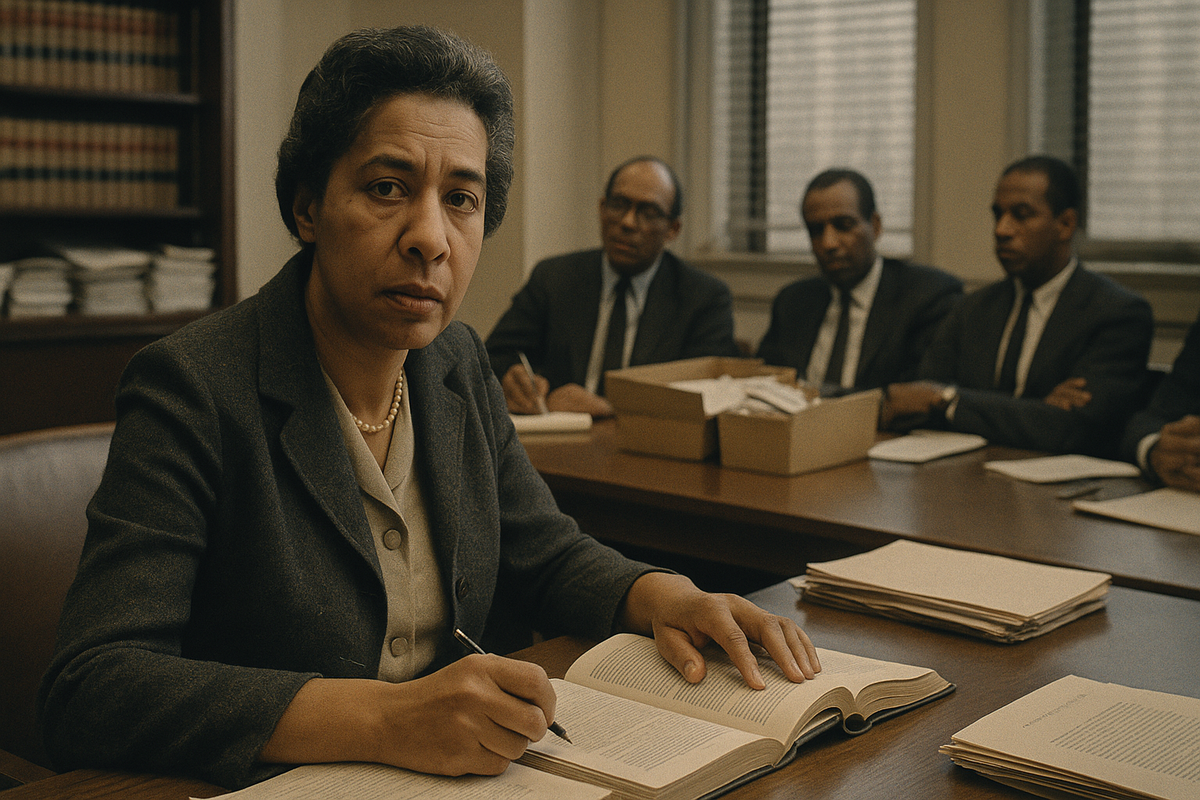
When Justice Wore a Briefcase
Constance Baker Motley and the Ebony Profile That Captured a Turning Point
In January 1963, while most of white America was reading about Jacqueline Kennedy's fashion choices and the space race, Black households across the country were studying a different kind of power. The new issue of Ebony Magazine had just arrived, and tucked inside—beneath Eartha Kitt's sultry cover portrait—was a profile that mattered more than most readers could have known at the time.
Its subject: Constance Baker Motley, the NAACP Legal Defense Fund attorney who had just forced the state of Mississippi to its knees.
This wasn't celebrity gossip. This was a war dispatch from the front lines of American law.
Archive Details
Historical Figure: Constance Baker Motley
Issue Date: January 1963
Archive Source: Ebony Magazine
Feature Title: "Top Woman Civil Rights Lawyer"
The Context: Why January 1963 Was a Hinge Moment
The timing of Ebony's "Top Woman Civil Rights Lawyer" feature was no accident. It arrived in the aftermath of a national trauma.
Just months earlier, James Meredith had walked onto the campus of the University of Mississippi—escorted by federal marshals, surrounded by tear gas, and shadowed by riots that left two people dead. President Kennedy had sent 30,000 troops. The governor of Mississippi had promised to resist "by all lawful means." And when the smoke cleared, Meredith was enrolled.
Behind that victory stood Constance Baker Motley.
She had been his lead attorney. She had written the briefs, argued before hostile judges, and absorbed the venom of a legal system that refused to acknowledge her as "Mrs. Motley"—Mississippi newspapers pointedly called her "the Motley woman" instead. She won anyway.
But the Ole Miss case was only the latest in a string of judicial earthquakes. In 1961, Motley had represented Charlayne Hunter and Hamilton Holmes in their fight to integrate the University of Georgia. Before that, she had worked on Autherine Lucy's doomed attempt to enter the University of Alabama. By 1963, Thurgood Marshall—her mentor—had been appointed to the federal bench, and Motley had become one of the NAACP Legal Defense Fund's most visible strategists.
The March on Washington was still eight months away. The Civil Rights Act was a year and a half out. But the legal architecture of Jim Crow was already cracking, and Motley was holding the sledgehammer.
Ebony knew its readers needed to see her face.
What the Magazine Showed—And Why It Mattered
Ebony didn't just profile Motley. It documented her.
The photographs were unsparing and deliberate. One image showed her at her desk in the NAACP Legal Defense Fund offices, surrounded by mountains of mail from James Meredith's case—every letter carefully cataloged, every piece of public support transformed into legal ammunition. Another captured her in conference with Derrick Bell, Norman Amaker, and other Fund attorneys, the only woman in a room full of men.
There was no airbrushing, no softening. Motley appeared exactly as she was: a lawyer at work, sleeves rolled up, case files stacked high.
The article laid out the realities of her courtroom existence. Southern judges refused her the courtesy titles extended to white male attorneys. Spectators heckled. Opposing counsel tried to rattle her with procedural ambushes. And yet, she kept winning.
Ebony also refused to flatten her into a symbol. Readers saw her at home with her husband Joel and their young son—a reminder that even while carrying some of the civil rights movement's heaviest legal battles, she was also a wife and mother navigating the ordinary demands of family life.
This was Ebony's editorial genius: it never separated the personal from the political. The magazine understood that for Black readers, Motley's story wasn't just about law—it was about what was possible.
The Philosophy Behind the Fight
Motley's own words, quoted in the article, revealed the psychological cost of her work:
"When I wait a long time for a decision and when it finally is handed down and is adverse, I feel depressed. But when you finally win, then everything is wonderful."
It's a deceptively simple statement. But it captures the grind of civil rights litigation in a way that protest marches and Freedom Rides often obscured. Legal victories came slowly, if at all. Judges delayed. Appeals dragged on for years. And when a ruling finally arrived, it could gut you—or vindicate everything you believed.
Motley lived in that tension. She had started as a research assistant under Thurgood Marshall in the 1940s, working her way up through the ranks of the Legal Defense Fund at a time when Black women lawyers were almost nonexistent. By 1963, she was associate counsel, personally arguing cases that would determine whether an entire generation of Black students could attend the same schools as their white peers.
The work required more than legal skill. It required stamina, emotional fortitude, and a willingness to absorb hatred without flinching.
Ebony made sure its readers understood that.
The Cover vs. the Content: A Dual Appeal
The January 1963 cover featured Eartha Kitt—the sultry, sharp-tongued entertainer who had become one of Black America's most visible stars. It was a choice that reflected Ebony's editorial strategy: celebrate Black excellence in all its forms, from Hollywood glamour to courtroom warfare.
Inside, the contrast was deliberate. Kitt represented culture and style. Motley represented strategy and power. Together, they told the full story of Black achievement in 1963—a story that mainstream white media either ignored or reduced to "racial unrest."
This balance was what made Ebony indispensable. It gave its readers both pride and purpose. It said: We are more than what they think we are.
And in January 1963, that message carried weight.
Why This Issue Endures
Civil Rights Documentation from the Inside
While mainstream outlets covered the Ole Miss riots, Ebony profiled the lawyer who won the case. It's a perspective shift that matters—this is the view from inside the strategy room, not from behind police barricades.
A Snapshot of Motley in Mid-Career
By the time she died in 2005, Constance Baker Motley had become the first Black woman appointed to the federal judiciary, serving as a U.S. District Judge for the Southern District of New York. But in 1963, she was still in the trenches, still fighting case by case. Seeing her at that moment—before her judicial appointment, before the honors and accolades—makes this issue especially significant.
Dual Collector Appeal
The Eartha Kitt cover attracts entertainment and pop culture collectors. The Motley feature draws civil rights historians and legal scholars. Few issues serve two such distinct audiences so well.
A Time Capsule of Black America
Beyond the articles, the advertisements, photo essays, and lifestyle features offer a window into how Black America saw itself in early 1963. The cars, the fashion, the aspirations—all of it preserved.
Vintage Ebony magazines aren't just reading material. They're physical evidence of how history was lived, reported, and understood by the people who shaped it.
Where to Find the Full Collection
If you're drawn to this issue—or want to explore the full sweep of Ebony's coverage from the 1940s through the 1970s—thousands of original issues are available in our archive. You'll find the civil rights movement unfolding in real time, year by year, case by case.
Browse Ebony Magazine CollectionThe Legacy
The January 1963 Ebony profile of Constance Baker Motley stands as one of the most important pieces of civil rights journalism from that decade. It captured a woman who was rewriting American law—quietly, methodically, and under conditions that would have broken most people.
Motley's courtroom victories didn't make front-page headlines the way marches and sit-ins did. But they changed the structure of American life in ways that still echo. Every Black student who walks onto a college campus today does so because someone like Motley argued their right to be there—and won.
This issue isn't just collectible. It's essential. It's proof that justice doesn't only come from the streets. Sometimes it comes from a woman with a briefcase, a stack of case law, and the nerve to stand up in a Mississippi courtroom and refuse to back down.
That story deserves to be remembered. And this magazine is how we remember it.