
The Magazine That Sold America the Atom
How Ladies' Home Journal turned nuclear policy into kitchen-table conversation in August 1955
In the summer of 1955, between a recipe for Jell-O salad and an advertisement for Westinghouse refrigerators, American housewives encountered something extraordinary: a government official promising them that nuclear radiation could keep their lettuce fresh.
This was not a joke. This was policy.
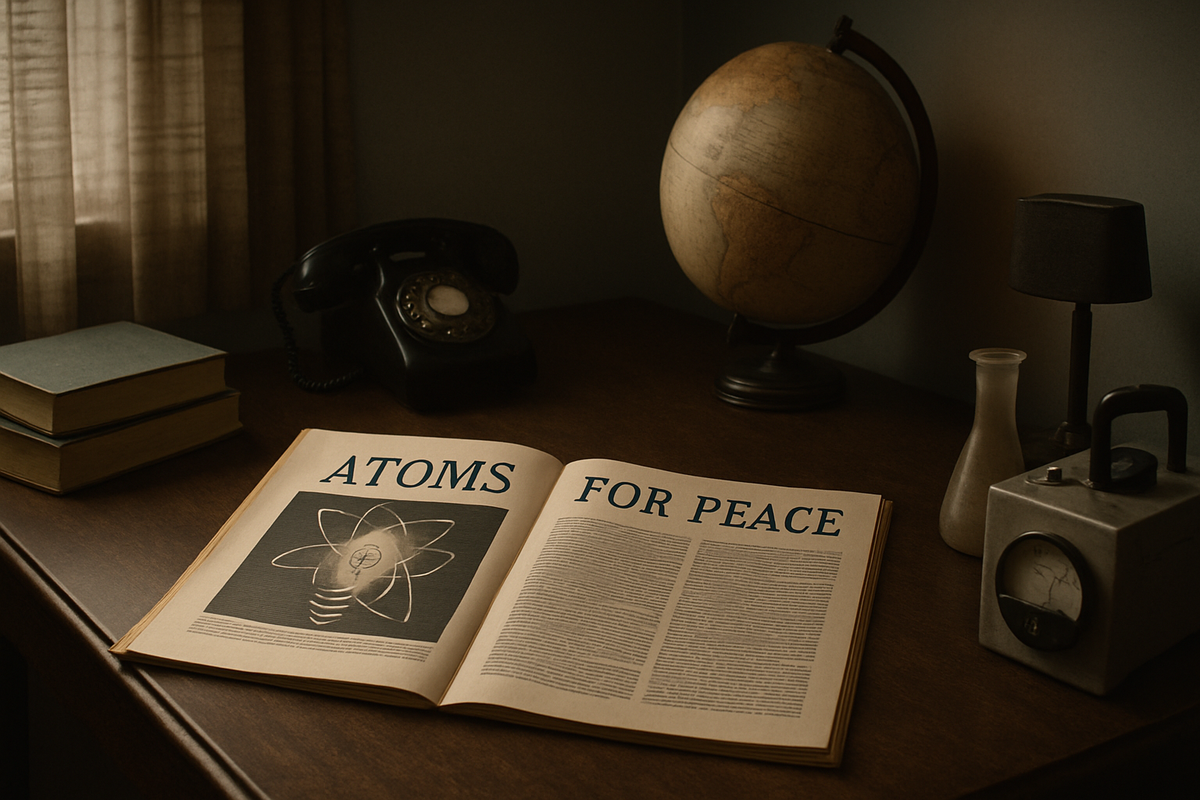
The August 1955 issue of Ladies' Home Journal—one of the most widely circulated magazines in postwar America—featured a sprawling article by Harold E. Stassen, President Eisenhower's Special Assistant on Disarmament, titled "Atoms for Peace." While the Soviet Union and United States stockpiled hydrogen bombs and schoolchildren practiced duck-and-cover drills, Stassen was writing about cancer cures, longer-lasting vegetables, and the coming age of limitless electricity. The mushroom cloud, he insisted, could become a halo.
This was the nuclear age translated for the living room—and it reveals more about Cold War America than a dozen policy documents ever could.
Archive Details
Historical Figure: Harold E. Stassen, Special Assistant to President Eisenhower on Disarmament
Publication: Ladies' Home Journal
Issue Date: August 1955
Article Title: "Atoms for Peace"
Historical Context: Published 20 months after Eisenhower's landmark UN speech
The Context: Living on the Edge of Annihilation
By 1955, nuclear anxiety had seeped into every corner of American life. Both superpowers had tested hydrogen bombs. Civil defense programs urged families to build backyard fallout shelters. Even detergent commercials name-dropped "atomic power" to sell soap.
Yet fear and optimism coexisted in strange harmony. In December 1953, Eisenhower delivered his landmark "Atoms for Peace" speech at the United Nations, pledging to redirect nuclear technology toward peaceful ends. The terrifying power that leveled Hiroshima, he argued, could be turned into medicine, energy, and abundance. Swords into plowshares—radiation into refrigeration.
The Ladies' Home Journal article was Eisenhower's vision brought home. Literally. This was not a speech for diplomats or a white paper for scientists. This was atomic policy served alongside pot roast recipes, written for the women who managed households, raised children, and shaped the moral center of American life. To place "Atoms for Peace" in the Journal was to declare nuclear energy a domestic concern—as ordinary as laundry detergent, as essential as penicillin.
Why Ladies' Home Journal Mattered
The Journal was not a niche publication. It was a cultural juggernaut, reaching millions of middle-class homes each month. While it offered the expected homemaking advice—recipes, decorating tips, child-rearing guidance—it also positioned itself as a forum for serious issues. The magazine published investigative journalism, literary fiction, and commentary on politics and social change. To appear in its pages was to speak directly to mainstream America.
Choosing the Journal for this message was deliberate. Nuclear policy needed public support, and public support required reaching the people who made daily decisions about health, safety, and the future. Mothers. Wives. The women who would decide whether the atom was friend or foe.
This was gendered persuasion at its most calculated—and most effective.
The Article Itself: Propaganda Meets Hope
Stassen's piece was a masterclass in accessible authority. The bold headline—ATOMS FOR PEACE—stretched across the pages in dramatic typography. The opening lines painted utopian pictures: "Imagine a world in which there is no disease… where hunger is unknown…" This was not technical writing. This was vision.
His credentials anchored the optimism. Harold Stassen was not a journalist or a popularizer—he was Eisenhower's disarmament advisor, a voice from the White House itself. Readers were getting policy, not speculation.
But the genius lay in the examples. Stassen made nuclear science tangible:
Cancer Treatment
Radioisotopes could target tumors, offering new hope against the era's most feared disease.
Food Preservation
Radiation could extend the shelf life of produce, reducing waste and stretching grocery budgets.
Agricultural Efficiency
Atomic research could analyze soil nutrients and boost crop yields.
Better Detergents
Radioactive tracers were being used to study how soap cleaned—a detail so domestic it bordered on surreal.
Limitless Energy
Nuclear power promised cheap, abundant electricity, ending shortages and dependence on coal.
American Leadership
The U.S. would wield atomic power responsibly and lead the world toward peace.
Each promise was carefully chosen. These were not abstract benefits. They were improvements housewives could imagine touching: fresher food, healthier children, lower bills, brighter homes.
The layout reinforced the message. Unlike magazines filled with photos of mushroom clouds or military hardware, the Journal kept the presentation clean and minimalist. No spectacle. No fear. Just words and reason.
The Cultural Work This Article Performed
The piece did more than inform—it reassured. It told millions of American women that their government was not only protecting them from Soviet aggression but also working to make their lives easier. The atom was not the enemy. The atom was the future.
This reassurance was deeply ideological. For women, nuclear energy became tied to household improvement: better food, better health, better living through chemistry (and physics). For the nation, it symbolized American technological superiority and moral leadership. The United States would wield atomic power responsibly. The United States would save the world.
By framing nuclear technology as a domestic good, the article also normalized it. If radiation could improve detergent, how dangerous could it really be? If doctors used it to fight cancer, surely it was safe in the right hands. The line between weapon and tool blurred until only intention seemed to matter.
This was soft power at its finest—delivered not through military might but through magazine subscriptions.
The Collector's Perspective: Why This Issue Endures
Historical Timing
Published less than two years after Eisenhower's UN speech, this issue represents the earliest wave of nuclear optimism propaganda aimed at ordinary citizens—not scientists, not politicians, but families.
Cultural Document
Unlike technical journals or political papers, this magazine shows how atomic energy was sold to women. It reveals the assumptions of the era: that housewives controlled domestic ideology, that science could be domesticated, that progress was inevitable.
Rare Insight
Today's nuclear debates focus on waste disposal, reactor safety, and climate mitigation. Reading Stassen's boundless optimism—his promises of disease-free, hunger-free futures—is jarring. It's a reminder of how drastically perspectives shift, how promises age, how hope can look naive in hindsight.
Collectible Value
Issues tied to milestone events—the home front during World War II, early space exploration, the atomic age—command attention from serious collectors. This magazine sits alongside wartime propaganda and moon landing coverage as a document of its time.
To own this issue is to hold a piece of the Cold War's emotional landscape, when America tried to convince itself that radiation could be redemptive.
The Legacy: What Stassen Got Right, and What He Didn't
Nuclear energy did transform medicine. Cancer treatments use radiation therapy. PET scans rely on radioisotopes. Agricultural research benefited from atomic techniques. Power plants generate electricity without carbon emissions.
But the promises also came with costs Stassen didn't mention—or didn't foresee. Nuclear waste. Reactor accidents. Weapons proliferation. The "limitless" energy required massive infrastructure, regulatory oversight, and public trust that would erode over decades.
The utopia never arrived. The atom remained double-edged.
Still, in 1955, the hope felt real. And that hope—fragile, ideological, deeply human—is what makes this magazine valuable. Not because it was right, but because it captures what Americans wanted to believe.
Explore the Archive
If this glimpse into Cold War optimism has sparked your curiosity, the full collection awaits. Original issues of Ladies' Home Journal offer more than nostalgia—they are windows into how generations of women navigated social change, cultural anxiety, and evolving definitions of domestic life.
Browse Ladies' Home Journal Magazine CollectionFrom atomic age propaganda to decades of literary voices, fashion evolution, and social commentary, these magazines are not relics. They are arguments, artifacts, and evidence of how America spoke to itself.
Conclusion: The Magazine as Time Capsule
The August 1955 Ladies' Home Journal accomplished what government white papers could not: it brought nuclear policy into kitchens and living rooms. It told mothers that the atom was not only survivable but beneficial. It promised that science, properly wielded, could end disease, hunger, and darkness itself.
Turn its pages today, and you don't just see articles. You see a nation trying to convince itself that the most dangerous invention in human history could become the most redemptive. You see hope wrestling with dread, propaganda dressed as domesticity, and the Cold War fought with words aimed at women.
That tension—between what was promised and what was delivered, between fear and faith—is what makes this issue more than collectible.
It makes it essential.