
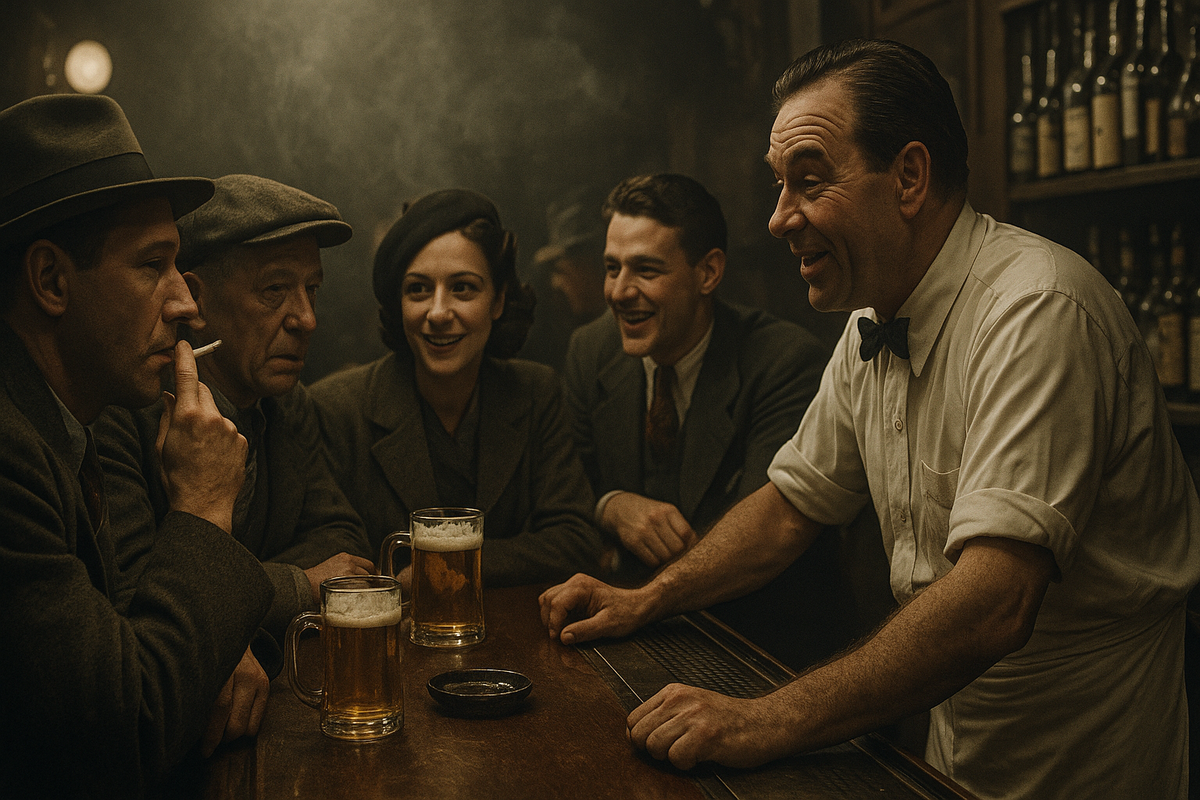
The Bartender as Historian
Inside The New Yorker's November 21, 1936 Portrait of a Nation Between Crises
On November 21, 1936, a reader sliding a dime across a newsstand counter for The New Yorker wasn't buying entertainment. They were purchasing anthropology.
Three years after Prohibition's repeal, with Roosevelt's landslide reelection still fresh and Europe's fascist machinery grinding toward war, the magazine's "A Reporter at Large: Bar and Grill" delivered something no wire service could: a close study of American resilience as performed nightly in the smoky theater of New York taverns. The bartender wasn't just pouring drinks—he was conducting democracy. The regulars weren't just killing time—they were building community in a republic still limping out of Depression, still pretending the world wasn't about to explode.
This wasn't reporting. It was reconnaissance into how ordinary Americans manufactured hope when the official channels had failed them.
Archive Details
Publication: The New Yorker
Issue Date: November 21, 1936
Featured Article: "A Reporter at Large: Bar and Grill"
Historical Context: Post-Roosevelt reelection, pre-World War II
Cultural Significance: Documentary portrait of post-Prohibition American nightlife
The Cultural Fault Line of 1936
November 1936 sits at a historical pressure point. Roosevelt had just crushed Alf Landon in the most lopsided electoral victory since James Monroe, carrying every state except Maine and Vermont. The New Deal's alphabet agencies were reshaping the American contract between citizen and state. Recovery, tentative and uneven, was visible.
But the international weather was turning catastrophic. Hitler had remilitarized the Rhineland that March. Mussolini's colonial ambitions had devoured Ethiopia. Spain was seven months into a civil war that would become the dress rehearsal for mechanized slaughter. Americans who read newspapers knew what was coming, even if they couldn't name it yet.
In this interval—after one catastrophe, before the next—bars became laboratories of survival. The speakeasy's outlaw glamour hadn't fully dissipated; the tavern was still half-legitimate, half-rebellious. Writers understood what historians would later confirm: if you wanted to understand how a culture processed trauma, you watched what it did after dark.
The New Yorker understood this instinctively. Rather than sermonize about vice or valorize virtue, the magazine observed. It recorded the bartender's theater, the democracy of the bar rail where dockworkers and bankers shared the same smoke and stool, the rhythm of voices negotiating another day survived.
The New Yorker's Radical Civility
By 1936, Harold Ross's 11-year-old magazine had already established its revolutionary premise: that wit, irony, and literary precision could coexist with journalism. Where other publications shouted, The New Yorker murmured. Where others moralized, it observed.
"Bar and Grill" exemplified the magazine's method. The piece didn't argue—it inhabited. Readers experienced the clinking glasses, the piano bleeding through cigarette haze, the bartender as confidant and gatekeeper. The journalism was literary without being precious, observational without being detached.
This was radical in 1936, and it remains rare today. The New Yorker created a prose style that treated everyday life as worthy of the same attention critics gave to symphony premieres. The bar wasn't low culture waiting for uplift—it was American culture in its most honest form, and the magazine recorded it with the seriousness it deserved.
For readers outside New York—in Kansas parlors, in Paris cafés—these pages functioned as ethnography. This was how the city actually lived, stripped of Hollywood gloss and tabloid sensationalism.
The Cover as Cultural Cipher
The November 21, 1936 cover remains a masterclass in visual understatement: a wide-eyed man pressing a finger to his lips, shushing a squawking chicken. The absurdity is deadpan. The humor refuses to explain itself.
This was New Yorker semiotics—illustration as cultural commentary, whimsy as critique. The cover didn't announce the issue's contents; it established a mood, a frequency only certain readers could tune into. You either got the joke or you bought Life instead.
Inside, the magazine's architecture—cartoons bleeding into fiction, poetry adjacent to advertisements, reportage indistinguishable from literature—created an editorial ecosystem no competitor could replicate. Other magazines organized content by hierarchy: news, then features, then filler. The New Yorker treated everything as equally worthy of intelligence and craft.
What "Bar and Grill" Actually Captured
The piece's genius lay in its refusal of obvious narrative. It wasn't about alcoholism or morality or urban decay. It was about character under pressure, about how humans create meaning in spaces designed for forgetting.
What the magazine captured, accidentally or not, was a portrait of resilience. These weren't broken people drowning sorrows. These were Americans improvising survival, building community from smoke and bourbon and conversation, creating culture in the only spaces that would have them.
The Permanence Problem
Digital media evaporates. Tweets vanish. Streaming platforms delete. Websites rot.
Physical magazines from the 1930s survive because they were printed on paper, bound, saved, passed down. They weren't designed for virality—they were designed for permanence. A family that kept this November 1936 issue wasn't preserving content; they were preserving a conversation across generations about what mattered, how it was said, and why it was worth saving.
These magazines are witnesses. Every advertisement reveals economic anxiety. Every cartoon captures the prevailing mood. Every article shows what a particular class of Americans thought was worth reading about when the world was coming apart.
In an era of algorithmic feeds and platform collapse, the durability of physical culture becomes more valuable, not less. These issues can't be edited retroactively, memory-holed, or deleted by terms-of-service updates. They exist, stubbornly analog, saying exactly what they said in 1936.
Why This Issue Endures as Collectible
For Collectors and Historians
Our collection houses thousands of original New Yorker issues spanning the magazine's first seven decades—from the Jazz Age through Vietnam, from the Depression through Watergate. Each issue is a sealed environment, preserving not just articles but the complete cultural atmosphere.
Browse The New Yorker Magazine CollectionCoda
The November 21, 1936 New Yorker remains a nearly perfect cultural artifact—a magazine that understood its moment well enough to document what would vanish, literary enough to make that documentation art, and physical enough to survive into an era that needs reminding of what permanence looks like.
The bartenders it described are dead. The bars have been demolished or renovated past recognition. The readers who first opened this issue and laughed at that absurd cover are gone.
But the magazine survives, a paper time machine back to a smoky tavern in 1936, where Americans were building resilience one drink and one conversation at a time, while the world outside prepared for fire.
For anyone who values cultural memory—who understands that magazines weren't just reading material but monuments to how a civilization talked to itself—this issue isn't vintage ephemera. It's evidence that we were here, that we paid attention, and that some things are worth saving.