
Four Days Before the Abyss
Life Magazine's Final Portrait of Peace
On August 28, 1939, American households received their weekly issue of Life Magazine. Tennis star Helen Wills Moody smiled from the cover—a last gesture toward normalcy. Inside, the pages told a different story: Germany had wheeled out its heaviest guns, Poland had mobilized a million men, and ten million soldiers across Europe were sleeping in uniform.
Four days later, the Wehrmacht crossed the Polish border.
This issue of Life wasn't just journalism. It was a countdown clock, photographed and captioned with surgical precision. Today, it stands as one of the most significant artifacts of pre-war photojournalism—a document that captured the exact moment when diplomatic theater hardened into military fact.
The Mechanics of Intimidation
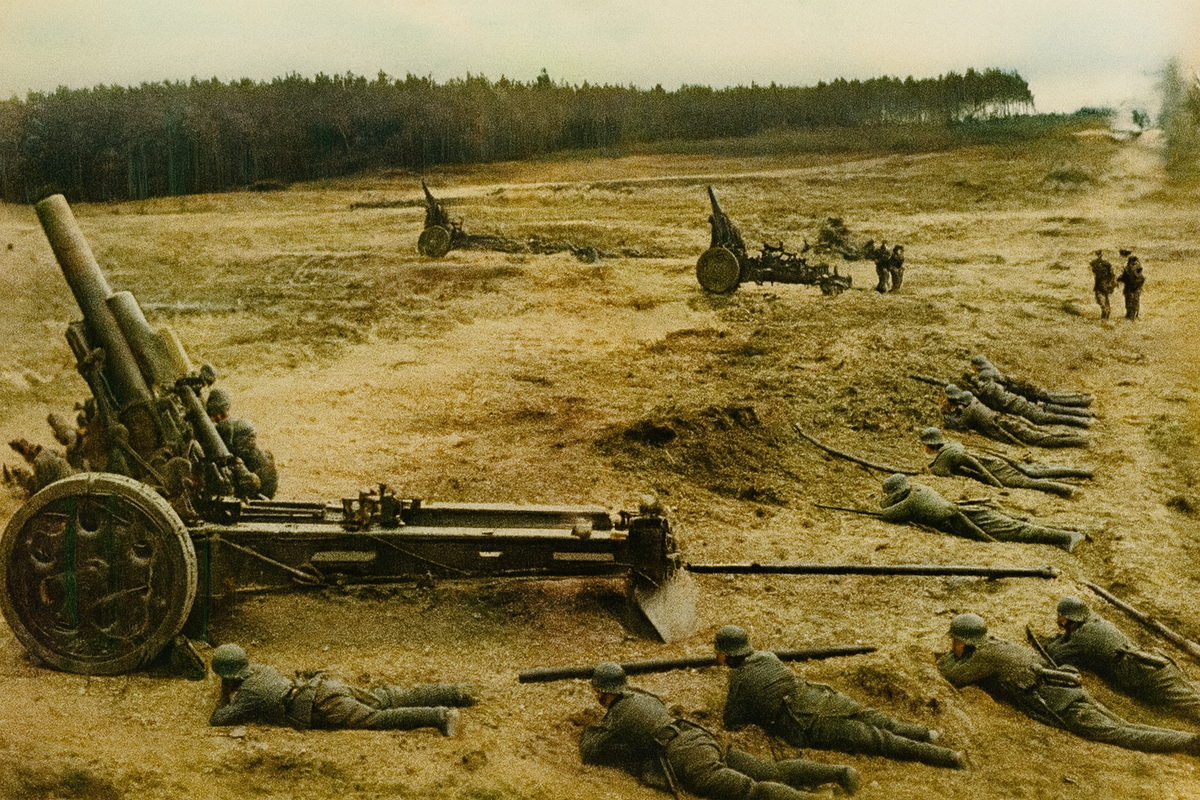
Life titled its photo essay "Germany Uncovers Its Heaviest Artillery to Cow Nationalist Poles," and the verb was chosen with care. This wasn't reportage on a skirmish or a border dispute. This was documentation of psychological warfare conducted through industrial scale.
The magazine's photographers captured Germany's new arsenal with forensic clarity:
Railway guns mounted on reinforced rail cars—12-inch and 13-inch bore weapons capable of hurling 700-pound shells more than 20 miles. Each photograph emphasized not just size but organization: the precision crews, the mechanized loading systems, the transformation of railyards into mobile fortresses.
Mortars designed for rapid deployment, firing 240-pound shells at a rate of one per minute. Life's captions explained the mechanics—recoil absorption, crew size, blast radius—with the detachment of a technical manual and the unease of a warning.
Camouflaged artillery batteries hidden in forest clearings, their barrels angled skyward, shrouded from aerial reconnaissance. The photographs showed what German propagandists wanted Poland to see: an army that had industrialized warfare itself.
This was Hitler's "fourth great gamble," as Life termed it. He had already reoccupied the Rhineland, absorbed Austria in the Anschluss, and dismantled Czechoslovakia through orchestrated crisis. Each success had been preceded by propaganda about ethnic Germans under threat. Now the same script was being deployed against Poland—but this time, the stage was set for total war.
Historical Context
Issue Date: August 28, 1939
Days Until Invasion: Four (September 1, 1939)
Featured Military Leader: Marshal Edward Śmigły-Rydz
Archive Significance: Last American newsmagazine to document Europe at peace
Poland's Answer: Nationalism and General Mud
Across the border, Poland prepared with what it had: pride, terrain, and a fierce refusal to capitulate.
Life's reporting emphasized Poland's natural advantages. The nation's poor roads and autumn rains had earned a nickname among military strategists: "General Mud." For centuries, invading armies had foundered in Polish marshlands and unpaved routes. Against Germany's mechanized divisions, Poland was betting that nature would prove a more reliable ally than Western guarantees.
The human element received equal attention. Marshal Edward Śmigły-Rydz, Poland's commander-in-chief, appeared in full military dress alongside his wife—a deliberate editorial choice by Life's photographers. This wasn't just a military leader; this was a nation's stakes made personal.
The photographs that followed showed Poland's contradictions:
- Cavalry formations with lances and sabers, thousands strong, a romantic holdover in an age of tanks and dive bombers
- The Polish Air Force with 1,500 first-line aircraft, including twin-engine bombers
- Approximately 600 tanks, mostly light models, positioned against a German armored force that dwarfed them in number and firepower
- Horse-drawn ammunition wagons moving supplies through mud that would have halted trucks
Life presented these images without mockery. The magazine understood what its readers needed to see: Poland knew it was outgunned. It was choosing to fight anyway.
Photojournalism as Historical Record
By 1939, Life had perfected a format that newspapers couldn't match: the photo essay as narrative architecture. Where text-based journalism required readers to imagine the scene, Life delivered proof.
The magazine's full-page spreads forced Americans to confront the scale of what was coming. A railway gun stretched across an entire page, its crew dwarfed by the barrel. A Polish cavalry officer gazed directly at the camera, his expression unreadable. German soldiers loaded shells with mechanical efficiency while Polish horsemen practiced formations that had last seen major use in the Napoleonic Wars.
This visual rhetoric carried an implicit argument: diplomacy had failed, mechanization was unstoppable, and American isolation was becoming harder to justify with each issue.
The contrast between Helen Wills Moody on the cover and the artillery spreads inside wasn't accidental. It was editorial commentary—a magazine showing its readers that tennis tournaments and European mobilization were sharing the same timeline, the same planet, the same fragile peace.
What This Issue Captured
The Legacy of Life's Coverage
Modern news cycles measure attention in hours. Stories break, trend, and vanish before dinner. The August 28, 1939 issue of Life Magazine offers a different model: information consumed slowly, studied at kitchen tables, preserved in attic boxes, and rediscovered by grandchildren who want to know what their grandparents saw.
These pages didn't just report history. They became part of it—shaping how a generation of Americans understood the war they would eventually join, the enemies they would face, and the allies they would defend.
The photographs of German guns and Polish cavalry are more than historical curiosities. They're reminders that nations can see catastrophe approaching and still believe they'll be spared. They're evidence that journalism once had the patience to document a crisis before it exploded, rather than simply covering the explosion.
Why Collectors Prize This Issue
Timing
Published exactly four days before Germany invaded Poland, it's the last American newsmagazine to document Europe at peace. Issues from September 4 onward were covering a world at war.
Photography
These images of German artillery and Polish defenses represent some of the most comprehensive pre-war military documentation available to American civilian audiences. The photographers had access that would disappear once combat began.
Cultural Evidence
This issue captures how Americans understood the crisis—what information they had, what framing they received, what visual language shaped their perception of events they couldn't yet call "World War II."
Historical Materiality
This isn't a digital archive or a reprinted anthology. These are the actual pages, with the original ink and paper stock, that Americans held in their hands during the final days of August 1939.
For collectors of WWII history, photojournalism, or cultural artifacts, this issue functions as both document and object—evidence of what was known, and a physical remnant of the world that knowledge couldn't save.
Explore the Collection
This issue is part of a curated archive spanning Life Magazine's most significant decades—from the 1930s through the 1970s. Each issue captures not just news but the texture of daily life: culture, politics, science, sports, and the ordinary moments that filled the space between headlines.
Whether you're a serious collector, a military historian, or someone honoring family who lived through these years, these magazines offer something digital archives cannot: the physical presence of history.
Browse Life Magazine CollectionA Final Artifact
The Life Magazine of August 28, 1939 is more than a collectible. It's a witness.
It witnessed the last days when war was still a possibility rather than a fact. It witnessed Germany revealing weapons designed to terrify before they were used to destroy. It witnessed Poland preparing to resist with insufficient resources and unbreakable resolve.
Four days after this issue reached American homes, the Wehrmacht crossed the border. Within weeks, the cavalry charges and General Mud would prove insufficient against Blitzkrieg tactics. Within years, the world Life documented in August 1939 would be unrecognizable.
But in these pages, that world still exists—frozen in halftone dots and printer's ink, waiting for someone to hold it again and remember what it felt like when the countdown was still running, and history hadn't yet chosen its course.