
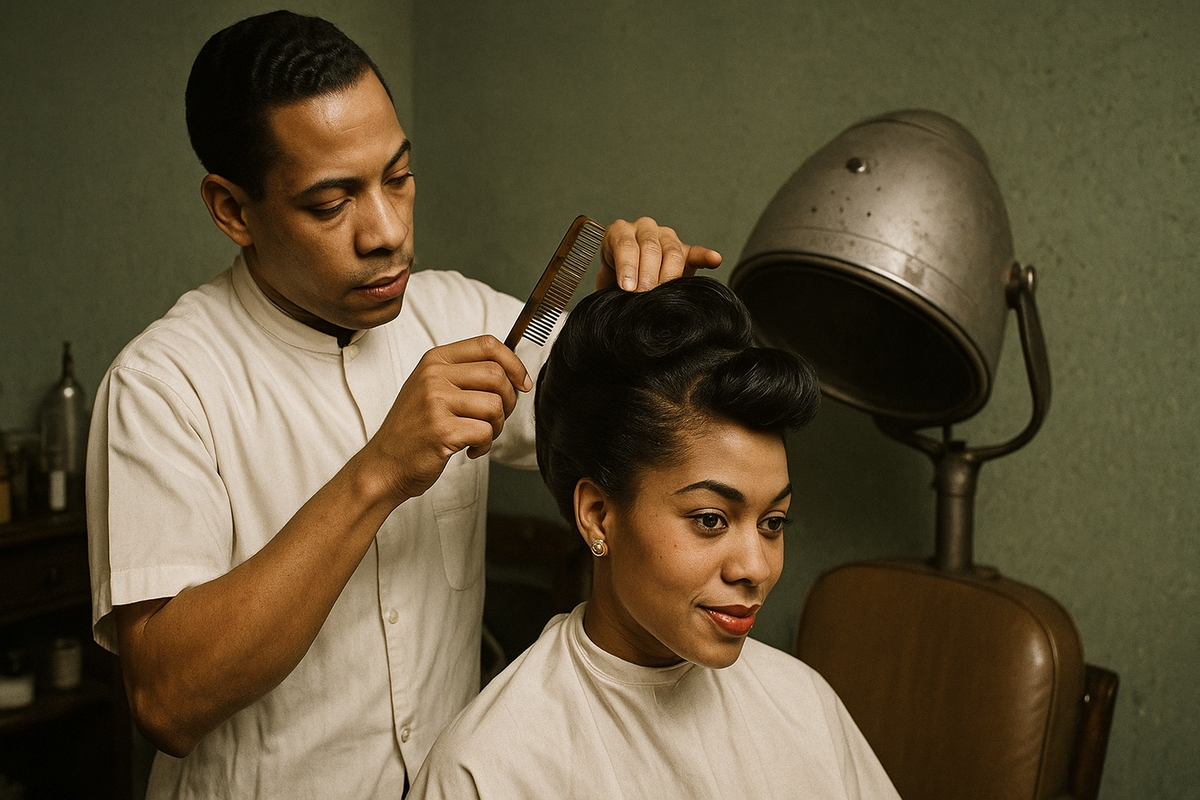
Beauty, Identity, and Breaking Barriers: Male Hairdressers in Black America, 1952
When Jet Magazine asked "Are Male Hairdressers Better?", it documented a quiet revolution in professional identity, gender roles, and Black cultural power
When readers cracked open the December 18, 1952 issue of Jet Magazine, they encountered something unexpected wedged between the usual celebrity profiles and political coverage: a question that would have seemed audacious in any publication, let alone one serving Black America during the height of Jim Crow.
"Are Male Hairdressers Better?"
The headline landed like a provocation. But for the women who made up Jet's core readership—women navigating the triple bind of race, gender, and economic survival in 1950s America—this wasn't fluff. It was a referendum on who deserved authority in one of the few industries where Black professionals could build genuine wealth and cultural power.
This article wasn't about hairstyles. It was about who gets to be an expert, who gets to touch Black women's bodies, and who gets to define beauty in a country that had spent centuries denying Black people could be beautiful at all.
Archive Details
Publication: Jet Magazine
Issue Date: December 18, 1952
Cover Model: Rosella Lawrence
Featured Professionals: Bryant Locke (Cleveland), Frenchy Casimir (Harlem), Harry K. Smith (New York), Eadward (Los Angeles)
Historical Context: Two years before Brown v. Board of Education; five years after Jackie Robinson integrated Major League Baseball
The Context: Beauty as Economic Resistance
By 1952, African Americans had spent decades building a parallel economy within a segregated nation. Two years before Brown v. Board of Education would challenge legal segregation, and five years after Jackie Robinson shattered baseball's color line, Black communities were already proving that excellence transcended the boundaries white America tried to enforce.
Nowhere was this more evident than in the beauty industry. From Madam C. J. Walker's empire-building in the early 1900s to the neighborhood salons that doubled as organizing hubs, Black beauty culture represented more than vanity. It represented autonomy. A Black woman who could afford a professional hairstylist wasn't just purchasing a service—she was participating in an act of economic self-determination.
Beauty shops functioned as secular churches: places where women could speak freely, debate politics, affirm each other's dignity, and literally reshape how they presented themselves to a hostile world. The products were developed by Black chemists. The techniques were refined by Black stylists. The profits stayed in Black hands.
What made Jet's December 1952 feature remarkable was its spotlight on an insurgent faction within this already-marginalized industry: male beauticians.
The Professional Vanguard
Jet reported approximately 2,000 male beauticians working across the United States in 1952—a figure that sounds modest until you consider the barriers. Beauty culture was women's territory, both as practitioners and clients. For a man to enter this space required not just skill but audacity.
The magazine profiled four who had already achieved celebrity status:
Bryant Locke, a Cleveland stylist whose glamorous up-sweep designs drew clients from across the city, treating each appointment as a sculptural commission.
Frenchy Casimir, Harlem aristocracy, Paris-trained, co-owner of Casudian—one of New York's premier beauty establishments. His clientele read like a who's who of Black entertainment and society.
Harry K. Smith, a New York technician famous for his swirl-curl designs, commanding fees that rivaled white stylists downtown. He was already plotting expansion to Paris, exporting Black beauty expertise back to the continent that had supposedly invented sophistication.
Eadward of Los Angeles, whose sharp, modernist styles incorporated European influences without submitting to European standards—a delicate cultural negotiation that Black creatives had perfected across every artistic medium.
These weren't hobbyists. They were professionals operating at the highest tier of their craft, often with celebrity clients from theater, television, and modeling. Their success challenged two suffocating assumptions: that beauty work was women's work, and that Black professionals belonged in service roles, not creative leadership.
What the Women Said
The article reported something fascinating: some women explicitly preferred male stylists, claiming men possessed a "magic touch" and better understood how to make women attractive to men.
Read one way, this sounds like internalized sexism. Read another way—the way Jet's readers likely understood it—this was women exercising choice in one of the few consumer markets where they held genuine power. Black women were saying: We decide who touches our hair. We decide whose artistry we trust. We decide what constitutes expertise.
The male stylists themselves understood their work as art, not just craft. They weren't simply executing requests—they were collaborating with clients to construct identity. In a society that constantly policed Black bodies and Black presentation, this was radical work.
The Magazine That Made the Moment
Jet Magazine launched in November 1951, a digest-sized weekly that could fit in a purse or a back pocket. While Life and Time might occasionally cover a Black celebrity or a particularly photogenic civil rights confrontation, Jet committed itself to comprehensive documentation of Black life: the jazz clubs, the churches, the fashion shows, the professional pioneers, the everyday victories that white America never noticed.
The December 18, 1952 cover featured model Rosella Lawrence against bold orange stripes—Jet's trademark design language, impossible to ignore on a newsstand. The magazine's compact format made it portable and shareable, passing from barbershop to beauty salon to kitchen table, creating a distributed conversation across Black America.
This particular issue exemplified Jet's range: seamlessly pivoting from hard-hitting social issues to cultural celebration, treating both as equally worthy of serious journalism. For readers, the message was clear: We contain multitudes. We are political and glamorous. We fight for dignity and we celebrate beauty. These are not contradictions.
The Enduring Power of the Archive
Jet lasted because it understood something fundamental: representation isn't a luxury. For people whose lives are systematically ignored or distorted by mainstream media, documentation becomes survival. Every issue of Jet said: You exist. Your work matters. Your choices matter. Your beauty matters.
The male beauticians profiled in December 1952 understood this. They weren't just styling hair—they were claiming authority in a space that hadn't been designed for them, proving that talent superseded convention, that Black professionals could excel anywhere they chose to plant their flag.
For modern readers, this issue offers a reminder that the fight for dignity happened everywhere: not just in courtrooms and polling places, but in beauty shops and barbershops, in the daily transactions where Black people insisted on defining themselves.
Why This Issue Matters Now
Timing
Published during the calm before the storm—the Montgomery Bus Boycott was three years away, the March on Washington eleven years away. This issue documents the cultural infrastructure that made mass movement possible: the institutions, the economic networks, the habits of self-definition that Black communities built while white America wasn't paying attention.
Subject Matter
No mainstream publication covered male beauticians in the Black community. This wasn't considered newsworthy. Jet understood that professionals redefining gender roles within an already-marginalized industry constituted a genuine cultural shift, worthy of documentation.
Condition & Rarity
Mid-century Jet issues in good condition are increasingly rare. The magazine's digest format and newsprint paper made it ephemeral by design. Surviving copies are survivors.
Visual Impact
Rosella Lawrence's cover photo, the striking typography, the interior layout—this is Black mid-century design at its most confident.
Owning this issue means holding evidence of a moment when Black professionals were quietly revolutionizing beauty culture, when Black women were exercising consumer power, when Black journalists were documenting their community with sophistication and nuance that the mainstream press couldn't be bothered to attempt.
Explore the Archive
The December 18, 1952 issue is one entry point into decades of Black cultural history preserved in real time. From the early 1950s through the 1970s, Jet captured the Montgomery Bus Boycott, the rise of Motown, the evolution of Black fashion, the celebrities, the athletes, the everyday people building extraordinary lives under impossible conditions.
These aren't replicas or reprints. They're original artifacts—newsprint that witnessed history, pages that passed through the hands of people who lived through the moments we now study.
Browse Jet Magazine Collection"Are Male Hairdressers Better?" The question itself was secondary. What mattered was that Jet asked it—that Black journalists considered Black male beauticians worthy of a feature story, that Black women's preferences warranted investigation, that Black beauty culture deserved serious analysis.
The December 18, 1952 issue documented men reshaping professional expectations, women exercising agency, and an entire community building institutions that white America would ignore for another decade. It proved that African Americans didn't need permission to redefine expertise, success, or beauty itself.
For anyone passionate about cultural history or serious about collecting, this issue isn't memorabilia. It's testimony.