
The Empire Built on Promises
When Time Magazine Profiled Prudential's $20 Billion Bet on the American Dream
March 18, 1957. Carroll Shanks stares out from the cover of Time Magazine, his expression somewhere between confidence and calculation. Behind him, unseen but omnipresent, lies an empire: $20 billion in assets, an army of door-to-door salesmen, and a financial apparatus so vast it could reshape skylines, bankroll suburbs, and determine which families would weather catastrophe and which would crumble.
This wasn't just a business profile. It was Time asking the question Americans were too busy thriving to ask themselves: Who really owns the future we're building?
Prosperity With a Price Tag
The late 1950s hummed with contradiction. Suburbia sprawled outward in concentric rings of ranch houses and two-car garages. Shopping centers bloomed like concrete dandelions. The middle class swelled with engineers, managers, and salesmen who could finally afford what their parents had only imagined: mortgage security, college funds, vacations in the family sedan.
But underneath the chrome and optimism, the Cold War cast a long shadow. Soviet nuclear capacity was no longer theoretical. The future felt simultaneously limitless and fragile. Into this psychological breach stepped life insurance—not merely a financial instrument but a cultural sedative. It promised that even if the worst happened, your family would survive. You could buy certainty. You could purchase peace of mind.
Prudential Insurance, under Shanks' leadership, had transformed itself from a life insurance company into something closer to a sovereign wealth fund. Its assets exceeded those of many nations. Its investment decisions rippled through Wall Street and Main Street alike, financing the very suburbs its policyholders inhabited, the skyscrapers where they worked, the shopping centers where they spent.
Time recognized what it was witnessing: a private corporation had become a public infrastructure. And it wanted readers to understand both the marvel and the menace of that arrangement.
Archive Details
Historical Figure: Carroll Shanks, President of Prudential Insurance
Issue Date: March 18, 1957
Archive Source: Time Magazine
Corporate Assets: Over $20 billion (1957)
Historical Context: Eisenhower Era, Cold War America, Suburban Expansion
The Anatomy of an Empire
What made the Prudential feature exceptional wasn't its financial reporting—though Time delivered that with trademark precision. It was the magazine's insistence on showing readers how this empire functioned, pulling back the curtain on mechanisms most Americans never questioned.
The salesmen came first. Thousands of them, fanning out across the country with leather briefcases and rehearsed pitches, knocking on doors from Brooklyn to Bakersfield. They sold security in five carefully calibrated forms: straight life, term, endowment, limited payment, and annuities. Each product was engineered for a different lifecycle stage, a different anxiety, a different vision of the future. Time explained them all, transforming actuarial science into something approaching narrative.
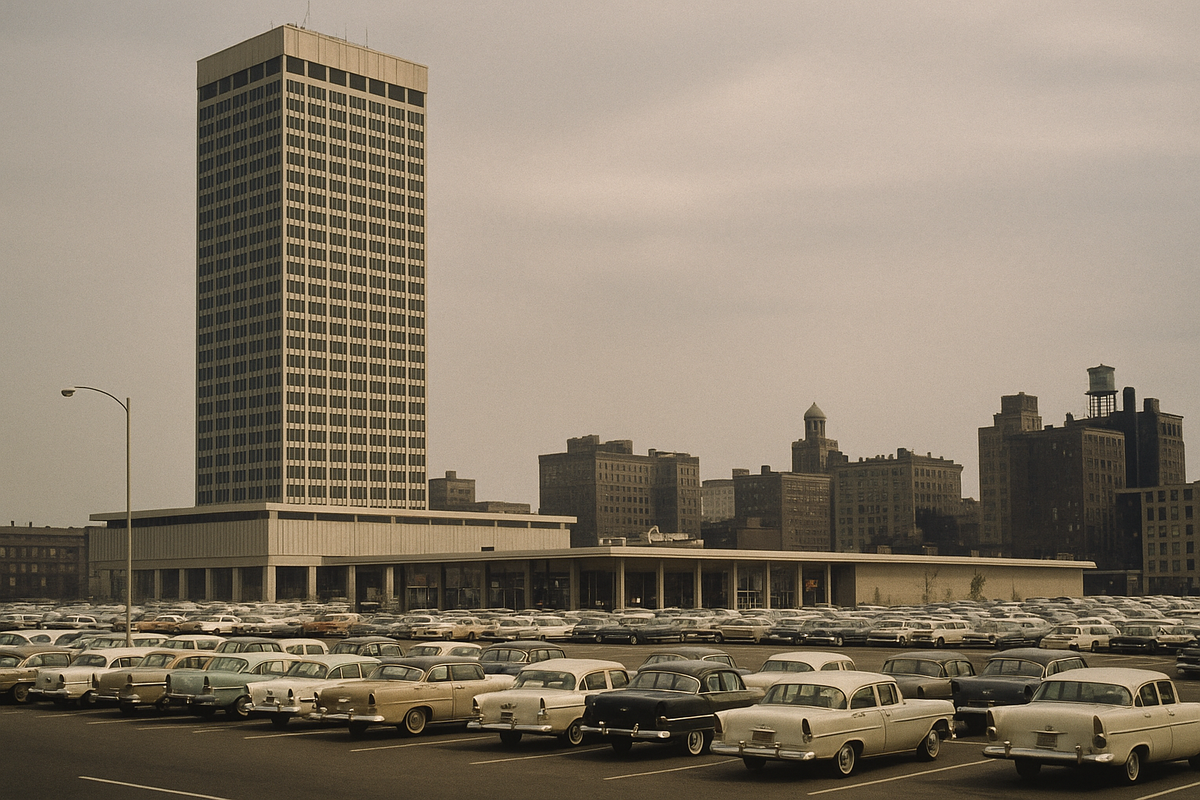
Then came the money itself. Prudential's $20 billion didn't sit idle in vaults. It flowed into construction loans, corporate bonds, and real estate ventures. The Prudential Building in Chicago—a monument to corporate permanence—was both symbol and reality. Insurance premiums paid by millions of working families were being transmuted into the physical landscape of postwar America. Your monthly payment wasn't just protecting your children; it was building the shopping center down the street.
Time captured this cycle with photographs that functioned as visual arguments: skyscrapers thrusting upward, suburban developments stretching toward the horizon, graphs charting exponential growth. This was capitalism as spectacle, as nation-building, as something that defied easy moral categorization.
Time's Mirror
The magazine's cover design said everything. No lifestyle flourishes, no entertainment gloss—just Shanks' portrait rendered with the gravitas reserved for presidents and generals. Time in 1957 understood its role: not to entertain but to contextualize power. Its readers didn't want distraction; they wanted to understand who controlled the levers of their prosperity.
Inside, the editorial voice walked a tightrope between celebration and interrogation. Yes, Prudential provided genuine security to millions. Yes, its growth reflected American dynamism. But Time also let the implications hang in the air: When a private company controls billions in assets, influences urban development, and shapes mortgage availability, where does corporate power end and public governance begin?
The article never answered that question directly. It didn't need to. The facts arranged themselves into an argument, the photographs into evidence. Time trusted its readers to grapple with complexity rather than demanding they embrace a conclusion.
Key Themes in the Prudential Profile
Financial Literacy for the Masses
Time broke down the five forms of life insurance—straight life, term, endowment, limited payment, and annuities—making complex actuarial concepts accessible to ordinary American readers.
Corporate Expansion as Nation-Building
Prudential's reach extended far beyond insurance, influencing construction, healthcare, urban development, and consumer finance across the American landscape.
The Salesmanship Culture
The article emphasized how much of the company's growth relied on its army of door-to-door salesmen—a distinctly American phenomenon of the 1950s middle-class economy.
$20 Billion in Influence
With more than $20 billion in holdings, Prudential was cast as both protector of families and a major economic force capable of reshaping cities and communities.
The Artifact as Archive
Vintage magazines outlive their moment because they capture something digital archives cannot: the experience of news consumption before fragmentation. Families read Time together. Conversations started at the kitchen table and continued at the office. Information moved slowly enough that readers could think about what they were reading rather than simply reacting to it.
The Prudential issue crystallizes this. It's long-form journalism that assumes intelligence in its audience, that builds arguments through accumulation rather than assertion, that treats commerce as worthy of the same analytical rigor as diplomacy or warfare.
For anyone studying how Americans understood their own prosperity—its sources, its fragility, its moral ambiguities—this single issue of Time is primary source material. It's evidence of what mid-century elites thought the middle class needed to know about the institutions managing their security.
Why This Issue Endures
Corporate Archaeology
The Prudential profile documents how a single institution reshaped American capitalism, moving from risk management into de facto urban planning. Scholars studying postwar financial power can trace the genealogy of modern insurance conglomerates back to this moment.
Cultural Decoding
The language Time used—the metaphors it chose, the anxieties it foregrounded—reveals what mattered to Eisenhower-era Americans. Security wasn't abstract; it was measured in premium payments and policy payouts.
Design as Historical Document
From typography to photograph composition, this issue embodies mid-century visual storytelling. The layout decisions were editorial arguments rendered in halftone dots and column inches.
Evergreen Resonance
Strip away the 1950s specifics and the core tension remains: How much corporate concentration is compatible with democratic capitalism? The questions Time posed in 1957 are the questions we're still asking.
Add This to Your Archive
The March 18, 1957 issue of Time Magazine is more than a profile of Prudential Insurance. It's a dispatch from the moment when American capitalism was still confident enough to examine itself critically, when magazines could assume readers would sit with complexity rather than demand simplification.
For collectors building archives of 20th-century business journalism, Cold War cultural history, or simply preserved examples of magazine craft at its apex, this issue is essential.
Browse Time Magazine CollectionCoda
Carroll Shanks stares out from that 1957 cover, frozen mid-century, his expression still ambiguous. Was Prudential building security or manufacturing dependence? Empowering families or concentrating power?
Time let readers decide. The magazine simply held up the mirror, adjusted the lighting, and asked: Is this the future you wanted to buy?
The question, like the issue itself, has never expired.