
When Lipstick Was Resistance
Inside Jet's Revolutionary Beauty Issue of 1955
On September 8, 1955, a pocket-sized magazine hit newsstands with a cover that refused to apologize. Lucille Rich, a New York model, gazed out from Jet's blue-and-white backdrop—not as an exception, not as a novelty, but as the standard. The headline promised "What Women Ought to Know About Make-Up," but what it delivered was something more dangerous: proof that Black women's beauty required no permission.
Three weeks earlier, Emmett Till had been murdered in Mississippi. The nation was fracturing along fault lines that had always been there. And yet here was Jet, slipping into purses and coat pockets across America, insisting that a tutorial on rouge application and eyebrow shaping was not trivial—it was essential. Because in 1955, for an African American woman to step into a job interview, a church service, or simply onto a city street looking polished and self-possessed was not vanity. It was defiance.
Archive Details
Publication: Jet Magazine
Issue Date: September 8, 1955
Cover Model: Lucille Rich, New York
Feature Story: "What Women Ought to Know About Make-Up"
Historical Context: Published three weeks after the murder of Emmett Till, one year after Brown v. Board of Education
The Magazine That Refused to Choose
What mainstream publications failed to understand—what Life, Vogue, and Ladies' Home Journal could not fathom—was that there was no contradiction between covering lynching and lipstick, between voter suppression and facial contouring. Jet's genius was recognizing that both were part of the same story: how African Americans defined themselves in a society determined to erase them.
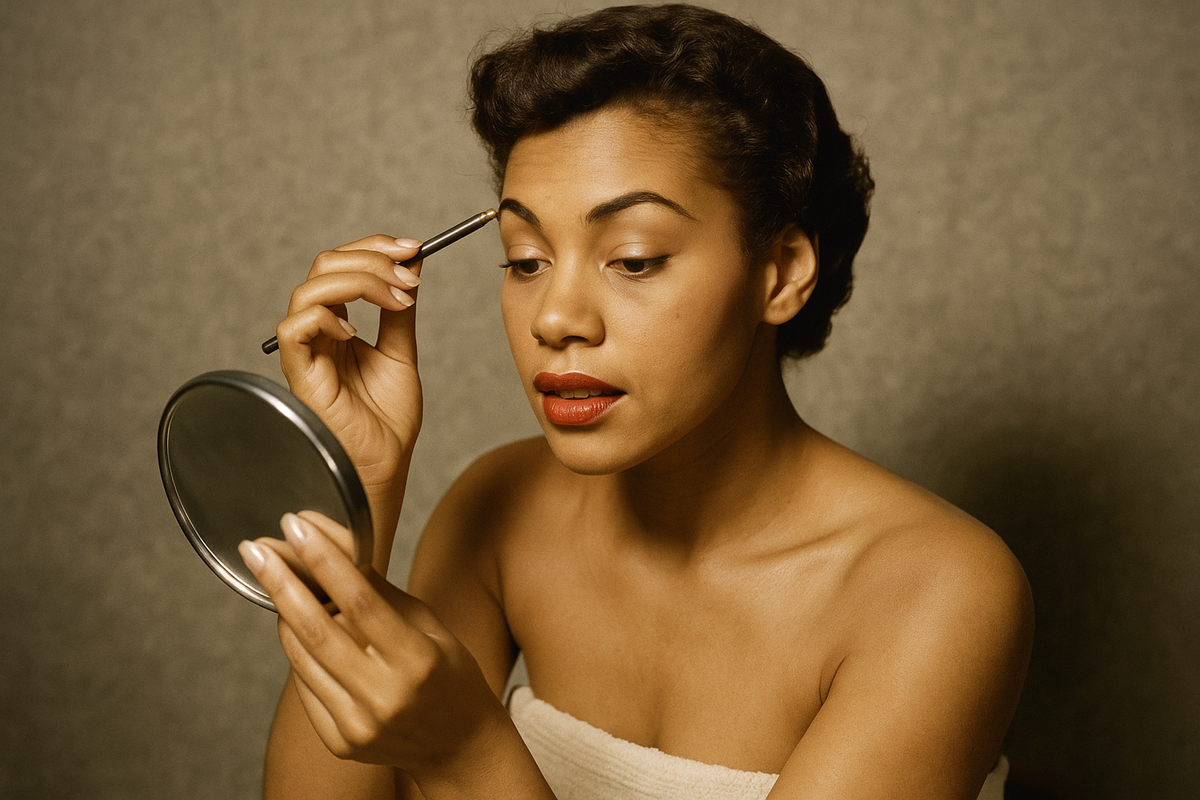
The beauty feature opened with photographs demonstrating techniques most cosmetics companies assumed Black women didn't need or couldn't afford. Facial contouring with rouge and powder to define features. Eyebrow styling—brushing and penciling arches into symmetry. Lipstick application that carefully traced contours to highlight expression. These weren't frivolous details. They were acts of self-determination documented with the same seriousness Jet brought to its civil rights reporting.
The models in those step-by-step photographs weren't white women with Black readers expected to translate. They were Black women, guiding other Black women through rituals the beauty industry had declared didn't exist. That visual representation—so obvious it should have been unremarkable—was revolutionary.
Beauty in the Shadow of Brown v. Board
The mid-1950s had cracked open with possibility and violence in equal measure. Brown v. Board of Education had declared school segregation unconstitutional just a year earlier, igniting the modern civil rights movement. But the Emmett Till murder had reminded everyone that legal victories meant nothing to a lynch mob. African Americans existed in that brutal tension—between hope for what might be and rage at what still was.
In this context, beauty culture carried weight it had never been asked to bear. Choosing a hairstyle or applying makeup became entangled with respectability politics—the calculated belief that looking "polished" might deflect white violence, might crack open professional doors, might prove Black humanity to people who'd spent centuries denying it. It was an impossible burden, and yet African American women bore it with a dignity that should have shamed their oppressors.
Jet understood this calculus without needing to explain it. The magazine had been documenting Black life in its fullness since 1951, and by 1955, it had mastered an editorial approach that felt both urgent and intimate. The September 8 issue bounced from "How Dark Negroes 'Pass' Down South" to beauty tips to entertainment news without apology, because that's what Black life actually looked like—multidimensional, resilient, refusing to be reduced.
The Economics of Representation
Behind Jet's beauty coverage was a consumer revolution most historians overlook. The 1950s saw Black-owned beauty companies expanding on the foundation laid by pioneers like Madam C.J. Walker and Annie Turnbo Malone. These weren't just businesses—they were declarations that Black women's beauty needs were specific, legitimate, and profitable. That products designed for their skin, their hair, their features weren't niche accommodations but essential markets.
The "What Women Ought to Know About Make-Up" feature emphasized accessible, affordable techniques. This wasn't beauty as luxury but beauty as right—something every woman deserved regardless of income. That democratic approach distinguished Jet from aspirational fashion magazines that treated elegance as the exclusive province of the wealthy. Jet spoke to working women, to mothers, to strivers who understood that presentation mattered in a world that scrutinized their every move.
Visual Authority
Black models demonstrated beauty techniques step-by-step, providing direct guidance in an industry that had systematically excluded African American women from representation.
Democratic Beauty
Emphasis on simple, affordable techniques proved that elegance wasn't restricted by class—it was accessible to every woman willing to invest in herself.
Cultural Documentation
Jet preserved beauty practices rarely captured in mainstream archives, creating an irreplaceable historical record of African American women's self-presentation.
Multidimensional Coverage
By refusing to separate beauty from politics, Jet acknowledged the full complexity of Black life—where cosmetics and civil rights were equally legitimate concerns.
The Long Conversation
Today's debates about natural hair, colorism, and beauty standards aren't new—they're inherited. When we argue about representation in cosmetics advertising or diversity in fashion magazines, we're continuing conversations that Jet was documenting seventy years ago. The magazine understood that these weren't superficial concerns but questions of dignity, economics, and power.
Revisiting issues like September 8, 1955 reminds us that the struggle for representation has always been multifaceted. It happened in courtrooms and at lunch counters, yes—but also in the pages of a pocket-sized magazine that insisted Black women deserved beauty advice as thoughtful and specific as anyone else's.
That's why Jet mattered. Not because it chose between politics and culture, but because it refused to.
Why This Issue Endures
Historical Timing
Published just after Emmett Till's murder and one year after Brown v. Board of Education, this issue captures African American life at a pivotal moment when the civil rights movement was gathering unstoppable momentum.
Cultural Documentation
Beauty culture is chronically underdocumented in mainstream archives. Jet's meticulous coverage of Black women's makeup practices has become an irreplaceable primary source for historians and researchers.
Visual Impact
The cover featuring Lucille Rich combines glamour with Jet's signature bold design—the kind of image that made the magazine impossible to ignore on newsstands crowded with publications that assumed Black readers didn't exist.
Scarcity & Condition
Mid-1950s Jet issues in good condition are increasingly rare. For vintage magazine collectors, this edition represents both investment value and profound cultural resonance—a piece of history you can hold.
Owning this issue means holding evidence that African American women refused to wait for permission to be beautiful, to be visible, to matter. It's a testament to resilience documented in real time—not as retrospective analysis but as lived experience preserved on newsprint.
The September 8, 1955 issue proves that Jet Magazine understood something profound: cosmetics could be more than surface-level. In the right hands, at the right moment, they became tools of empowerment, statements of dignity, quiet acts of resistance against a culture that wanted Black women invisible.
Lucille Rich's face on that cover wasn't asking for approval. It was announcing arrival.
Explore the Archive
From the 1950s through the 1970s, Jet chronicled decades of Black culture, politics, entertainment, and style in real time. These magazines aren't just reading material—they're artifacts of resistance, documentation of joy, evidence that African Americans built their own media ecosystem when the mainstream refused them entry.
Browse Jet Magazine Collection