
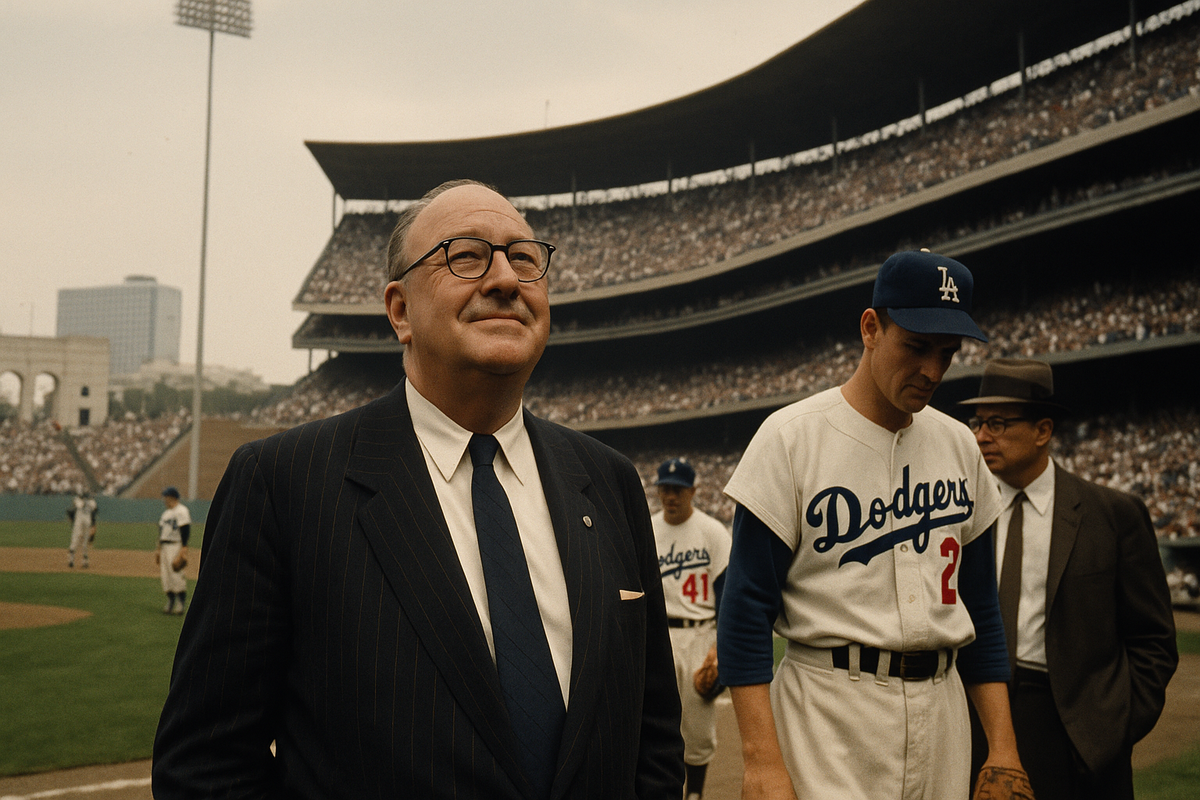
The Day Baseball Crossed the Continent
Time Magazine Chronicles the Dodgers' 1958 Exodus and the Transformation of American Sports
On April 28, 1958, Time Magazine published what would become one of the most significant sports stories of the twentieth century—not because of a championship or a scandal, but because it documented the moment professional baseball abandoned its eastern roots and gambled everything on the West Coast.
The stakes were existential. No Major League team had ever played west of St. Louis. California was booming—highways unfurling across desert valleys, suburbs sprawling under relentless sun—but it remained untested territory for America's pastime. Walter O'Malley, the Brooklyn Dodgers' owner, made the bet anyway. He uprooted "Dem Bums" from their aging Ebbets Field shrine and transplanted them to Los Angeles, triggering what Brooklyn fans would forever call a betrayal and what Los Angeles would celebrate as coronation.
Time's coverage of the Dodgers' debut season captured this rupture with the precision and swagger that defined the magazine's golden age. This wasn't just sports journalism—it was cultural cartography, mapping America's seismic demographic shift from aging industrial cities to the sunbelt's car-centric sprawl.
Archive Details
Historical Figure: Walter O'Malley, Owner of the Brooklyn/Los Angeles Dodgers
Issue Date: April 28, 1958
Archive Source: Time Magazine
Cultural Context: The Dodgers' inaugural season in Los Angeles and the westward expansion of Major League Baseball
O'Malley: Visionary or Villain?
Time never trafficked in hagiography, and its portrait of O'Malley reflected that editorial sharpness. The magazine dissected him as a businessman who understood what baseball's old guard refused to acknowledge: television and interstate highways had rewritten the rules. The neighborhood ballpark, with its cramped seating and limited parking, belonged to a vanishing America.
O'Malley saw the future, and it looked like the Los Angeles Memorial Coliseum—a vast concrete bowl that could swallow Ebbets Field whole. On opening day, more than 78,000 fans packed the stadium, shattering every previous attendance record in Major League history. The spectacle announced that West Coast baseball wasn't an experiment—it was an inevitability.
Time understood what this meant. The article framed the Dodgers' relocation within the larger story of postwar American transformation: the exodus from dense urban neighborhoods to suburban sprawl, the rise of California as the nation's demographic and cultural center, and the emergence of sports as big business rather than civic pastime.
Two Stadiums, Two Americas
The magazine's contrast between Ebbets Field and the Coliseum became a metaphor for the chasm between old and new America. Ebbets Field sat embedded in Brooklyn's urban fabric—intimate, aging, inseparable from the rowhouses and corner bars that surrounded it. Fans walked to games. They knew the vendors by name. The ballpark was neighborhood infrastructure.
The Coliseum represented something else entirely: a monument to automotive culture and mass entertainment. Fans drove from across the sprawling Los Angeles basin, parking in vast lots before filing into a stadium built for Olympic spectacle, not baseball intimacy. The geometry was all wrong—a left field fence so close it required a towering screen, dimensions that made purists wince. But the capacity was undeniable, and in the television age, capacity meant revenue.
Time recognized this wasn't simply about baseball. It was about which version of American life would prevail: the dense, pedestrian urbanism of the East or the horizontal, car-dependent landscape of the West. By 1958, the outcome was already clear. The Dodgers were just catching up.
Key Themes in Time's Coverage
Opening Day Spectacle
More than 78,000 fans packed the Coliseum, proving Los Angeles could support big-league baseball and setting an attendance record that announced the West Coast's arrival.
O'Malley's Vision
Time emphasized O'Malley's role as the mastermind of the move, portraying him as shrewd but ruthless—a businessman who understood the future of sports.
Cultural Divide
The piece contrasted Brooklyn's intimate, tradition-bound fandom with California's new, mass-market enthusiasm—two different visions of American community.
Symbol of Change
The Dodgers' move west was portrayed as part of a larger national migration from East to West, old to new, neighborhood to suburb.
The Legacy: When Sports Became Business
What Time documented in 1958 established the template for modern professional sports. Teams would follow markets, not traditions. Stadiums would be built or abandoned based on revenue projections, not community bonds. Television contracts would dictate scheduling and expansion.
O'Malley didn't invent this model, but his audacious cross-country relocation proved it worked. Within five years, other teams followed the Dodgers west. Within two decades, expansion franchises dotted the map, chasing population growth and television markets. The neighborhood baseball team became a corporate asset, loyalty a commodity to be leveraged or discarded.
The April 28, 1958 issue of Time preserves the exact moment this transformation became irreversible—when Walter O'Malley proved you could abandon a fanbase, cross a continent, and build something bigger on the other side.
A Window Into Postwar America
Beyond baseball, this magazine offers insight into how Americans understood their changing nation in 1958. Time's coverage reflected and shaped middle-class perspectives during a period of unprecedented transformation. The magazine's analysis of the Dodgers' move west revealed anxieties about urbanization, optimism about western expansion, and acceptance that modern life meant leaving old certainties behind.
Reading this issue today means encountering American self-understanding at a pivotal moment—when the country was reinventing itself but still close enough to the old order to feel the loss.
Why This Issue Commands Premium Value
Historical Precision
This issue appeared during the Dodgers' inaugural weeks in Los Angeles, capturing real-time reactions rather than retrospective analysis. Time's reporters were documenting history as it unfolded, giving the coverage an immediacy later accounts could never replicate.
Dual Market Appeal
Brooklyn nostalgia remains potent—the borough never forgave O'Malley, and that wounded pride keeps this issue in demand among East Coast collectors. Simultaneously, Los Angeles fans and California historians prize it as validation of their city's arrival as a major-league metropolis.
Cultural Breadth
Sports collectors want it for the baseball milestone. Cultural historians want it for the migration narrative. Media scholars want it for Time's editorial approach during its most influential period. This cross-market demand creates pricing resilience.
Scarcity Factor
Well-preserved copies of 1950s Time magazines grow scarcer each year. Issues tied to watershed moments command premiums, and few moments reshaped American sports geography like the Dodgers' westward journey.
Add This Historic Issue to Your Collection
Whether you collect sports memorabilia, study postwar American culture, or simply appreciate landmark journalism, the April 28, 1958 issue belongs in your archive. It's not reading material—it's testimony from the day baseball became continental, and America became something new.
Browse Time Magazine Collection