
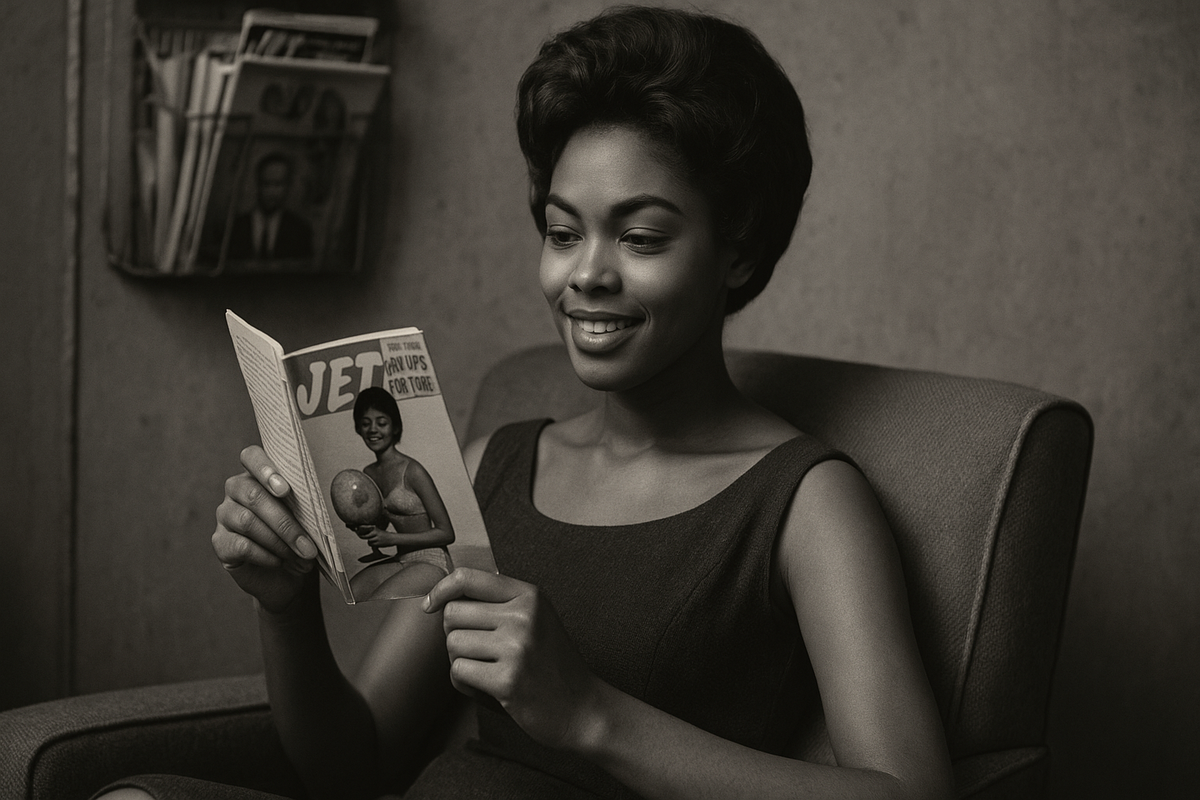
When Beauty Became Protest: Inside Jet Magazine's Revolutionary Pin-Ups of 1963
How twelve young Black women claimed visibility in America's most turbulent year
On January 10, 1963, Kaaron Sidney stood on a magazine cover holding a globe. She wore a plaid bikini. She smiled directly at the camera. And for thousands of African American readers picking up that week's issue of Jet Magazine, her image carried a weight far beyond swimwear or sunshine.
This was six months before Birmingham. Four months before Medgar Evers would be murdered in his driveway. Eight months before the March on Washington. In January 1963, the Civil Rights Movement was building toward its most dramatic confrontations, and Jet Magazine—pocket-sized, ubiquitous, unapologetic—was waging a quieter war on a different front.
The battlefield was representation itself.
The Magazine That Refused to Wait
Jet didn't ask permission. Founded in 1951 by John H. Johnson, it had spent a decade perfecting a formula that mainstream publishers considered impossible: a weekly digest that treated Black life as inherently newsworthy. Not as tragedy. Not as problem. As life.
By 1963, Jet had become essential infrastructure in Black America. Barbershops stacked it next to their combs. Beauty salons kept back issues in milk crates. Church ladies passed it down the pews. Its compact format—designed to fit in a pocket or purse—made it portable, shareable, subversive in its accessibility.
The January 10 issue exemplified Jet's refusal to choose between politics and culture. Inside this single publication, readers found coverage of civil rights legislation, economic disparity, and voter registration drives. They also found Jet's annual tradition: the Pin-Ups for 1963, a twelve-month calendar showcasing young Black women from across the country.
To call this merely "cheesecake" would be to miss the point entirely.
Issue Intelligence
Publication: Jet Magazine
Issue Date: January 10, 1963
Cover Feature: Kaaron Sidney, Chicago Teachers College student
Historical Context: Published six months before Birmingham Campaign, eight months before March on Washington
Archive Source: Original 20th Century Magazine Collection
What a Pin-Up Meant in 1963
Consider the landscape. In January 1963, mainstream American media operated under an unspoken apartheid. Life Magazine featured white families. Vogue photographed white models. Hollywood exported white beauty standards to the world. When Black women appeared at all, they were maids, mammies, or musicians—never the aspirational center of the frame.
Jet's pin-ups didn't argue with this erasure. They simply acted as if it didn't exist.
Kaaron Sidney, the October girl featured on the cover, was a student at Chicago Teachers College. Inside, eleven other women represented eleven other months:
Carolyn Davis (January) worked as a photographer's assistant in New York and skied in her spare time.
Mildred Harris (February), a New Jersey model, painted.
Cecelia Cooper (March) had been crowned "Miss Cannes Film Festival of 1960"—international glamour claimed by a Black woman.
Janet Foucher (April), a part-time model in Chicago, loved music.
Mayra Reyes (May), "Miss Nutley 1961" from New Jersey, was also a photographer.
Betty Ellis (June) represented Toledo, Ohio as a beauty queen.
Jackie Simmons (July) studied in New York City.
Yolanda Griffith (August), eighteen years old, listened to classical music.
Nikki Cadenhead (September) worked as a secretary while pursuing her ambition to become a certified public accountant.
Lauri Douglass (November) held a business role at New York Telephone Company.
Dee Simmons (December) had won "Miss Press Queen of 1962."
These weren't Hollywood stars. They were readers' neighbors, sisters, daughters. Students with textbooks. Secretaries with ambitions. Models with hobbies. The descriptions emphasized not just their appearance but their dimensionality—the skiing, the painting, the classical music, the CPA dreams.
This was radical. In an America that reduced Black women to domestic labor or hypersexualized caricature, Jet presented them as complex, aspirational, worthy of admiration on their own terms.
The Politics of Looking
There's a reason Jet published this calendar in the same issues that covered lynchings and lunch counter sit-ins. The magazine understood what its readers understood: that the fight for civil rights was also a fight for the right to be seen as fully human.
Beauty has never been apolitical. When a society decides who is beautiful, it decides who matters. In 1963, American beauty standards were codified in film, fashion, and advertising as exclusively white. To publish twelve Black women in swimsuits and evening gowns—smiling, confident, occupying space without apology—was to assert a counter-narrative.
This wasn't objectification wearing the mask of empowerment. The pin-ups included biographical details that grounded each woman in achievement and ambition. They weren't passive objects of the gaze; they were active participants in their own presentation. The images said: We are here. We are beautiful. We are going places. Watch us.
For Black women in 1963—navigating a world that told them daily they were invisible or inferior—these pages offered something rare: affirmation without apology.
For Black men, the calendar provided images of pride rather than degradation.
For white America, should it happen to glance at a copy, the message was simpler: You don't get to decide anymore.
The Cover as Manifesto
Kaaron Sidney's cover image deserves particular attention. Against a green-and-white background, she holds a globe—an object heavy with symbolism. The world in her hands. The world as her stage. She wears a plaid bikini, yes, but her expression carries no coyness, no invitation to diminish her. She looks directly out, meeting the viewer's eyes with confidence.
This wasn't the first time Jet had featured pin-ups, but the timing of the January 1963 issue gave it particular resonance. Within weeks, the nation would watch police dogs attack children in Birmingham. Within months, the world would hear "I Have a Dream" echo across the National Mall. The pin-ups existed in the same historical moment as the violence and the marches—not as distraction from them, but as part of the same struggle.
Cultural representation and political liberation have always moved together. You cannot march for the right to sit at a lunch counter if you've internalized the belief that you don't deserve to be seen. Jet's pin-ups were part of building that internal architecture of dignity.
Deep Dive: Cultural Significance
Representation as Resistance
At a time when mainstream media excluded African American women from images of glamour, Jet placed them front and center—claiming cultural territory that had been systematically denied.
Diversity of Achievement
The calendar highlighted students, professionals, and artists, showing that beauty and ambition could go hand in hand—countering reductive stereotypes.
A Cultural Tradition
Jet's annual pin-ups became a beloved feature, eagerly anticipated by readers each January and forming part of the magazine's identity.
Intersection of Culture and Politics
By featuring young women during the same years the Civil Rights Movement was reshaping the nation, Jet emphasized that cultural pride was inseparable from political progress.
Everyday Role Models
Unlike Hollywood celebrities, Jet's pin-ups were often everyday women—accessible role models for readers across the country who could see themselves reflected.
Material Culture
The magazine's pocket-sized format made it uniquely portable and shareable, allowing these images to circulate through barbershops, beauty salons, and living rooms nationwide.
Why This Issue Endures
Historical Proximity
Published months before the watershed events of Birmingham and the March on Washington, it captures Black cultural life on the threshold of transformation. The issue documents not just what people were fighting against, but what they were fighting for—dignity, visibility, joy.
Iconic Imagery
Kaaron Sidney's cover remains one of Jet's most recognizable from the early 1960s. The image has been reproduced in documentaries, exhibitions, and academic studies of Black media history.
Cultural Testimony
The pin-ups represent an essential chapter in the long struggle for media representation. They are primary sources for understanding how African Americans constructed self-image during the civil rights era.
Collector Demand
Jet's pin-up issues command premium prices in the vintage magazine market. They appeal to collectors of civil rights history, students of mid-century fashion and photography, and those interested in Black cultural studies.
Material Scarcity
Despite Jet's wide circulation, relatively few issues survive in good condition. The magazine's pocket size and newsprint quality made it ephemeral by design. Copies that remain intact after sixty years are increasingly rare.
Academic Value
Universities, museums, and research institutions actively seek vintage Jet issues for their archives. This issue in particular serves as primary source material for civil rights scholarship and media studies.
The Artifact as Archive
Vintage magazines occupy a unique space in historical preservation. Unlike newspapers—designed to be read and discarded—magazines were kept. Unlike books—too formal for some households—magazines were accessible. They accumulated on coffee tables, in bedroom drawers, in church basements.
Jet magazines, in particular, served as informal archives of Black life in the twentieth century. Families saved issues that featured their cities, their churches, their relatives. Barbershops kept years of back issues. These publications documented the full spectrum of African American experience as it unfolded—not retrospectively sanitized, but captured in real time with all its complexity, joy, struggle, and style.
The January 10, 1963 issue is more than a collectible. It's a window into how a community saw itself, celebrated itself, and asserted its right to visibility in an America that preferred to look away.
For Collectors and Historians
Thousands of original Jet magazines from the 1950s through the 1970s remain available to collectors, researchers, and enthusiasts. These publications trace decades of African American culture, politics, and media representation as they were documented week by week.
Whether you're a seasoned collector, a cultural historian, or someone preserving family history, these magazines provide something increasingly rare: the chance to hold history as it was first reported to the people who lived it.
Browse Jet Magazine CollectionEpilogue: What Endures
The twelve women featured in Jet's 1963 pin-ups are now in their eighties, if they're still living. Their names—Carolyn, Mildred, Cecelia, Janet, Mayra, Betty, Jackie, Yolanda, Nikki, Kaaron, Lauri, Dee—have largely faded from public memory.
But their images remain. In archives. In private collections. In the hands of researchers who understand that history is built from more than speeches and legislation.
The January 10, 1963 issue of Jet Magazine captured a particular kind of courage: the courage to be visible, to be beautiful, to be ambitious in a country that criminalized all three for Black women. These pin-ups didn't wait for permission. They didn't wait for society to change its mind about who deserved to be celebrated.
They simply appeared on the page, twelve months of Black womanhood asserting its right to exist in full color, full dimension, full humanity.
That's not just history. That's blueprint.