
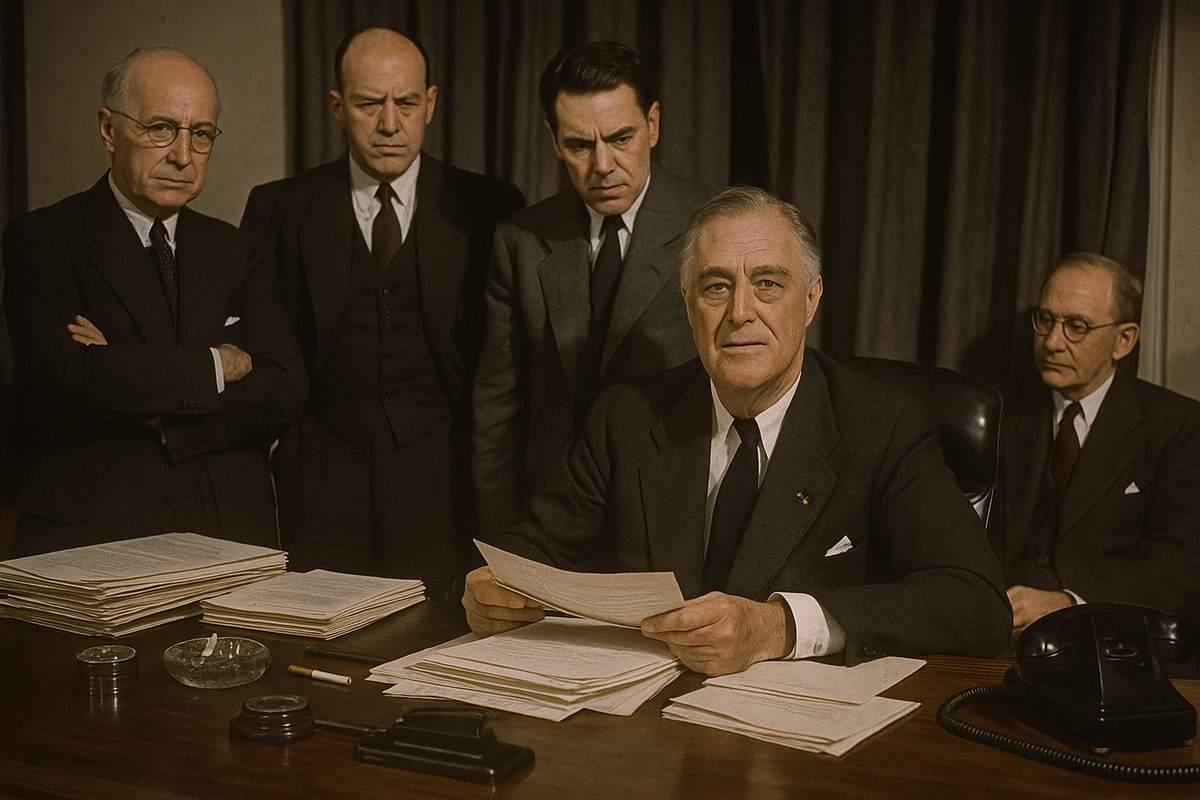
The Day America's Living Room Got a Ringside Seat to the Supreme Court Wars
How Harold Ickes' brutal memoir in the Saturday Evening Post turned the battle for FDR's judicial legacy into must-read entertainment for millions
On a summer morning in 1948, a Philadelphia steelworker, a Kansas schoolteacher, and a Seattle grocer all did the same thing: they opened the July 3rd issue of The Saturday Evening Post and discovered Harold L. Ickes was settling scores.
Not politely. Not cautiously. But with the brass-knuckled honesty of a man who'd spent twelve years watching Franklin Delano Roosevelt bend Washington to his will—and now, three years after FDR's death, had decided the public deserved the unvarnished truth.
This wasn't memoir as nostalgia. It was memoir as indictment, revelation, and warning. And it landed in American homes at a moment when the battles Ickes described—over judicial power, government intervention, and the limits of democracy—were anything but settled.
Historical Archive
Primary Figure: Harold L. Ickes, Secretary of the Interior (1933-1946)
Issue Date: The Saturday Evening Post, July 3, 1948
Series: "My Twelve Years With F.D.R." – Part Five
Cover Artist: John Falter
Archive Source: Original issue from mid-century political memoir collection
A Nation Still Reckoning With Roosevelt
By mid-1948, the United States was rebuilding. The Depression's breadlines were gone. World War II's victory parades had faded into memory. But the architecture Roosevelt built—Social Security, labor protections, regulatory agencies—still stood, and conservatives were sharpening their knives.
FDR had been dead only three years. His presidency wasn't history yet. It was contested ground.
Enter Harold L. Ickes, Roosevelt's Secretary of the Interior and one of the most combative men ever to hold Cabinet rank. Ickes didn't do hagiography. He did truth-telling, and in this fifth installment of "My Twelve Years With F.D.R.," he turned his attention to the most explosive chapter of Roosevelt's presidency: the war to reshape the Supreme Court.
For readers in 1948—many of whom had voted for or against FDR, lived through the New Deal's upheavals, and watched the Court strike down legislation they needed to survive—this wasn't ancient history. It was the story of how their country had been remade, told by a man who'd held the hammer.
The Magazine That Sat on Every Coffee Table in America
The Saturday Evening Post wasn't niche. It was ubiquitous.
At its 1948 peak, the magazine reached millions of subscribers, blending Norman Rockwell covers, serial fiction, humor columns, and hard-hitting political commentary into a formula that appealed to farmers and financiers alike. It was the publication families fought over at the dinner table—kids wanted the comics, mothers browsed recipes and ads, fathers devoured the politics.
Publishing Ickes' memoir wasn't a departure for the Post. It was the magazine doing what it did best: giving Middle America access to power without condescension. The same issue that carried Ickes' account of Supreme Court machinations also featured short stories by Don Waters and Loretta Burrough, ads for Wayne gasoline pumps and Three Daughters deodorant, and John Falter's cover illustration of golfers on a Phoenix course (complete with Eastern trees that had no business in the Arizona desert—a winking reminder that artists, like politicians, reshape reality to suit their vision).
This was the Post's genius: it treated readers as citizens capable of digesting both escapist fiction and constitutional crises, often within the same sitting.
Roosevelt's Court Problem: When Nine Men Block a Presidency
Ickes opened his narrative on familiar ground for Depression-era Americans: the fury of watching the Supreme Court dismantle the New Deal, piece by piece.
Throughout the 1930s, a conservative majority struck down legislation designed to save the economy—farm relief, labor protections, regulatory schemes. To Roosevelt and millions of voters, the Court wasn't interpreting the Constitution. It was strangling democracy.
In 1937, Roosevelt struck back with a plan so audacious it nearly destroyed his presidency: expand the Court from nine justices to fifteen, giving him six new appointments. Opponents called it court-packing. Roosevelt called it reform. The Senate called it dead on arrival.
But Ickes revealed what happened next—the part that mattered more than the plan's defeat. Under intense political pressure, the Court shifted. Justices who had voted against the New Deal began voting for it. Legal scholars would later call it "the switch in time that saved nine." Ickes called it proof that Roosevelt's willingness to fight had changed the game.
And then came the appointments.
The Justices Who Remade American Law
Ickes devoted substantial space to the men Roosevelt placed on the Court, and he didn't shy from complexity:
Hugo Black – An Alabama senator with a past. Rumors of Ku Klux Klan membership haunted his 1937 confirmation, and Ickes didn't sugarcoat the scandal. But he also documented Black's transformation into one of the Court's most passionate defenders of civil liberties, proving that past and principle don't always align neatly.
Felix Frankfurter – An Austrian-born intellectual whose nomination sparked nativist backlash. Ickes portrayed Frankfurter as indispensable yet divisive, a legal mind so sharp it cut allies and enemies alike. His influence on mid-century constitutional thought would prove profound, even when controversial.
Robert H. Jackson – Brilliant, ambitious, and later famous as chief prosecutor at Nuremberg. Ickes hinted at the rivalries that would fracture the Court in later years, particularly Jackson's feud with Black—a conflict that nearly tore the institution apart.
These weren't sanitized portraits. Ickes wrote with the intimacy of a man who'd watched Roosevelt deliberate over these choices, weighing political debts against legal philosophy, regional balance against ideological purity. The article made clear: Roosevelt didn't just want liberals on the Court. He wanted loyalists who would defend the government's power to intervene in American life.
Images of Power
The article came illustrated with photographs that underscored the stakes:
- • Roosevelt aboard a presidential yacht, ringed by advisors and military brass—commander-in-chief as political general.
- • Felix Frankfurter, intense and intellectual, embodying the European-trained legal minds reshaping American jurisprudence.
- • Hugo Black standing beside Chief Justice Charles Evans Hughes, the image capturing the Court's ideological civil war.
- • FDR dining with Jim Farley, his political fixer—a reminder that the Democratic coalition Roosevelt built was fragile, held together by deals and grudges in equal measure.
These weren't stock photos. They were power made visible.
The Magazine That Shaped a Nation
In 1948, television was a novelty. Radio was king. But magazines—especially the Saturday Evening Post—were how Americans understood their country.
The Post didn't just report events. It framed them. It told readers what mattered and why, mixing entertainment with education so skillfully that millions absorbed political analysis without realizing they were being educated. Ickes' memoir gave ordinary citizens access to the corridors of power, demystifying government without dumbing it down.
This was the Post's cultural role: a translator between Washington and Main Street, making democracy comprehensible to the people it was supposed to serve.
Why This Issue Matters to Collectors Today
Historical Weight
Ickes' firsthand account of Supreme Court politics during the New Deal represents primary source material unavailable elsewhere. This isn't a historian's interpretation. It's testimony from the room where it happened.
Cultural Archaeology
The blend of Ickes' political memoir with postwar consumer advertising creates a time capsule of 1948 America. The ads for deodorant and gasoline pumps reveal what Americans bought. The Ickes article reveals what they worried about.
Artistic Merit
While not a Rockwell cover, John Falter's illustration captures the optimism of postwar leisure culture. His playful manipulation of geography echoes the political manipulations Ickes describes inside—both artists and politicians reshape landscapes to serve their visions.
Your Portal to 1948
If you're drawn to moments when America wrestled with its own identity—when the New Deal's legacy hung in the balance, when the Supreme Court's future was uncertain, when political memoirs appeared beside ads for gasoline pumps—the July 3, 1948 issue of The Saturday Evening Post belongs in your collection.
It captures a nation in transition, told through Ickes' unsparing prose, Falter's evocative art, and the advertisements that reveal what Americans valued when the war ended and prosperity returned.
Explore the Complete Archive
These aren't reprints. They're artifacts—the paper, the ink, the voices of a generation that built modern America and argued bitterly over what it should become.
Browse Saturday Evening Post Magazine CollectionCoda: When Magazines Were Battlegrounds
The July 3, 1948 Saturday Evening Post stands as proof that magazines once served as arenas for national self-examination. Ickes' account of Roosevelt's Supreme Court battles did more than inform—it reminded readers that democracy is a contact sport, played by flawed people making consequential decisions under pressure.
Seventy-seven years later, those battles haven't ended. They've just changed venues.
For anyone seeking to understand how FDR's war over the Court shaped the America we inherited—or for collectors who recognize that magazines are historical documents in their own right—this issue offers something rare: a front-row seat to the moment when liberalism fought for survival, told by a man who never learned to pull his punches.