
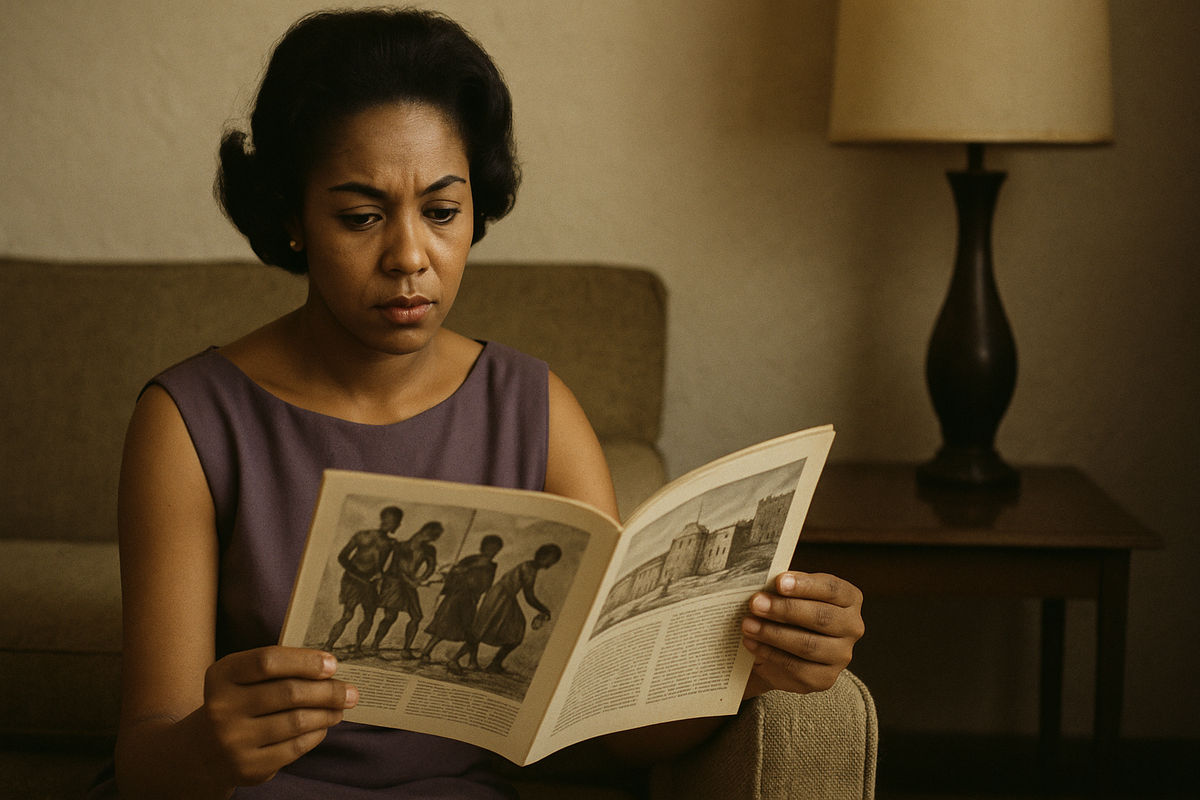
When History Arrived in a Mailbox
The Ebony Issue That Rewrote America's Beginning
August 1619. A Dutch man-of-war dropped anchor off Point Comfort, Virginia. Twenty Africans stepped onto colonial soil—a full year before the Mayflower would deliver its cargo of Pilgrims to Plymouth Rock.
For three centuries, that fact had been buried.
Then, in September 1961, it arrived in American mailboxes wrapped in the face of Sarah Vaughan.
The cover of Ebony Magazine promised jazz elegance. Inside, subscribers found something far more combustible: Lerone Bennett Jr.'s "Before the Mayflower," an essay that detonated the foundation of American mythology. At a moment when Freedom Riders were being beaten in Alabama bus stations and Black students needed armed escorts to enter universities, Bennett handed African Americans a weapon more powerful than any the Civil Rights Movement had yet wielded—an origin story that predated the Pilgrims themselves.
This wasn't activism disguised as history. It was history deployed as a moral reckoning.
The Architecture of Reclamation
Bennett's essay opened with Antony and Isabella, two Africans who arrived on that 1619 ship. Within years, they would have a son, William Tucker—the first recorded African American child born in the English colonies. Not immigrants. Not arrivals. Founders. Bennett repositioned Black Americans from the margins of the national narrative to its opening chapter, a move that carried enormous psychological and political weight in 1961.
The timing was surgical. Southern textbooks still treated slavery as a footnote, a regional economic arrangement that ended tidily with the Emancipation Proclamation. Schools avoided the mathematics of the trade: an estimated 20 million Africans transported across the Middle Passage, another 40 million dead in the machinery of capture, march, and crossing. Bennett called it "the greatest forced migration in recorded history." He didn't flinch from the geometry of suffering—holds on slave ships measured 18 inches high, human beings "packed like rows of books on shelves," branded like livestock, sold in markets whose advertisements Ebony reproduced with chilling clarity.
The essay moved through Christiansborg Castle, Fort St. George, Dixcove Fort—the stone fortresses on Ghana's coast where captives waited in darkness before the Atlantic crossing. Bennett showed readers the physical sites of their ancestors' last moments on African soil. These weren't abstractions. They were coordinates. Places that still existed, that could be visited, that anchored memory in geography.
Then came the counternarrative: resistance. Bennett catalogued the mutinies, the shipboard revolts, the suicides chosen over enslavement. He elevated the Haitian Revolution—not as a sidebar to European history, but as a seismic event that fractured the entire structure of New World slavery. Captain Tomba, Nealee, and dozens of others whose names had been erased were restored to the record. Bennett refused to let his readers inherit only a history of victimization. He gave them a genealogy of defiance.
Historical Data
Publication: Ebony Magazine, September 1961
Featured Essay: "Before the Mayflower" by Lerone Bennett Jr.
Cover Subject: Sarah Vaughan, Jazz Vocalist
Historical Context: Published during the height of the Civil Rights Movement—Freedom Rides, sit-ins, and school integration battles
Key Figures: Antony and Isabella (1619 arrivals), William Tucker (first African American child), Captain Tomba, Nealee
Publisher: John H. Johnson, Johnson Publishing Company
The Economic Verdict
The essay's most devastating passages came when Bennett turned to profit. Liverpool, Bristol, Bordeaux, and the ports of New England had built their prosperity on the triangle trade—rum, sugar, tobacco, cotton, all of it flowing through the bodies of enslaved Africans. Eric Williams's brutal arithmetic appeared in the text: "Every brick in [Liverpool's] infernal town is cemented with an African's blood." Bennett was not making a metaphor. He was presenting an invoice. Western capitalism, he argued, had been capitalized with Black flesh. The factories, the banks, the universities—all had their accounting tied to the trade.
W.E.B. Du Bois appeared in the essay's closing meditation: "For four hundred years Ethiopia stretched forth her hands unto God." Bennett framed African American history not as a story of rescue or charity, but as an epic of endurance and spiritual resilience spanning centuries.
For Black readers in 1961, many of whom had been taught in segregated schools that their history began with bondage, this was an act of restoration. Bennett handed them Rome, Carthage, Timbuktu—civilizations that existed before Europe had cathedrals. He traced a line from African empires through the Middle Passage to the sit-ins happening outside their windows. The message was unmistakable: the fight for freedom was not new. It was ancestral.
The Power of the Platform
Ebony was uniquely positioned to deliver this message. Founded by John H. Johnson in 1945, the magazine had become the most influential Black publication in America by refusing the binary choice between entertainment and enlightenment. A single issue might feature Hollywood celebrities, fashion spreads, investigative journalism on lynching, and scholarly essays on African kingdoms. The magazine addressed its readers as complete human beings—people who wanted to see Lena Horne's latest gown and understand the economic structure of sharecropping.
The September 1961 issue embodied this synthesis. Sarah Vaughan's portrait on the cover radiated joy and sophistication—a Black woman celebrated for artistry, not tragedy. Readers turned the page and found Bennett's essay, illustrated with engravings of chained captives and auction blocks. The juxtaposition was deliberate. Ebony insisted that Black life contained both beauty and struggle, achievement and memory, without contradiction.
In an era when mainstream magazines either ignored Black Americans entirely or reduced them to problems requiring white solutions, Ebony spoke directly to its community with authority and intimacy. It documented Black life as it was lived—not as sociology, but as culture. The "Before the Mayflower" series was among the magazine's most ambitious intellectual projects, later expanded by Bennett into a book that became required reading in Black homes and classrooms across the country.
Essential Themes from the Essay
1619: The True Beginning
Antony and Isabella arrived in Virginia before the Mayflower reached Plymouth. Their son William Tucker became the first African American child, anchoring Black presence at America's founding.
The Mathematics of Horror
20 million Africans transported, 40 million dead. Ship holds 18 inches high. Bodies "packed like rows of books on shelves." Bennett refused sanitized history.
Geography of Captivity
Christiansborg Castle, Fort St. George, Dixcove Fort—the stone fortresses on Ghana's coast where ancestors waited before the Middle Passage. Memory anchored in coordinates.
Resistance as Legacy
Mutinies, revolts, suicides chosen over bondage. The Haitian Revolution as a seismic fracture. Captain Tomba and Nealee restored to the historical record.
The Economic Invoice
Liverpool, Bristol, Bordeaux, New England—all built on the triangle trade. Eric Williams: "Every brick in [Liverpool's] infernal town is cemented with an African's blood."
Ancestral Endurance
W.E.B. Du Bois: "For four hundred years Ethiopia stretched forth her hands unto God." Freedom struggle as centuries-old genealogy, not recent phenomenon.
The Artifact Today
For collectors and historians, the September 1961 issue of Ebony represents a junction point in American cultural history. It captured the Civil Rights Movement at a moment when the intellectual groundwork was being laid for legal and social transformation. Bennett's essay provided historical legitimacy to demands for equality—this was not a request for inclusion in someone else's story, but a claim to co-authorship of the American narrative from its inception.
Historical Milestone
The "Before the Mayflower" series became foundational scholarship, cited in classrooms and courtrooms. Owning the original publication is holding the first articulation of arguments that would reshape American historiography.
Civil Rights Documentation
This issue arrived at the height of the movement's most dangerous and transformative phase. It is both chronicle and participant in the struggle.
Visual Archive
The reproduced slave advertisements, fortress photographs, and ship diagrams create a unique visual record. These were primary sources republished for a mass audience.
Cultural Iconography
Sarah Vaughan's cover, the layout design, the advertisements inside—all reflect Black middle-class life and aspiration at a specific moment. The issue is anthropology and art simultaneously.
Vintage Ebony magazines occupy a category distinct from other collectibles. They are not merely nostalgic objects. They are primary sources, created by and for African Americans, documenting a community's life, thought, and activism when mainstream institutions refused to do so. Each issue is evidence—proof that Black intellectual and cultural life thrived despite systematic exclusion from national narratives.
The Living Collection
Across decades, Ebony chronicled the complete spectrum of Black American experience: the victories of Jackie Robinson and Sidney Poitier, the assassinations of Malcolm X and Martin Luther King Jr., the rise of Motown, the election of the first Black mayors, the debates over Black Power, the emergence of hip-hop. Every issue contained multiple layers—celebrity profiles that were also statements about representation, fashion spreads that were also claims to dignity, business features that were also arguments for economic self-determination.
To collect Ebony is to assemble an alternative archive of the twentieth century, one that centers Black voices and perspectives. It is history written by the people who lived it, published for the community that needed it most.
Explore the Archive
The September 1961 issue—with its explosive historical essay and its portrait of Black excellence—stands as one of Ebony's most significant publications. Whether you are building a research library, preserving family heritage, or collecting the primary documents of American cultural history, vintage Ebony magazines offer something rare: the authentic voice of a community speaking to itself, recording its own story, refusing to be erased.
This is history you can hold. These are the pages that shaped a movement.
Browse Ebony Magazines Collection