
The Typewriter in Larchmont: How Jean Kerr Rewrote Broadway From Her Kitchen Table
When Time Magazine profiled a suburban playwright in 1961, it captured the moment American comedy discovered its most authentic voice
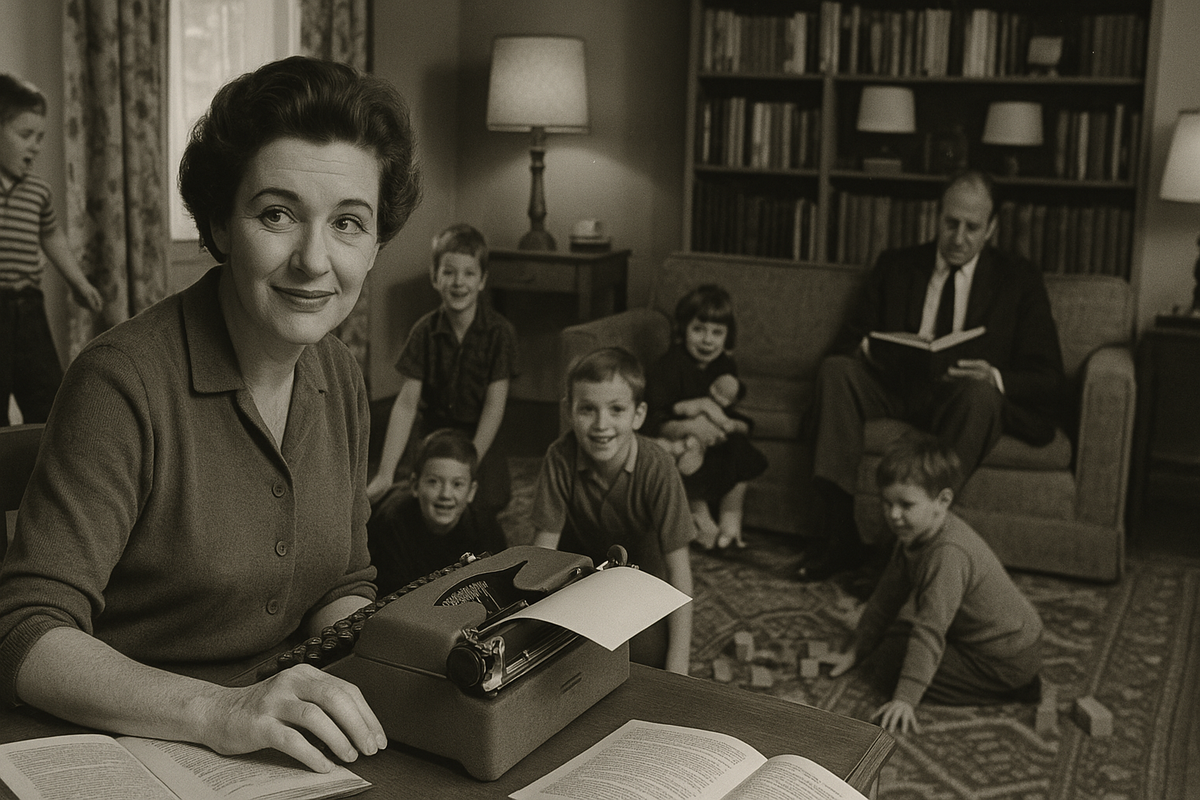
In the spring of 1961, while Washington debated nuclear brinkmanship and Berlin built walls, Time Magazine made an audacious editorial choice: it dedicated prime real estate in its April 14th issue not to Khrushchev or Kennedy, but to a playwright working from a suburban desk surrounded by children's toys.
The subject was Jean Kerr. The play was Mary, Mary. And the story Time told—"Children Run Longer Than Plays"—captured the exact moment American comedy discovered it didn't need Manhattan penthouses or European drawing rooms. It needed Larchmont. It needed chaos. It needed a woman who understood that the sharpest observations about modern marriage came from living it, not studying it.
This wasn't just theater coverage. It was Time recognizing a seismic shift: the American middle class had found its voice, and that voice was funny, female, and typing between carpool runs.
Archive Details
Historical Figure: Jean Kerr, playwright
Issue Date: April 14, 1961
Archive Source: Time Magazine
Feature Title: "Children Run Longer Than Plays"
Broadway's Domestic Revolution
When Mary, Mary opened in March 1961, critics expected another light romantic comedy. What they got was something sharper—a play that turned the rituals of divorced couples, tax accountants, and remarriage anxiety into 1,572 performances, making it one of the longest-running comedies in Broadway history.
Jean Kerr didn't write from theatrical tradition. She wrote from life. Her husband, Walter Kerr, was the New York Herald Tribune's chief drama critic—one of the most powerful voices in American theater, later a Pulitzer Prize winner. Their Larchmont home was a laboratory where suburban domesticity collided with opening-night sophistication. Critics debated plays in the living room. Kids interrupted with homework questions. Jean typed through it all.
Time understood what made this compelling: Kerr had cracked the code of postwar American comedy. Her humor didn't mock domesticity—it celebrated its absurdities with affection. She wrote about educated women navigating marriage, mothers juggling intellect and chaos, suburbanites who read Thurber and dealt with crabgrass. This was the Kennedy-era audience: upwardly mobile, college-educated, living in split-levels, hungry for entertainment that reflected their actual lives.
Male playwrights dominated Broadway. Kerr proved domestic observation could outrun their cynicism at the box office.
Time's Cultural X-Ray
By 1961, Time had mastered a peculiar journalistic art: making readers feel they were witnessing history as it crystallized. The magazine didn't just report Jean Kerr's success—it embedded readers in her world.
The article painted scenes with novelistic precision: Kerr at her typewriter, cigarette burning, children's noise filtering through walls. Walter hosting post-theater dissections with fellow critics. The family navigating the strange duality of suburban normalcy and Broadway glamour. Time's photographers captured it all—the documentary realism of domestic clutter juxtaposed against the sheen of theatrical success.
This wasn't celebrity puff. Time treated Kerr as a cultural indicator, a symbol of how American humor was evolving. The magazine's genius was showing readers that Mary, Mary's wit wasn't manufactured in rehearsal rooms—it was refined at kitchen tables, tested on actual marriages, born from the observation that modern life's most ridiculous moments were also its most universal.
The typography reinforced the message: bold "SHOW BUSINESS" headlines, carefully sequenced photographs turning pages into visual essays. Time wasn't covering entertainment. It was documenting a cultural shift.
What the Issue Reveals
Jean Kerr's Method
Her comedy rooted itself in affection, never cruelty. Marriage was absurd but worth it. Parenthood was chaos but meaningful. Suburbia was banal but rich with material. This optimism distinguished her from the acidic wit dominating male-written comedy.
Walter Kerr's Dual Role
As critic and collaborator, he occupied a fascinating position. Time acknowledged the complexity: he couldn't review his wife's plays, but he shaped the theatrical culture that made her success possible.
The Suburban Sophisticate
Kerr represented a new American archetype: the educated woman who chose domesticity but refused to abandon intellectual ambition. Her plays validated that choice while satirizing its complications.
Broadway as Middle-Class Mirror
Time positioned Mary, Mary as evidence that American theater was finally reflecting its actual audience. Not New York elites. Not European imports. The people buying tickets to Kerr's play recognized themselves onstage—and loved it.
The Endurance of Print
Vintage Time magazines survive as deliberate objects. Families saved them. Libraries archived them. Collectors preserved them. Unlike digital ephemera, these physical artifacts demand space and care—which means each surviving copy represents someone's active choice to value it.
For theater historians, the April 14, 1961 issue isn't documentation—it's evidence. Evidence that Jean Kerr's revolution happened. Evidence that Time recognized it. Evidence that before streaming buried Broadway's cultural centrality, a suburban playwright typing between school runs could reshape American comedy.
The magazine's physicality matters. The paper stock. The advertising for cars and cigarettes. The layout conventions. Together they form a portal back to 1961, when magazines were how Americans understood their culture, and Time was the most trusted interpreter.
Why Collectors Covet This Issue
Historical Inflection Point
It captures Broadway at a creative zenith, profiling a woman playwright ascending to the top of a male-dominated field. Within months, Mary, Mary would break records. This issue documents the moment before that triumph solidified.
Cross-Genre Significance
Theater historians want it for Kerr. Cultural scholars want it for its portrait of early-'60s suburban life. Collectors of women's history want it for its rare mainstream celebration of female creative achievement.
Visual Archive
The photographs preserve details lost to time: how Broadway critics dressed for openings, how successful creative families navigated domestic space, the aesthetic of Larchmont prosperity in the Kennedy years.
Kennedy-Era Optimism Preserved
This issue radiates the confidence of early 1961—America convinced it could master both geopolitics and domestic comedy, that suburban life could produce art, that women could rewrite Broadway rules. Within two years, Kennedy would be dead. This magazine captures the last innocent spring.
Holding this issue means holding a moment when American culture believed in its own promise.
Jean Kerr's Mary, Mary closed in 1964 after 1,572 performances. Walter Kerr won his Pulitzer in 1978. Time Magazine continued chronicling American culture for decades. But the April 14, 1961 issue remains frozen in its particular spring—capturing the moment a playwright from Larchmont proved that the funniest observations about American life came from living it fully, domestically, and with a typewriter always within reach.
For collectors, historians, and anyone who values the theater of everyday life, this issue isn't nostalgia. It's a window into when American comedy discovered its most authentic voice—and Time had the foresight to document it.
The magazine sits in archives and collections now, its pages yellowing but its insights sharp. Jean Kerr's laughter still echoes through these pages. You just have to turn them to hear it.
Where History Lives
Our curated collection includes thousands of original Time magazines spanning the 1920s through the 1970s—decades of politics, arts, science, and cultural transformation preserved in their original form.
Browse Time Magazines CollectionWhether you collect Broadway history, mid-century culture, or simply want to understand how Americans once made sense of their changing world, these magazines offer something irreplaceable: the chance to read history before it knew it was history.