
When the Stones Became the Sound of Revolution
The magazine hit newsstands on January 4, 1969. Readers who picked it up weren't looking for entertainment news—they were searching for proof that someone understood what was happening to the world.
Jon Landau's essay on Beggars Banquet gave them that proof. Across several pages of Rolling Stone, the critic didn't just review an album. He decoded a moment when rock and roll stopped being escapism and became a mirror held up to violence, chaos, and generational rupture.
For collectors today, this issue represents more than vintage journalism. It's the artifact of a transformation—the moment the Rolling Stones stopped being a band and became the soundtrack to insurrection.
Archive Details
Publication: Rolling Stone Magazine
Issue Date: January 4, 1969
Featured Artist: The Rolling Stones
Album Reviewed: Beggars Banquet (1968)
Critic: Jon Landau
Cover Feature: MC5 – "Kick Out the Jams!"
The Year That Demanded a Different Sound
By late 1968, optimism had curdled into rage. Martin Luther King Jr. and Robert F. Kennedy had been assassinated within months of each other. Chicago's streets ran red outside the Democratic National Convention. Paris burned with student revolts. Vietnam had become a wound that wouldn't close.
The Rolling Stones could have stayed in the psychedelic haze of Their Satanic Majesties Request. Instead, they stripped everything back to bone and blues. Beggars Banquet arrived in December 1968 like a fist through glass—raw, deliberate, unadorned.
Where the Beatles' White Album sprawled across genres and moods, the Stones honed a single edge. "Street Fighting Man" wasn't metaphor. "Sympathy for the Devil" wasn't fantasy. These were dispatches from the front lines, and Landau heard them as such.
His essay in Rolling Stone didn't just praise the music. It argued that the Stones had mastered something older and more dangerous than rock: ritual. They'd turned repetition into incantation, riffs into weapons, performances into acts of collective survival.
Photography as Evidence
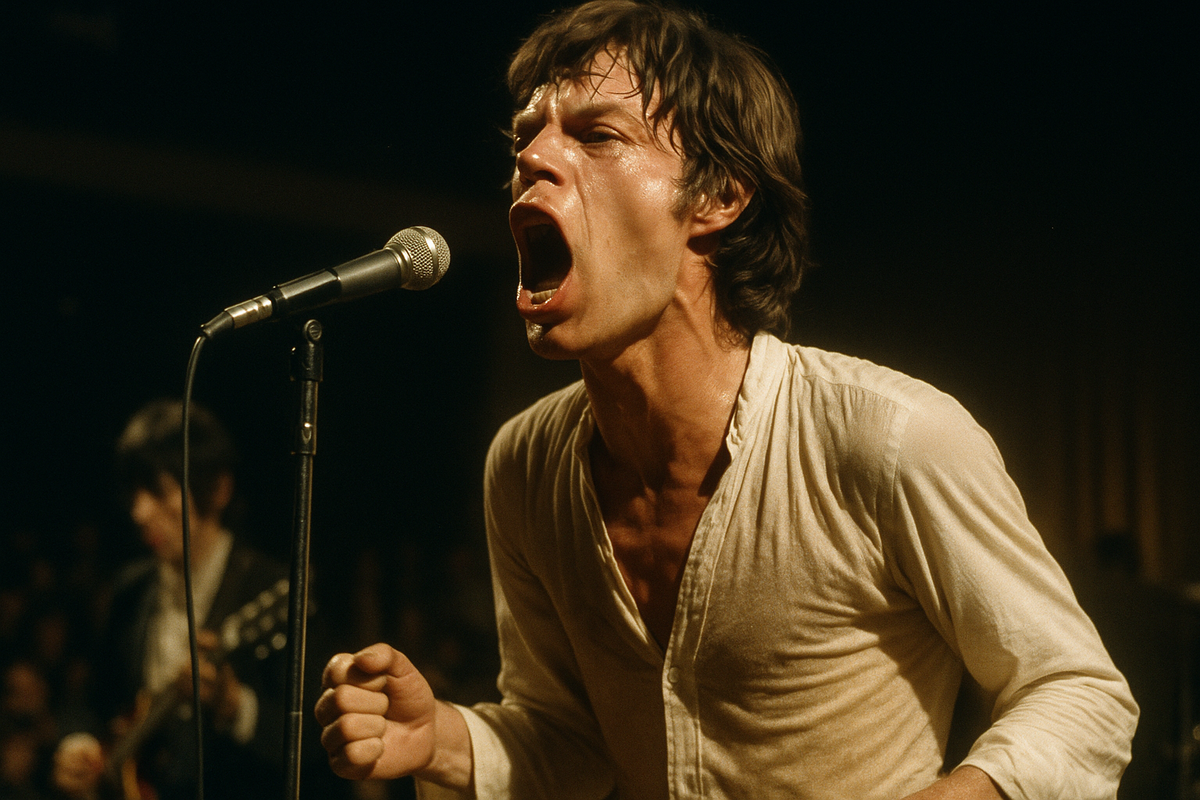
The issue opens with a full-page image on page 10: Mick Jagger mid-scream, shirt soaked, face contorted, body straining against the microphone. This isn't a rock star posing. This is a preacher at the pulpit, channeling something larger and more violent than himself.
Pages 11 through 13 continue the visual testimony. Jagger points into the crowd like a revolutionary issuing orders. Brian Jones, Keith Richards, Charlie Watts, and Bill Wyman appear in stark close-ups—each face carrying the gravity of the moment. Then, unexpectedly: Watts backstage with a coffee cup, exhausted, human. The contrast is deliberate. Even gods need rest between exorcisms.
The black-and-white photography doesn't glamorize. It testifies. These images function as proof that the Stones weren't manufacturing danger for album sales—they were conduits for something already in the air.
Landau's Argument: Violence as Ritual
The essay's core insight remains radical: the Stones didn't create the violence of 1968, but they gave it form. They turned chaos into structure, rage into rhythm, despair into something you could move to.
Landau framed Beggars Banquet as ritualistic simplicity. The band abandoned studio tricks and returned to primal repetition—the kind of musical structure that tribes have used for centuries to process trauma, war, and death. Jagger's role shifted from entertainer to shaman. The band became a collective force channeling what audiences couldn't articulate themselves.
This wasn't the Beatles' experimental optimism. This was endurance. This was staring into the abyss and refusing to blink.
The Stones understood what 1968 demanded: not complexity, but intensity. Not innovation, but confrontation. Songs that could be chanted in the streets. Riffs that felt inevitable, inescapable, true.
The Stones vs. The Beatles: Two Paths Through Chaos
The contrast matters. The Beatles released the White Album weeks before Beggars Banquet, and both bands were reckoning with the same fractured world. But their responses diverged completely.
The Beatles sprawled—30 tracks ranging from music hall pastiche to avant-garde noise, each member pulling in different directions. The White Album reflected fragmentation.
The Stones compressed. They found one sound, one tone, one posture and drove it home with relentless focus. Beggars Banquet reflected unity forged through stripped-down ferocity.
Landau recognized this distinction. His essay positioned the Stones as the band willing to look directly at violence without flinching, without softening it with experimentation or irony. That made them more dangerous. It also made them essential.
Why Early Rolling Stone Issues Matter
Publications like this one didn't just document the counterculture—they constructed it. Through the combination of longform criticism, concert photography, and political framing, Rolling Stone created the interpretive framework that still shapes how we understand 1960s rock.
Other outlets treated music as entertainment. Rolling Stone treated it as history unfolding in real time. That editorial strategy transformed musicians into symbols and albums into manifestos.
Early issues featuring the Stones, Dylan, Hendrix, or Joplin remain reference points because they show rock journalism becoming a form of cultural commentary with its own authority and agenda. The magazine wasn't neutral. It was an actor in the story it covered.
Why This Issue Became Essential
Cultural Timing
Published immediately after Beggars Banquet's release, it captures the Stones at the precise moment they fused with the political upheaval of the era. They weren't commenting on revolution—they were accused of soundtracking it.
Critical Evolution
Landau's essay represents early rock criticism treating albums as cultural history rather than consumer products. This approach would define how generations understood the relationship between music and social change.
Visual Iconography
The full-page Jagger photograph and intimate band portraits have become canonical images of late-1960s rock—the visual language that shaped how we remember that era's danger and urgency.
Historical Resonance
The issue documents the moment when rock journalism itself became part of the counterculture it covered. Rolling Stone wasn't reporting from outside the movement. It was inside, shaping the narrative in real time.
The Artifact of Revolution
The January 4, 1969 issue stands as one of Rolling Stone's most significant early statements—a convergence of critical insight, visual power, and historical moment. For collectors, this magazine represents a direct line to 1969—the year when rock stopped being background music and became the sound of a world coming apart at the seams.
Browse Rolling Stone Magazine CollectionWhether you're pursuing the Stones' cultural legacy, studying the evolution of music journalism, or building a collection of 20th-century counterculture artifacts, these magazines offer something more valuable than retrospective analysis: they offer presence.