
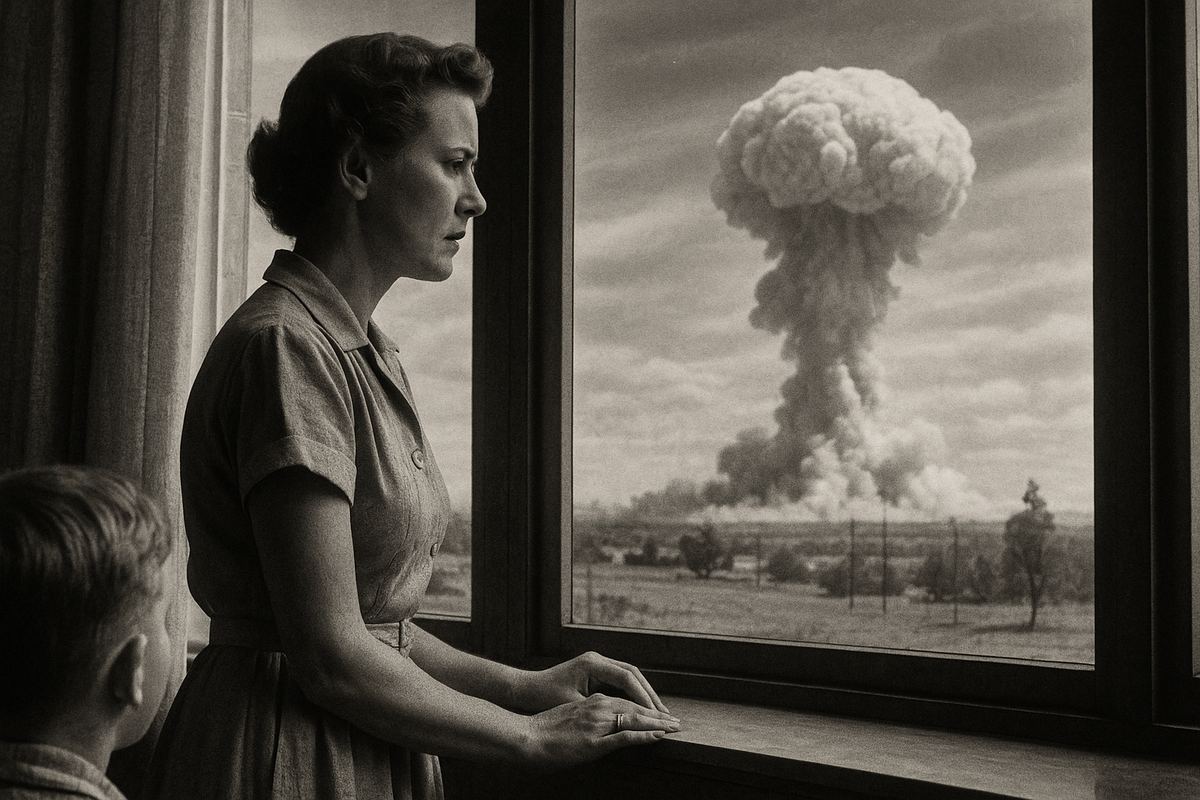
When a Women's Magazine Stared Down Armageddon
Dorothy Thompson's July 1953 meditation on nuclear deterrence in Ladies' Home Journal—and how ordinary Americans confronted the end of the world between recipes and soap ads
In July 1953, American housewives opened their mailboxes to find something unusual tucked between recipes for aspic salad and advertisements for Cashmere Bouquet Soap: a clear-eyed meditation on nuclear annihilation.
Dorothy Thompson's "Can the Cold War Be Ended?" appeared in Ladies' Home Journal that month—not in Foreign Affairs or The Atlantic, but in a magazine read over morning coffee by millions of women managing households under the shadow of the hydrogen bomb. The placement was no accident. Thompson understood that the mothers raising children in the Atomic Age were not bystanders to geopolitics. They were its front line.
The timing made the article incendiary. Stalin had died in March. The Korean War armistice would be signed weeks after the issue hit newsstands. For a brief, disorienting moment, the world wondered if the Cold War's death grip might loosen—or if the Soviet Union's uncertain leadership would lurch toward catastrophe. Thompson wrote into that silence, and she did not offer comfort.
Archive Details
Historical Figure: Dorothy Thompson, Journalist
Issue Date: July 1953
Archive Source: Ladies' Home Journal
Featured Article: "Can the Cold War Be Ended?"
The Architecture of Fear
Thompson's central argument was surgical: nuclear war had made itself obsolete. Not because humanity had evolved beyond violence, but because the weapons themselves had created a paradox. Both superpowers now possessed arsenals capable of ending civilization, which meant neither could use them without guaranteeing mutual extinction. Peace, such as it was, rested entirely on this balance of terror.
She called it what it was—a psychological cage. The bombs would likely never fall, but their presence alone was warping the national psyche. Thompson documented the toll: rising rates of mental illness, a pervasive despair that no government propaganda could fully suppress, the creeping sense that ordinary life was a charade performed atop a trapdoor.
Her prose did not flinch. She described a future war that would not merely kill soldiers but unravel governments, collapse food systems, and leave survivors in anarchic ruin. The hydrogen bomb had not just raised the stakes of conflict—it had erased the distinction between battlefield and home. Every city was now a potential front line. Every civilian, a target.
Why Ladies' Home Journal Mattered
The magazine's format gave Thompson's argument an unsettling intimacy. Readers encountered nuclear strategy after flipping past Tampax ads and household tips—a jarring adjacency that underscored her point. The Cold War was not an abstraction debated in Washington. It was a presence in every kitchen, every school drop-off, every moment a mother looked at her children and imagined the world they might not inherit.
Ladies' Home Journal had built its reputation on understanding women's lives with uncommon seriousness. In 1953, that meant acknowledging what government officials often would not: that the women managing America's households were also managing existential dread. They were planning meals and contemplating vaporization. They were teaching children to read and wondering if those children would live to adulthood.
Thompson did not condescend. She wrote as if her readers were capable of grasping the stakes—because they were. The article translated deterrence theory and geopolitical strategy into language that was rigorous without being obscure, accessible without being simplistic. It treated its audience as participants in the national conversation, not spectators.
The Fragile Calculus of Deterrence
Weapons Built Never to Be Used
Both nations stockpiled bombs not for deployment but for display—a grotesque theater meant to convince the other side that aggression would be suicidal.
Anarchy as the Real Endgame
Thompson warned that nuclear war might not just kill populations but dissolve the structures holding society together, leaving survivors without governance, infrastructure, or hope.
The Human Toll Beyond the Body Count
Radiation and blast zones were measurable. The psychological damage—despair, trauma, the slow erosion of meaning—was not. Thompson insisted both were real.
Stalin's Death as Pivot Point
With the Soviet dictator gone, would his successors seek détente or double down on aggression? The uncertainty itself was destabilizing.
What made Thompson's analysis endure was its refusal of optimism. She did not predict peace. She described a stalemate sustained by fear, a world locked in place by the prospect of its own obliteration. It was not a vision anyone wanted to accept. It was also, disturbingly, accurate.
A Cold War Artifact That Still Speaks
For collectors of mid-century media, the July 1953 Ladies' Home Journal occupies a unique position. It captures a precise historical moment—the interregnum between Stalin's death and Korea's end, when the Cold War's trajectory seemed briefly uncertain. But it also does something rarer: it shows how ordinary Americans metabolized geopolitical terror through the textures of daily life.
Thompson was already a titan of journalism by 1953—one of the few women to command authority in foreign reporting, a writer whose syndicated column reached millions. Her choice to publish this analysis in a women's magazine was deliberate. She was insisting that nuclear policy was not the sole province of military strategists and diplomats. It belonged to anyone raising children in a world that might not see another generation.
The issue itself is a time capsule. The advertisements reveal the consumer culture that coexisted with apocalyptic anxiety. The design and language show how Cold War consciousness seeped into domestic spaces, coloring even mundane rituals with dread. To hold this magazine is to touch the lived experience of the Atomic Age—not as myth or memory, but as it was felt in real time.
The Record of How We Lived
Vintage magazines survive because they preserve something beyond facts. They capture the texture of historical experience—the way major events filtered into private lives, the conversations that unfolded at dinner tables, the slow accumulation of fear that no headline could fully convey.
In an era of instant digital news, these artifacts remind us that history was once absorbed differently: read in quiet moments, discussed with neighbors, internalized over weeks rather than scrolled past in seconds. The July 1953 Ladies' Home Journal is not just a collectible. It is evidence of how millions of people tried to make sense of the unthinkable.
A Cold War Document of Uncommon Power
Historical Timing
Published in the crucial months following Stalin's death and the Korean armistice—capturing a moment when the Cold War's future seemed uncertain.
Dorothy Thompson's Authority
One of America's most influential journalists delivering foreign policy analysis to millions of readers through an unexpected venue.
Domestic Cold War Culture
A rare artifact showing how nuclear anxiety permeated everyday American life—positioned between household ads and family content.
Primary Source Material
The actual magazine as it was read—complete with context, advertisements, and the physical presence that shaped mid-century American consciousness.
For Collectors and Historians
If you study Cold War culture, women's history, or the evolution of American journalism, this issue is essential. Thompson's article is not a curiosity—it is a primary document, a window into how one of the era's sharpest minds grappled with deterrence, fear, and the possibility of peace in a nuclear world.
Browse Ladies' Home Journal Magazine CollectionThe July 1953 Ladies' Home Journal is a document of survival. Not because it offered solutions, but because it refused to look away. Dorothy Thompson gave her readers permission to name their fear, and in doing so, she helped them live with it. That remains the magazine's most radical achievement.