
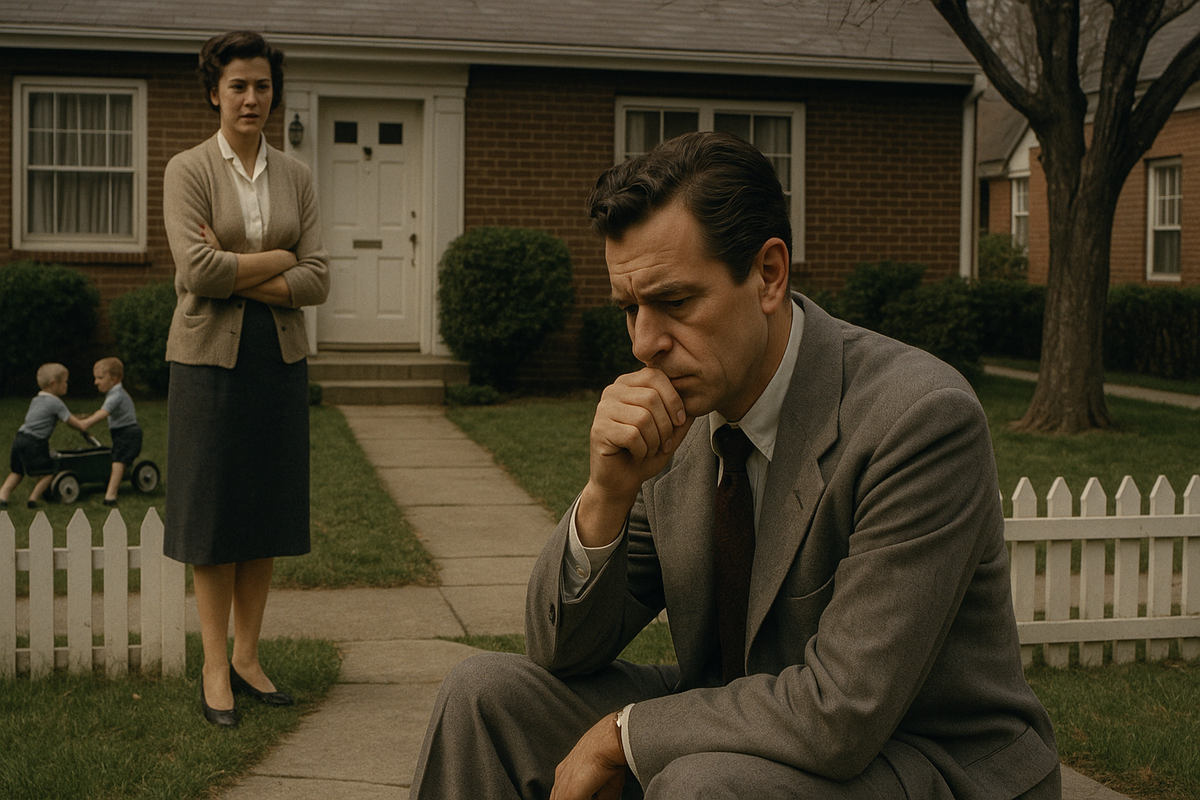
The Moral Reckoning: John Cheever's "The Housebreaker of Shady Hill"
How the April 14, 1956 New Yorker captured America's suburban crisis in fiction, advertisements, and elegant despair
Johnny Hake stood in his neighbor's bedroom, a respectable suburban father turned petty thief, rifling through dresser drawers while his wife and children slept soundly in an identical house three doors down. The year was 1956. America had never looked more prosperous. And John Cheever had never written a more damning portrait of that prosperity's cost.
When The New Yorker published "The Housebreaker of Shady Hill" in its April 14, 1956 issue, readers opened their mailboxes to find something more unsettling than fiction—they found a diagnosis. Cheever had taken the American suburban dream, that gleaming promise of postwar abundance, and cracked it open to reveal the moral vertigo underneath.
This wasn't just another short story in a prestigious magazine. It was a cultural autopsy performed while the patient was still alive.
Archive Details
Historical Figure: John Cheever, "Chekhov of the suburbs"
Issue Date: April 14, 1956
Archive Source: The New Yorker Magazine
Story: "The Housebreaker of Shady Hill"
The Eisenhower Mirage
By 1956, the suburban experiment was in full bloom. Levittown had exported its assembly-line paradise across the nation. The GI Bill had transformed working-class veterans into mortgage-holding homeowners. The baby boom was remaking the American family in real time, and consumer culture offered an unprecedented catalog of desires—all of them purchasable, all of them within reach.
But prosperity breeds its own anxieties.
The same families who'd survived the Depression and won a world war now found themselves adrift in cul-de-sacs, surrounded by appliances they'd once only dreamed of, and haunted by a question nobody dared ask aloud: Is this it?
The Cold War amplified everything. Nuclear drills. McCarthyism. The paranoid sense that enemies lurked not just abroad but next door, perhaps even within oneself. Writers like Cheever, Richard Yates, and John Updike understood that the real battleground wasn't ideological—it was psychological. The war being fought in 1956 was the one between the life you were supposed to want and the life you actually had.
Johnny Hake embodied that war perfectly. Outwardly successful, inwardly corroded. Morally bankrupt while maintaining perfect credit. Cheever didn't need to mention the Cold War directly; his protagonist's theft and self-deception mirrored the era's larger crisis of authenticity.
The Magazine That Mattered
The New Yorker in 1956 occupied a singular position in American cultural life. It wasn't mass-market comfort food like Life or The Saturday Evening Post. It was something rarer: a publication that treated its readers as intelligent adults capable of irony, ambiguity, and sustained attention.
The April 14, 1956 issue exemplified this balance. Alongside Cheever's unflinching suburban portrait, readers found:
Cartoons that skewered modern manners without cheap laughs—wit that required you to think before you smiled.
Poetry that grappled with personal and universal tensions, refusing easy sentiment.
Advertisements that inadvertently documented the era's material religion—Renault automobiles, Sheraton hotels, Bermuda getaways, and bespoke millinery. Each ad whispered the same promise: Buy this, become that.
The magazine's genius lay in this collision. Cheever's story critiqued the very consumer appetites that the surrounding ads stoked. Readers absorbed both simultaneously, creating a cognitive dissonance that was the point. The New Yorker didn't preach. It presented contradictions and trusted its audience to navigate them.
Suburban Elegance, Urban Wit
The cover—a genteel street scene rendered in The New Yorker's signature understated style—captured the magazine's aesthetic philosophy. A woman walks. Children in miniature uniforms play. The illustration suggests order, refinement, a world where everything has its place.
Then you turn the page and meet Johnny Hake.
Cheever wrote with a painter's eye for suburban landscapes: the manicured lawns, the identical station wagons, the carefully tended facades. But his real subject was interior—the guilt that gnawed, the rationalizations that failed, the desperate search for meaning in a life that looked perfect from the street.
"The Housebreaker of Shady Hill" deployed psychological realism as a scalpel. Hake's theft isn't born of poverty but of something more corrosive: the sense that the rules no longer apply, that respectability is performance, that beneath every white picket fence lies the same moral quicksand.
Cheever would later be called the "Chekhov of the suburbs"—a title that captures both his literary precision and his territory. Like Chekhov observing the Russian provinces, Cheever documented a specific American moment when prosperity and emptiness occupied the same address.
What the Story Revealed
The Fragility of Respectability
Johnny Hake proves that middle-class virtue is thinner than anyone wants to admit. One financial setback, one moment of panic, and the entire edifice collapses.
Consumer Culture as Spiritual Void
The advertisements surrounding Cheever's story weren't incidental—they illustrated the problem. When identity becomes purchasing power, what happens when the power fails?
The Suburban Mask
Shady Hill represents every postwar development where appearance trumped authenticity, where conformity promised belonging but delivered isolation.
Cold War Paranoia, Internalized
Hake's self-surveillance and moral panic mirror the era's larger obsession with hidden threats. The enemy wasn't just communism—it was the stranger in your own mirror.
Cheever understood that 1956's crisis wasn't political or economic. It was existential. And he articulated it with prose that was simultaneously elegant and merciless.
The Enduring Architecture
The New Yorker remains influential because it pioneered a form that balanced high and low, serious and satirical, literary and commercial. Each issue functioned as both entertainment and cultural record.
The April 14, 1956 edition perfected this formula. Cheever's fiction provided the intellectual weight. The cartoons offered relief. The advertisements documented desire. Together, they created a composite portrait of American life at a hinge moment—when postwar optimism began curdling into something more complex.
These vintage issues remind us that magazines once served as salons, gathering places for a certain kind of mind. Reading wasn't passive consumption but active engagement. Words and images were studied, debated, savored.
In an era of algorithmic feeds and disposable content, holding a 1956 New Yorker is a radical act: proof that journalism and literature can marry, that commerce and art can coexist, that a magazine can be permanent.
Why Collectors Covet This Issue
The April 14, 1956 New Yorker transcends its magazine status to become a historical document, a literary landmark, and a design artifact simultaneously.
Cheever's Pivotal Work
"The Housebreaker of Shady Hill" remains one of his most anthologized stories. Owning it in its original publication context—surrounded by the ads, cartoons, and cultural detritus of 1956—provides insights no anthology can replicate.
Cultural Archaeology
From the typography to the tobacco ads, every page offers evidence of how mid-century America saw itself and what it desired.
Artistic Integrity
New Yorker covers from this era, illustrated by masters of understated sophistication, are prized by design collectors independent of the magazine's literary content.
Historical Rarity
As fewer vintage issues survive in good condition, first-publication Cheever becomes increasingly scarce. Literary historians and serious collectors recognize this.
Investment Value
Landmark issues from prestigious publications appreciate steadily, particularly when they capture a specific cultural moment as precisely as this one does.
To own this issue is to possess a fragment of the conversation Americans were having with themselves in 1956—about success, morality, and whether the dream they'd achieved was the dream they wanted.
Acquire the Artifact
For collectors of American literary history, vintage magazines, or mid-century cultural ephemera, the April 14, 1956 New Yorker represents a rare convergence: landmark fiction, elegant design, and historical significance.
Browse The New Yorker Magazine CollectionExplore decades of fiction, satire, and art that shaped American intellectual life—each issue a time capsule waiting to be opened.
Conclusion: The Suburban Reckoning
The April 14, 1956 New Yorker endures because Cheever articulated what thousands felt but couldn't name: the suspicion that winning the American Dream might mean losing something essential. His Johnny Hake, stealing from neighbors in the dark, represented every man who'd achieved the prescribed life and found it hollow.
Seven decades later, the issue remains urgent. The suburbs have changed. The anxieties haven't.
This isn't just reading material for collectors. It's evidence—of how we got here, what we wanted, and what we sacrificed to get it. The magazine lies flat in archival sleeves now, but the questions it raised still walk through our identical streets, still knock on our identical doors, still wait for answers we haven't found.