
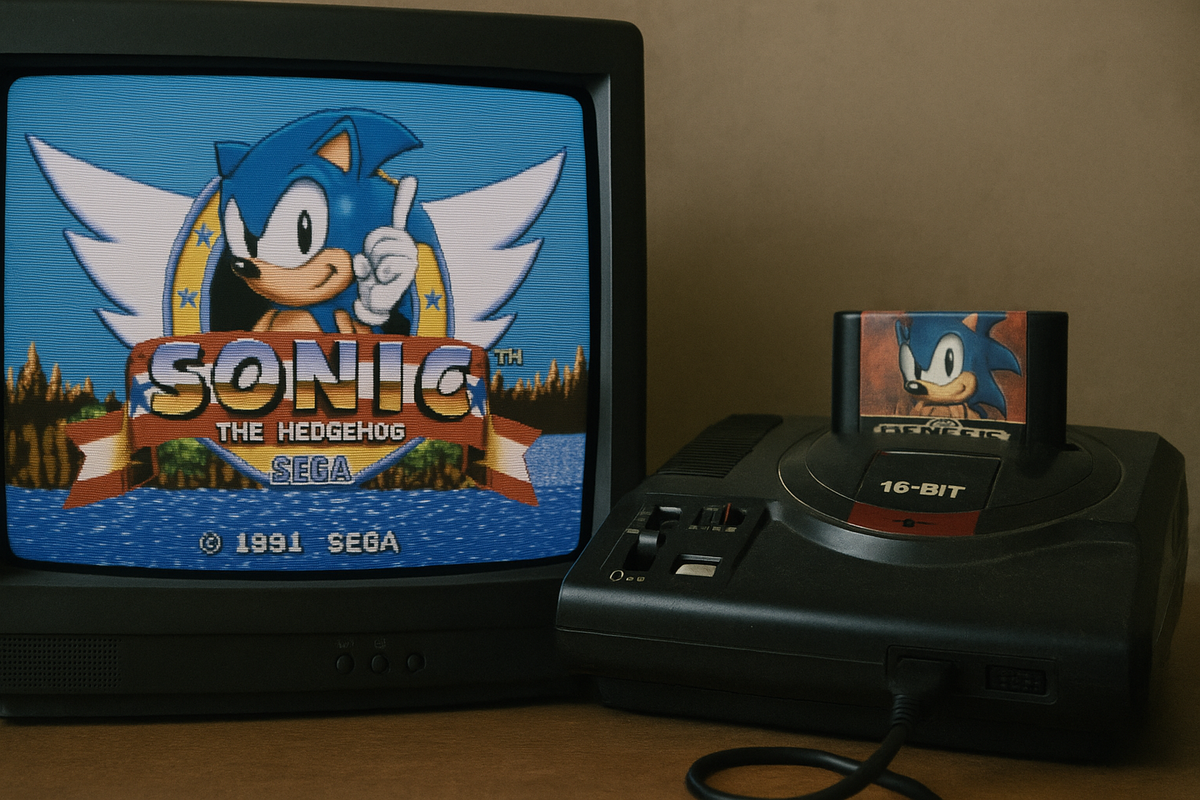
The Day Forbes Declared War on Nintendo's Empire
How a hedgehog became a $4.5 billion weapon in the battle for America's living rooms
On September 2, 1991, a hedgehog made the cover story of American capitalism.
Not literally—but close enough. That week, Forbes Magazine published "The Charge of the Hedgehog," a feature that treated Sonic the Hedgehog not as a cartoon mascot but as a $4.5 billion corporate weapon aimed directly at Nintendo's throat. For readers accustomed to Forbes' coverage of oil barons and Wall Street titans, the message was unmistakable: the video game industry had graduated from toy aisles to boardrooms, and the battle for America's living rooms was now a legitimate business story.
This wasn't fluff. It was Forbes acknowledging that whoever controlled the next generation of home entertainment would command billions in revenue—and that Nintendo's 90% stranglehold on the U.S. market was about to face its first credible threat.
Archive Document
Publication: Forbes Magazine
Issue Date: September 2, 1991
Feature: "The Charge of the Hedgehog"
Key Figure: Hayao Nakayama, President of Sega
Historical Context: The opening salvo of the Console Wars
The Monopoly Nintendo Built
By 1991, Nintendo didn't just dominate the American video game market—it was the market. The company controlled nearly 90% of sales, a level of supremacy rarely achieved outside of utilities and railroads. The Nintendo Entertainment System had single-handedly resurrected an industry left for dead after the 1983 crash, and Nintendo leveraged that rescue into an ironclad grip on developers, retailers, and licensing agreements.
But monopolies breed challengers. Sega arrived with the Genesis, a 16-bit console that made Nintendo's 8-bit NES look antiquated. Faster processors. Sharper graphics. More sophisticated gameplay. Still, hardware alone wouldn't crack Nintendo's fortress. Sega needed something visceral, something that could stand toe-to-toe with Mario in the American imagination.
They built a blue hedgehog with an attitude problem.
Sonic as Strategic Asset
Released in June 1991 and bundled with every Genesis console by summer's end, Sonic the Hedgehog was designed as Nintendo's inverse. Where Mario was wholesome and methodical, Sonic was brash and kinetic. Where Nintendo projected family-friendly safety, Sega broadcast rebellion. The character wasn't just marketing—he was corporate strategy given cartilage and speed lines.
Forbes understood this immediately. The magazine framed Sonic not as children's entertainment but as a case study in how underdogs disrupt entrenched powers. The article dissected Sega's audacious pricing gamble: slashing the Genesis from $190 to $150 while including Sonic for free. In economic terms, Sega was sacrificing short-term margins to capture long-term market share, betting that Christmas 1991 would be the inflection point.
It was a calculated assault, and Forbes treated it as such.
Nakayama's Manifesto
Central to the Forbes feature was Sega President Hayao Nakayama, photographed with the confident smile of a man who'd found Nintendo's weakness. The caption read simply: "Challenging Nintendo's near monopoly." But it was Nakayama's quote that crystallized Sega's positioning: "I don't like the idea of one company monopolizing an industry."
The statement was brilliant corporate messaging—casting Sega not as a competitor but as a liberator, the antitrust crusader in a David-versus-Goliath narrative that American business culture has always romanticized. Forbes bought it, or at least understood its strategic value. The magazine's portrait of Nakayama remains one of the rare Western features to profile Sega's leadership during the console wars, making it a visual artifact as significant as the text itself.
What Forbes Saw Coming
The September 2, 1991 issue proved prescient in ways even its editors may not have anticipated. By documenting the console wars at their inception, Forbes captured several seismic shifts:
The Legitimization of Interactive Entertainment
Video games weren't toys anymore—they were a $4.5 billion industry worth serious financial analysis.
The Birth of Platform Wars
The battle between Sega and Nintendo established a template that would define console competition for decades.
The Power of Mascot Branding
Sonic's success validated character-driven marketing in technology, a strategy later adopted across industries.
The Holiday Retail Apocalypse
Christmas 1991 wasn't just a sales season—it was a referendum on whether monopolies could be broken.
The magazine didn't just report on the console wars. It understood that this was a proxy battle for something larger: who would control the emerging digital entertainment economy.
The Magazine That Saw the Future
Forbes' willingness to cover Sonic versus Mario as serious corporate combat now looks visionary. The video game industry today generates more revenue than film and music combined, and the platform wars that began with Sega and Nintendo continue through Sony, Microsoft, and Nintendo's modern iterations.
But in September 1991, none of that was guaranteed. Forbes took a risk by treating a blue hedgehog as a legitimate business story, and that editorial instinct is precisely what makes this issue essential reading—and essential collecting.
Why This Issue Endures
Historical Precision
Captures the exact moment Sonic entered mainstream American consciousness, documented in real-time by one of the nation's most respected business publications.
Cross-Disciplinary Significance
Sits at the intersection of technology reporting, cultural criticism, and financial analysis—categories that rarely overlapped in early '90s journalism.
Primary Source Authority
This isn't secondary analysis or retrospective hagiography. It's contemporaneous business intelligence from 1991, unfiltered by nostalgia or hindsight.
Artifact Scarcity
Unlike gaming magazines printed in high volumes, Forbes issues from 1991 are comparatively rare in collectible condition. Business magazines were read, recycled, and discarded.
Own the Document That Declared the Console Wars
This isn't memorabilia. It's primary source journalism from the moment the video game industry became too big to ignore, preserved in the pages of America's most influential business magazine.
Browse Forbes Magazine CollectionFrom the Forbes 400 lists to groundbreaking features like "The Charge of the Hedgehog," every issue archives the economic turning points, leadership battles, and cultural transformations that shaped the modern world.
The September 2, 1991 issue of Forbes Magazine remains what it was thirty years ago: proof that even the mightiest monopolies can be challenged, and that sometimes, the most important business stories come wearing sneakers and moving at supersonic speed.