
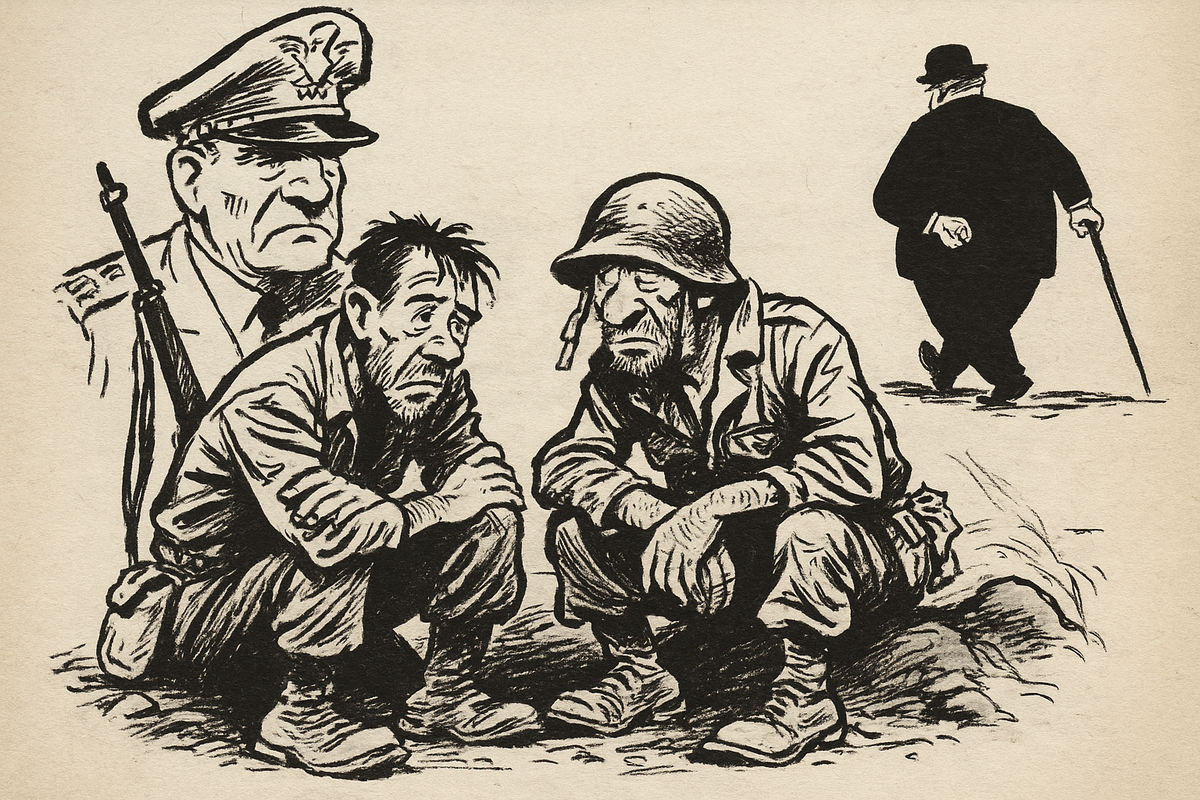
Bill Mauldin, Sharp Lines and Sharper Truths
The Cartoonist Who Sketched America's Conscience
On a sweltering July morning in 1961, Americans unfolded their copies of Time Magazine and found themselves staring at something unexpected: not another politician's carefully managed portrait, not another general pontificating about the Soviet threat, but the weathered, irreverent face of Bill Mauldin—a cartoonist who had spent two decades proving that a pen could wound deeper than any speech.
The date was July 21, 1961. Berlin was fracturing. Khrushchev was rattling sabers. Kennedy's New Frontier promised everything and guaranteed nothing. And here was Time, dedicating serious editorial real estate to a man whose weapon of choice was ink, whose targets were pomposity and power, and whose greatest creation—two mud-caked infantrymen named Willie and Joe—had become the conscience of a generation that survived one war only to stumble into another.
This wasn't nostalgia. This was a reckoning.
Archive Details
Historical Figure: Bill Mauldin
Issue Date: July 21, 1961
Archive Source: Time Magazine
Historical Context: Cold War Era, Berlin Crisis, Nuclear Arms Race
The Return of a Wartime Prophet to a Cold War Stage
By the summer of 1961, the world had traded foxholes for fallout shelters. The anxiety was different but no less suffocating. Kennedy and Khrushchev had just finished their brutal Vienna Summit, where the young American president discovered that charm meant nothing to a Soviet premier who measured strength in megatons. The Berlin Wall would rise within weeks. Nuclear annihilation wasn't a distant abstraction—it was a Tuesday afternoon fear.
Into this powder keg walked Bill Mauldin, already a legend for his World War II cartoons. Willie and Joe—those unshaven, exhausted G.I.s trudging through Italian mud—had captured something the official war correspondents never could: the grinding, unglamorous truth of what it meant to be a soldier when the generals were safely behind the lines and the politicians were safely behind their desks.
But Mauldin hadn't rested on wartime laurels. By 1961, he'd retrained his sights on Cold War bureaucracy, nuclear brinkmanship, and the theatrical absurdity of two superpowers threatening mutual destruction while calling it peace. Time's decision to profile him wasn't simply cultural commentary—it was an acknowledgment that in an age of carefully scripted propaganda, Mauldin's cartoons delivered unscripted truth.
How Time Elevated a Cartoonist to Cultural Referee
Time Magazine never treated illustration as decoration. The July 21, 1961 issue exemplified this editorial philosophy, presenting Mauldin not as a mere sketch artist but as an American voice whose influence rivaled any columnist or correspondent.
The feature traced his evolution with surgical precision: from his early days drawing foxholes in Italy, through his legendary confrontations with General George S. Patton—who threatened to court-martial him for depicting soldiers who looked, God forbid, actually human—to his emergence as the era's sharpest satirist of Cold War folly.
Patton had wanted clean uniforms and military discipline. Mauldin gave him exhausted men with thousand-yard stares. The clash became legend, and Mauldin's refusal to sanitize war for the comfort of brass made him untouchable. By 1961, he'd become what Time recognized as a cultural referee: someone who could skewer Congress, lampoon Soviet bluster, and even puncture Kennedy's soaring rhetoric with equal precision.
Time didn't just reprint his cartoons—it embedded them within historical analysis, showing readers not merely what Mauldin drew but why it mattered. This was editorial journalism as high art: satire and scholarship intertwined, reshaping how Americans understood their leaders and their wars.
The Architecture of Truth: Visual Storytelling in the Cold War
The cover of the July 21, 1961 Time captured the tension of its moment with characteristic design intelligence. Inside, the Mauldin feature stood apart through its deliberate integration of visual and written narrative. This wasn't a cartoon page tacked onto an article—it was a seamless argument constructed from ink drawings and incisive prose.
Where newspapers relegated cartoons to isolated boxes, Time wove Mauldin's artwork into the fabric of its storytelling. Readers absorbed his illustrations alongside historical context, political analysis, and biographical detail. The magazine understood what made Mauldin dangerous and essential: his ability to condense complex geopolitical absurdity into a single image that lingered longer than any editorial.
This approach elevated both the art and the journalism. Facts gained emotional resonance. Satire gained intellectual weight. And readers gained something increasingly rare in 1961—a publication that trusted their intelligence enough to demand they think while they laughed.
"Hit It If It's Big": The Philosophy Behind the Pen
The Time profile distilled several principles that defined Mauldin's approach:
"Hit it if it's big"
His operating philosophy, targeting power, pomposity, and institutions drunk on their own importance. The bigger the target, the harder Mauldin swung.
Willie and Joe's enduring shadow
Even as he shifted from wartime GIs to peacetime politicians, those two weary soldiers remained his moral compass, reminding him that satire must always punch upward, never down.
Vulnerability as strength
The article emphasized Mauldin's fusion of humor and empathy. He never mocked the powerless. His pen reserved its venom for those who wielded authority without accountability.
Cold War double vision
His 1961 cartoons lampooned both Communist leaders and American politicians, exposing the parallel absurdities of two systems locked in mutual assured destruction.
Personal reckoning
Time didn't shy from Mauldin's postwar drift, his struggles to find purpose after the war ended and Willie and Joe were retired. His return to relevance through Cold War satire represented more than professional revival—it was ideological rearmament.
These weren't just techniques. They were a moral framework for using humor as both shield and sword, protection for the vulnerable and weapon against the vain.
The Timeless Edge of Moral Clarity
More than six decades later, Mauldin's work refuses to age. His genius lay in understanding that specific moments could illustrate universal truths. Willie and Joe represented every soldier abandoned by comfortable leadership. His 1961 Cold War cartoons spoke for every citizen trapped between the terror of nuclear war and the theater of political posturing.
Time Magazine recognized that Mauldin's drawings weren't simply illustrations—they were moral signposts, marking the distance between stated ideals and practiced reality. The July 21, 1961 issue endures not as collectible ephemera but as evidence of satire's enduring necessity. When power grows pompous and truth becomes negotiable, someone must still be willing to draw the uncomfortable picture.
Why Collectors Prize the July 21, 1961 Issue
Historical Convergence
Published during one of the Cold War's most precarious summers, it captures the precise moment when postwar confidence curdled into nuclear anxiety.
Cultural Permanence
Bill Mauldin's wartime cartoons remain required study in military history courses. This issue bridges his World War II legacy with his Cold War reinvention, documenting the evolution of America's greatest satirical conscience.
Visual Archaeology
The magazine preserves Mauldin's unmistakable sketches in their original editorial context—not as isolated artifacts but as integral components of political discourse, making this both historical record and artistic showcase.
Market Significance
Issues featuring major cultural figures who straddled both World War II and Cold War eras command sustained collector interest, particularly when the subject's work retains contemporary relevance.
To own this issue is to possess a document of American satire at its apex, when cartoons carried the weight of moral argument and magazines still believed readers could handle complexity.
For the Collector, the Historian, the Student of American Conscience
If you're searching for a tangible connection to the moment when Cold War anxiety met satirical precision, the July 21, 1961 Time Magazine delivers a direct portal into 1961's political tensions, captured as they unfolded.
Explore our complete archive of original Time magazines from the 1920s through the 1980s—an unfiltered journey through American history as it was first reported, before retrospect could soften the edges or revise the narratives.
Browse Time Magazines CollectionA Pen That Still Cuts
The July 21, 1961 Time Magazine stands as one of its era's essential cultural documents. By centering Bill Mauldin, it reminded Americans that truth doesn't always emerge from official channels—sometimes it arrives as a sketch of a weary soldier, a bloated general, or a politician inflated by his own rhetoric.
To hold this issue today is to hold a moment when satire carried moral authority, when cartoons shouldered the burden of conscience, and when a magazine understood that preserving those sketches meant preserving a piece of America's soul.
For anyone who values the intersection of history, humor, and the eternal struggle between power and accountability, this vintage Time isn't reading material. It's testimony—a living voice from the moment when America's mid-century confidence met its mid-century doubts, and a cartoonist armed with nothing but ink reminded the nation what it meant to tell the truth.