
The Woman Who Made Madison Avenue Bow
Inside Vogue's 1972 Portrait of Power: Mary Wells Lawrence and the Revolution That Came Between the Perfume Ads
The readers who opened Vogue on February 15, 1972, weren't expecting a revolution between the perfume ads.
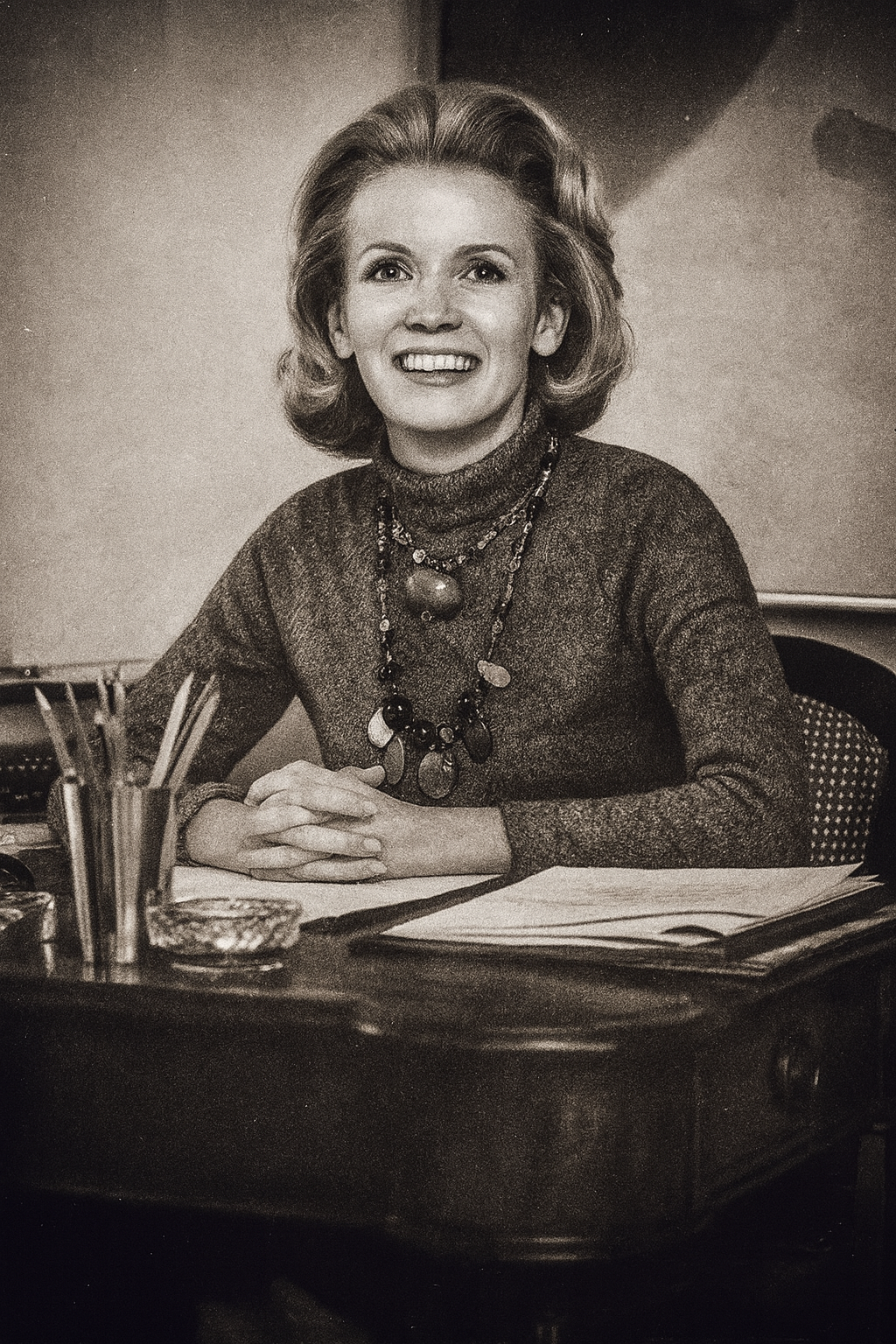
But there she was: Mary Wells Lawrence, cigarette in hand, surrounded by sharpened pencils and advertising mock-ups, staring directly into the camera with the kind of unflinching confidence that made men in corner offices nervous. The headline didn't whisper. It declared: "The Best-Paid Woman in America."
Not the best-paid woman in advertising. Not the best-paid woman executive. The best-paid woman in the entire United States.
For a magazine built on hemlines and haute couture, this was a shot across the bow—a signal that Vogue understood something the rest of America was only beginning to grasp: the future of womanhood wouldn't be won in parlors or protest marches alone. It would be claimed in boardrooms, with contracts, clients, and cold hard cash.
Historical Record
Featured Subject: Mary Wells Lawrence, Advertising Executive
Publication: Vogue Magazine, February 15, 1972
Historical Context: Published during the height of the women's liberation movement, months before the Equal Rights Amendment's ratification battle
Archive Significance: One of the earliest mainstream celebrations of female executive power in American business journalism
The Year Everything Changed
Nineteen seventy-two sat at the hinge of history. The Equal Rights Amendment had just passed Congress in March, though its ratification fight loomed. Women's liberation was no longer fringe—it was front page. But female CEOs? Women commanding six-figure salaries? That was still science fiction to most Americans.
Mary Wells Lawrence made it fact.
At forty, she had already co-founded Wells, Rich, Greene, Inc., an advertising agency that didn't just compete with the Mad Men establishment—it humiliated them. She'd stolen accounts from agencies three times her size. She'd turned product campaigns into cultural moments. And she'd done it while earning more than any other woman in corporate America, a distinction that carried both triumph and isolation in equal measure.
Vogue didn't just profile her. It canonized her.
When Fashion Magazines Became Feminist Manifestos
By 1972, Vogue had evolved beyond runway coverage into something more dangerous: cultural arbiter. Its editors understood that fashion was never just fabric—it was identity, aspiration, power. And power, in the early Seventies, meant money.
The Lawrence feature didn't relegate her to the society pages or frame her success through her husband's achievements. It placed her squarely in the center of the frame: at her desk, at work, wielding influence like a weapon. The photographs weren't glamour shots. They were documentary evidence.
Here was Lawrence reading The New York Times and The Wall Street Journal before dawn. Here she was pitching to clients with celebrity connections—Barbra Streisand, Lucille Ball—bridging Madison Avenue and Hollywood with ease. Here she was commanding meetings, navigating male skepticism, and building an empire one campaign at a time.
The message wasn't subtle: this is what winning looks like.
For women reading at kitchen tables in suburban homes or cramped city apartments, the effect was seismic. Vogue had cracked open a door most didn't know existed. It showed them the mechanics of executive power—the early mornings, the high-stakes negotiations, the unshakable self-possession required to outmaneuver men who'd spent lifetimes assuming the room belonged to them.
The Architecture of Ambition
What made the Vogue feature unforgettable wasn't hagiography—it was specificity.
The profile humanized without softening. Lawrence had humor. She had friendships. She also had an office full of sharpened pencils and a typewriter that didn't care about her gender—only her output.
Vogue framed her beauty not as decoration but as extension: the confidence, the intellect, the control all made visible. This wasn't "having it all" in the future cliché sense. This was taking it all, piece by piece, pitch by pitch.
Why This Issue Became a Collector's Grail
Fifty-three years later, the February 15, 1972 Vogue commands attention in vintage markets not because of nostalgia, but because of rarity—the rarity of witnessing history as it happened, before anyone knew which moments would matter.
It arrived at the exact inflection point: women's liberation reaching critical mass, corporate barriers beginning to fracture, and a major publication choosing to spotlight executive achievement over domestic performance. The issue didn't predict the future. It documented the present while the present was still uncertain.
For collectors, this is a trifecta: cultural significance, historical timing, and Vogue's institutional authority. The magazine that defined style for generations also defined what female success could look like. That intersection—fashion, feminism, commerce, power—makes this issue essential.
It's not ephemera. It's evidence.
The Permanence of Print
Digital archives preserve information. Original magazines preserve experience.
The heft of the paper. The layout decisions. The advertisements that ran alongside the editorial—artifacts of what brands thought women wanted, needed, aspired to become. Every page of this issue carries the texture of 1972: the optimism, the urgency, the sense that rules were rewriting themselves in real time.
Historians mine these issues because they contain what algorithms can't replicate: the unfiltered voice of an era, frozen before revisionism or retrospect could smooth the edges. The February 1972 Vogue doesn't tell you what the women's movement meant—it shows you what it looked like as it unfolded.
That's why collectors preserve them. That's why they matter.
Collector Significance
Where History Lives
If you're drawn to the intersection of culture, commerce, and change—if you want to hold the same pages readers gripped in 1972 when everything felt possible and nothing felt certain—thousands of original Vogue issues spanning the 1930s through the 1970s are available for exploration.
Each one is a time capsule. Each one contains fashion, yes, but also politics, social upheaval, and the slow, hard-won transformation of what it meant to be a woman in America.
Browse Vogue Magazine CollectionThe Last Word
The February 15, 1972 Vogue didn't just profile the best-paid woman in America. It announced that the rules had changed—and that the women rewriting them weren't asking for permission.
Mary Wells Lawrence didn't wait for a seat at the table. She built her own agency, stole the clients, and made Madison Avenue come to her. Vogue recognized what that meant: not an anomaly, but a blueprint.
More than half a century later, this issue remains what it was then—proof that barriers break not in abstractions but in specifics. In salaries. In titles. In women who show up before dawn, sharpen their pencils, and get to work.
The magazine captured that moment before it became history. Now it is history.
And thanks to Vogue's editorial vision, that history hasn't faded. It's still sharp. Still immediate. Still waiting on the page.