
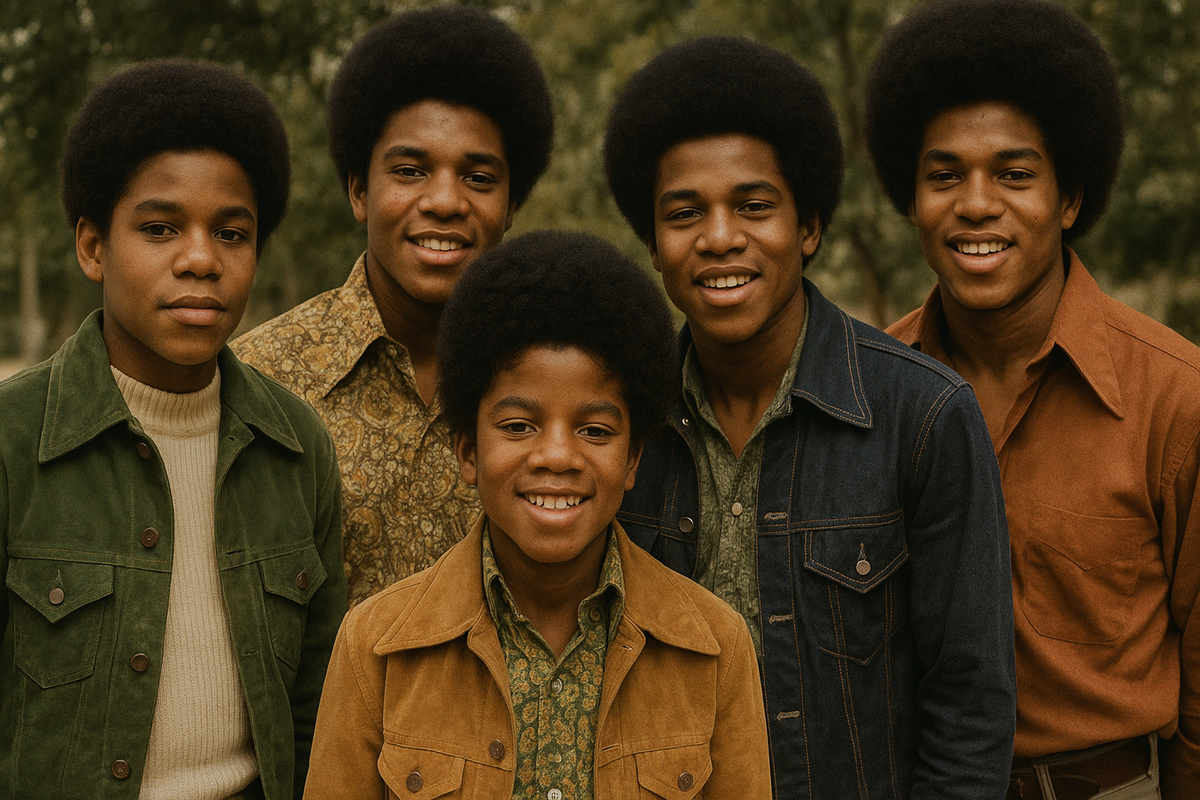
The Moment America Asked: Will Success Spoil the Jackson Five?
How Jet Magazine Captured Black Excellence at Its Peak in August 1970
On August 6, 1970, a question appeared on newsstands across America that nobody had thought to ask about Black child performers before. Not whether they would succeed—but whether success would ruin them.
The cover of Jet Magazine that week showed five brothers from Gary, Indiana, smiling with the confidence of young men who had just conquered the impossible. Michael, Jermaine, Marlon, Tito, and Jackie Jackson weren't just famous. They were a phenomenon that had forced America to reconsider what Black excellence looked like, who it could come from, and how far it could reach.
For the two million readers who slipped that pocket-sized magazine into their purses and jacket pockets, this wasn't entertainment news. This was evidence.
The Weight of 1970
Two years removed from the assassination of Dr. Martin Luther King Jr., Black America stood at a crossroads. The civil rights movement had won legal victories, but the Black Power movement demanded something more—economic control, political representation, and unapologetic pride in Black culture. The streets still smoldered with the memory of urban uprisings. The debate over integration versus self-determination fractured communities and dinner tables alike.
Music became the neutral ground where these tensions dissolved. Motown Records had already proven that Black sound could dominate white airwaves—Diana Ross & The Supremes, The Temptations, and Marvin Gaye had seen to that. But the Jackson Five represented something unprecedented: a family of children whose energy didn't just cross racial boundaries—it erased them entirely.
Their ascent was surgical in its precision. "I Want You Back" hit No. 1 in January 1970, moving three million copies. "ABC" followed in March. "The Love You Save" in May. By the time Jet posed its provocative question, the group had already been crowned America's answer to Beatlemania. But where the Beatles symbolized white youth rebellion, the Jackson Five embodied Black family strength, discipline, and the audacity of children who refused to know their place.
Archive Metadata
Publication: Jet Magazine
Issue Date: August 6, 1970
Featured Artists: The Jackson Five (Michael, Jermaine, Marlon, Tito, Jackie)
Historical Context: Peak of Jackson Five mania; Michael Jackson age 9
Cultural Significance: Documentation of Black music reshaping mainstream American youth culture
Why Jet Held the Story Others Couldn't Tell
By 1970, Jet Magazine had become the connective tissue of Black America. Founded in 1951 by John H. Johnson, it arrived weekly in homes from Harlem to Houston, from Detroit to Delta towns where no other publication spoke directly to Black readers. Its pocket-size format—small enough to fold into a back pocket or handbag—made it the most portable chronicle of Black life in America. Barbers kept stacks by their chairs. Beauty salons displayed them like scripture. Churches left them in vestibules alongside bulletins.
Where Life Magazine might feature the Jackson Five as a novelty and Rolling Stone as a musical curiosity, Jet understood them as a culmination. The August 6 cover presented all five brothers in a casual portrait that radiated both youthful charm and serious intent. The headline—"Will Success Spoil the Jackson Five?"—carried an assumption that white publications rarely made: that Black talent deserved sustained success, and the only question worth asking was whether fame's corrupting influence would diminish what made them special.
Inside, the coverage struck a balance that only Jet could manage. Photographs showed the brothers mobbed by screaming fans at concerts, then pivot to intimate shots of them at home in Gary, still rooted in the community that raised them. The article acknowledged the chaos—girls fainting, security overwhelmed, phone lines jammed—but anchored every observation in family values, church discipline, and community obligation.
This was Jet's genius: refusing to separate Black entertainment from Black humanity.
What Made Them Unstoppable
The statistics alone rewrote the rules. The Jackson Five became Motown's first act to send their first four singles—"I Want You Back," "ABC," "The Love You Save," and "I'll Be There"—straight to No. 1 on the Billboard Hot 100. No artist, Black or white, had achieved that kind of immediate and sustained dominance.
But Jet's coverage dug beneath the chart positions to explain the architecture of their success. Father Joe Jackson, a steel mill crane operator by day, had trained his sons with military precision. Katherine Jackson, their devoutly religious mother, had instilled both musical sensitivity and moral grounding. Despite the screaming crowds and mounting wealth, insiders told Jet the brothers remained "yes-ma'am, yes-sir types"—a detail that reassured Black parents watching their own children navigate a culture that seemed increasingly unmoored from tradition.
The symbolism resonated beyond music. Five boys from Gary—a gritty industrial city where their father worked alongside thousands of other Black men in the steel mills—had proven that talent and discipline could overcome every structural barrier America had constructed. They performed benefit concerts for underprivileged youth in Watts. They appeared at rallies for Gary's first Black mayor, Richard Hatcher, linking their celebrity to political empowerment.
This wasn't just success. This was strategy. This was proof of concept.
Chart Dominance
First four singles reached No. 1 on Billboard Hot 100—unprecedented achievement for any Motown artist.
Gary Roots
Five sons of a steel mill worker conquering the music world symbolized Black working-class triumph.
Family Discipline
Joe and Katherine Jackson's strict training kept the brothers grounded despite global fame.
Community Connection
Benefit concerts in Watts and support for Mayor Hatcher linked success to Black political empowerment.
Why This Issue Matters Now
For collectors today, the August 6, 1970 issue of Jet functions as something rarer than memorabilia—it's a historical artifact that captures multiple revolutions simultaneously.
The timing alone makes it irreplaceable. Michael Jackson was nine years old, years away from "Thriller," decades before "King of Pop" became his inevitable title. This issue freezes him in the moment before the mythology, when he was still a child from Gary whose voice happened to contain magic.
The cultural documentation is equally significant. These photographs—the brothers on stage, at home, in their community—represent one of the earliest visual records of how Black music was reshaping mainstream American youth culture. Not influencing it. Not contributing to it. Reshaping it entirely.
The editorial context matters just as much. This same issue carried headlines about civil rights battles, Black political leadership, and the demographic debates shaping America's future. Jet never treated entertainment as escapism. It positioned Black artistic achievement as inseparable from Black political progress, reflecting the lived reality of readers who celebrated the Jackson Five on Saturday night and organized for fair housing on Sunday morning.
For serious collectors—whether focused on music history, Black media, or 20th-century popular culture—this issue checks every box. It documents a pivotal moment in American entertainment, captures an icon before his transformation, and preserves the voice of a publication that shaped Black consciousness for half a century.
The Archive Speaks
Jet Magazine operated on a principle that seems almost quaint now: that Black life deserved weekly documentation, that Black achievement warranted celebration, and that Black readers needed a publication that refused to separate their joy from their struggle, their artistry from their activism, their entertainment from their history.
The August 6, 1970 issue asking "Will Success Spoil the Jackson Five?" embodies that principle perfectly. It celebrates five talented children while acknowledging the weight they carried. It revels in their chart dominance while anchoring them in family and community. It documents their fame while questioning whether America's machinery of celebrity would destroy what made them remarkable.
Sixty-five years later, we know the answer. Success didn't spoil them—it complicated them, transformed them, and ultimately consumed them in ways that 1970 couldn't predict. But for one summer week, Jet captured them at the moment of pure ascent, when five brothers from Gary proved that Black excellence wasn't just possible—it was inevitable.
For anyone building a collection of vintage magazines, studying Black media history, or preserving the artifacts that shaped American culture, this issue isn't optional. It's foundational.
Collector Significance
Historic Timing
Published at the peak of Jackson Five mania, capturing Michael Jackson at age nine—years before "Thriller" and his transformation into the King of Pop.
Cultural Documentation
Photographs and coverage showing how Black music was reshaping (not just influencing) mainstream American youth culture in 1970.
Editorial Context
Jet's unique approach positioning Black artistic achievement as inseparable from Black political progress and community empowerment.
Collector Demand
Early Michael Jackson features in Jet are among the most sought-after issues by music historians, cultural archivists, and serious collectors.
Build Your Archive
From casual enthusiasts to institutional archivists, these magazines offer something more valuable than nostalgia. They offer evidence. They offer context. They offer the unfiltered voice of a publication that refused to look away from either Black achievement or Black struggle.
Browse Jet Magazine Collection