
The Last Gamble: When The Saturday Evening Post Brought the Bulge Home
Three years after V-E Day, Americans opened their mailboxes to find snow and blood.
The October 2, 1948 issue of The Saturday Evening Post arrived with a painted cover showing a delivery truck splashing rainwater onto Connecticut pedestrians—Stevan Dohanos at his most mundane. But inside, Major General E. N. Harmon was describing how he'd bet thousands of American lives on a single armored thrust through the frozen Ardennes. The dissonance was intentional. This was the Post's editorial doctrine: wrap the century's most savage moments in the language of the living room.
Harmon's article, "We Gambled in the Battle of the Bulge," written with Milton MacKaye, remains one of the most candid command-level accounts published in a mass-market American magazine. No hedging. No sanitized strategy. Just a two-star general admitting that stopping Hitler's final offensive required gambling with men's lives in subzero darkness.
Archive Details
Historical Figure: Major General E. N. Harmon, 2nd Armored Division
Issue Date: October 2, 1948
Article Title: "We Gambled in the Battle of the Bulge"
Cover Artist: Stevan Dohanos
Archive Source: The Saturday Evening Post
Hitler's Final Throw
December 16, 1944. Hitler committed 250,000 troops and over 1,000 tanks to a surprise assault through the Ardennes Forest, aiming to split the Allied armies and seize Antwerp. The shock was total. Bastogne encircled. Entire divisions shattered. Temperatures below freezing turned tanks into crawling iron coffins—three miles per hour through snowdrifts. Supplies froze solid in open fields.
Harmon's 2nd Armored Division moved to the Meuse River, the last defensible line before the Germans could rupture the Allied front. If the Meuse fell, the war might have dragged into 1946. Harmon knew it. His soldiers knew it. And in the Post's pages, he told readers exactly what that knowledge cost.
"Combat Generals Have to Be Gamblers"
Harmon opened his account with this admission, stripping away any illusion of certainty. The Battle of the Bulge was not won by superior firepower or flawless planning—it was won by commanders willing to risk annihilation on risky attacks and relentless counterthrusts.
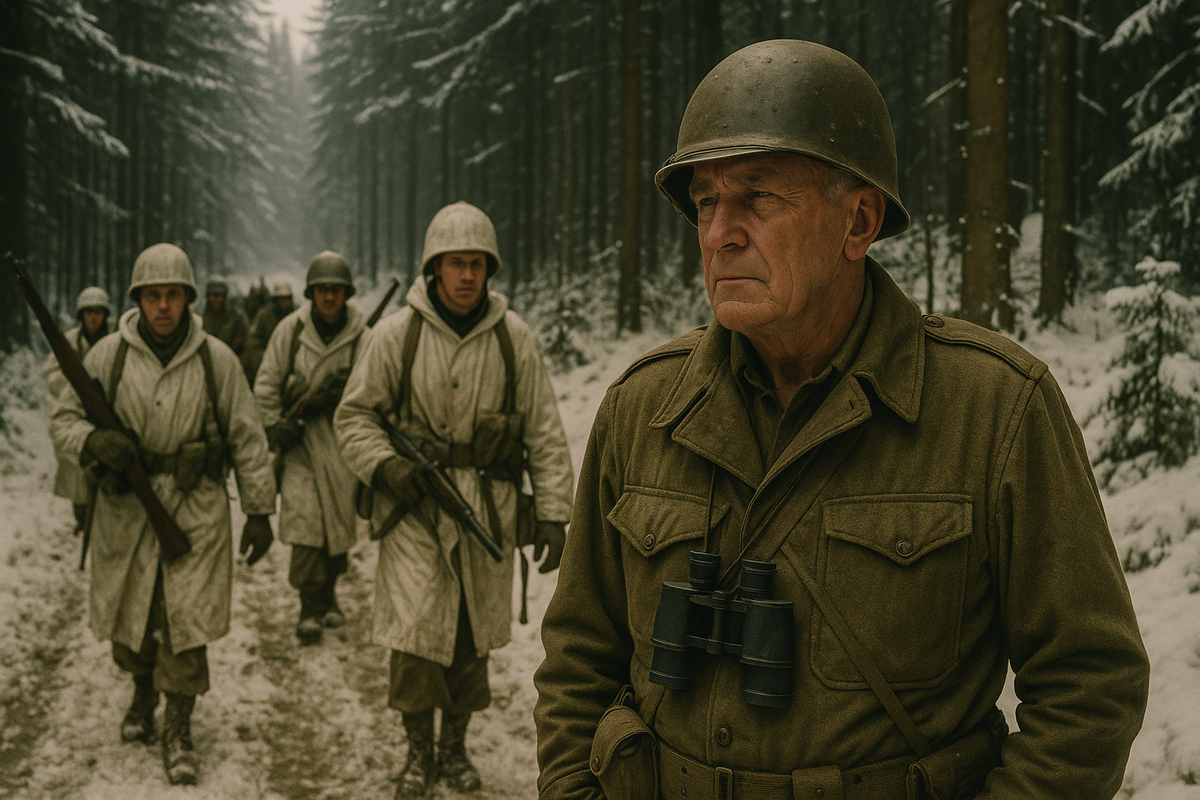
The article detailed the human arithmetic of winter warfare: artillery fire against men dug into frozen earth, Montgomery's accusations of reckless tactics, Patton's counterattack from the south. Harmon described decisions made in hours that would haunt him for years. The Post illustrated it all with maps marked by swastikas, arrows showing German advances, and photographs of soldiers in white camouflage disappearing into snowbound forests.
By January 1945, the Allies had broken the offensive. Over 600,000 Americans fought in the Bulge. 19,000 died. 47,500 were wounded. It was the largest and bloodiest battle the U.S. fought in Europe—and the last chance Hitler had to alter the war's trajectory.
Why the Post Mattered in 1948
The Saturday Evening Post was not Life's photographic bluntness or The New Yorker's literary detachment. It was something else: the magazine of American consensus. Trusted in Des Moines and Boston alike, the Post specialized in making global consequence feel personal. Harmon's testimony was not academic history—it was visceral memory, only three years old, told by a man who'd been there.
The editorial pairing was deliberate. Dohanos' rainy street cover signaled postwar normalcy—the peaceful, consumer-driven America veterans had returned to. Inside, Harmon's article reminded readers how close that peace had come to collapsing in the snow. The Post's genius was holding both truths at once: we are safe now, but we nearly weren't.
Alongside Harmon's account were short stories, serialized fiction, cartoons, and advertisements for nylon brushes and wristwatches. This wasn't tonal whiplash—it was the Post's core philosophy. War and peace, tragedy and commerce, memory and optimism, all bound in the same edition.
What Harmon Revealed
The article contained moments that lodged in readers' memories:
Each detail reinforced a single truth: the Bulge was not inevitable. It was won by desperate men making impossible choices.
The Archive Lives
Like Life's photo essays or Collier's war dispatches, the Post's wartime and postwar journalism endures because it preserved not just events but atmospheres—the fear, exhaustion, and fragile relief of 1948.
When we read Harmon's testimony now, we hear a man three years removed from combat still calculating whether his gambles were justified. When we see Dohanos' rainy street, we glimpse what veterans came home to: a nation determined to rebuild, even as it couldn't stop looking back.
Why Collectors Seek This Issue
Owning this issue means holding both a primary source on the Bulge and a snapshot of how America processed its most recent war.
For Collectors and Historians
If the Battle of the Bulge or postwar American culture draws you, this issue deserves examination.
Browse The Saturday Evening Post Magazine CollectionFrom the Depression through World War II and into the Cold War, the Post chronicled American life with unmatched editorial range. Its articles, covers, and ads remain living documents of the twentieth century.
Final Word
The October 2, 1948 Saturday Evening Post is a document of risk and survival. General Harmon's account of the Battle of the Bulge—candid, unsentimental, and precise—stands as one of the finest pieces of command-level testimony published in a mainstream American magazine. Paired with Dohanos' slice-of-life cover and the Post's editorial balance, it captures both the drama of war and the fragility of peace.
Holding this issue is holding a moment when American soldiers gambled everything in the frozen Ardennes—and won. The Post made sure their story survived. More than seventy years later, it still does.