
Bulganin, Khrushchev, and the Power Struggle of 1955
The Soviet Union at a Crossroads
On July 25, 1955, Time Magazine went to press with a problem: how do you explain a government where the man with the title has no power, and the man with the power has no title?
Joseph Stalin had been dead for barely two years. The Soviet Union's leadership was a hall of mirrors—men in identical suits, smiling for cameras at Geneva while plotting each other's destruction back in Moscow. Nikolai Bulganin held the premiership. Nikita Khrushchev controlled the Party. Vyacheslav Molotov still commanded the foreign ministry. Lazar Kaganovich, Georgy Malenkov, and Marshal Georgy Zhukov circled like wolves, waiting to see which way the wind would blow.
Time's reporters understood what was at stake. This wasn't palace intrigue for its own sake—this was the question of who would inherit Stalin's empire, and whether that empire would bury the West or learn to live with it.
Archive Details
Historical Figures: Nikolai Bulganin, Nikita Khrushchev, Vyacheslav Molotov, Lazar Kaganovich, Georgy Malenkov, Marshal Georgy Zhukov
Issue Date: July 25, 1955
Archive Source: Time Magazine
Historical Context: Geneva Summit, Post-Stalin Power Struggle, Cold War Diplomacy
Geneva: The First Thaw
The Geneva Summit brought Dwight Eisenhower, Anthony Eden, and Edgar Faure face-to-face with the Soviet leadership for the first time since World War II ended. The Korean War had just concluded. Both sides now possessed hydrogen bombs. The choice was stark: talk, or prepare for annihilation.
What emerged was the "Spirit of Geneva"—a phrase that captured both hope and skepticism. The Soviets smiled, shook hands, and proposed plans for European security that would have kept Germany divided and Eastern Europe firmly under Moscow's boot. The West countered with calls for free elections and reunification. Neither side budged. But they kept talking, and in 1955, that alone felt revolutionary.
Time understood that Geneva was theater, but consequential theater. The magazine gave American readers a front-row seat to diplomatic choreography that would determine whether their children would inherit peace or radioactive ash.
Bulganin: The Man Who Wasn't There
Time dubbed him "The Chummy Commissar," and the nickname captured everything about Nikolai Bulganin's strange position. He was Premier of the USSR—on paper, the second most powerful position in the Soviet state. He reviewed troops at May Day parades. He flew to Yugoslavia to charm Marshal Tito. He sat at the head table in Geneva.
But everyone who mattered knew the truth: Bulganin was a placeholder. Charming, yes. Diplomatic, certainly. Powerful? Not remotely.
The real story was happening one seat over, where Khrushchev sat. Short, blunt, and ruthless, Khrushchev had spent Stalin's final years consolidating control over the Communist Party apparatus—the true center of Soviet power. By summer 1955, he was maneuvering to eliminate his rivals one by one. Molotov would be neutralized. Malenkov had already been demoted. Within three years, Bulganin himself would be gone, and Khrushchev would stand alone.
Time's coverage matters because it captured this transition in real time, when the outcome was still uncertain and the stakes were existential.
The Faces of Power
Time didn't just report policy—it profiled personalities. The magazine understood that Soviet politics was personal, driven by grudges and ambitions as much as by ideology. The July 25, 1955 issue dissected the key players:
Khrushchev was rising, already showing the boldness that would lead him to denounce Stalin in his Secret Speech of 1956 and launch the reforms that cracked open the Soviet system. Molotov was surviving, still wielding influence as Foreign Minister but increasingly marginalized by younger rivals who saw him as a relic of Stalin's worst excesses. Bulganin was performing, projecting authority he didn't possess while the real decisions were made behind closed doors.
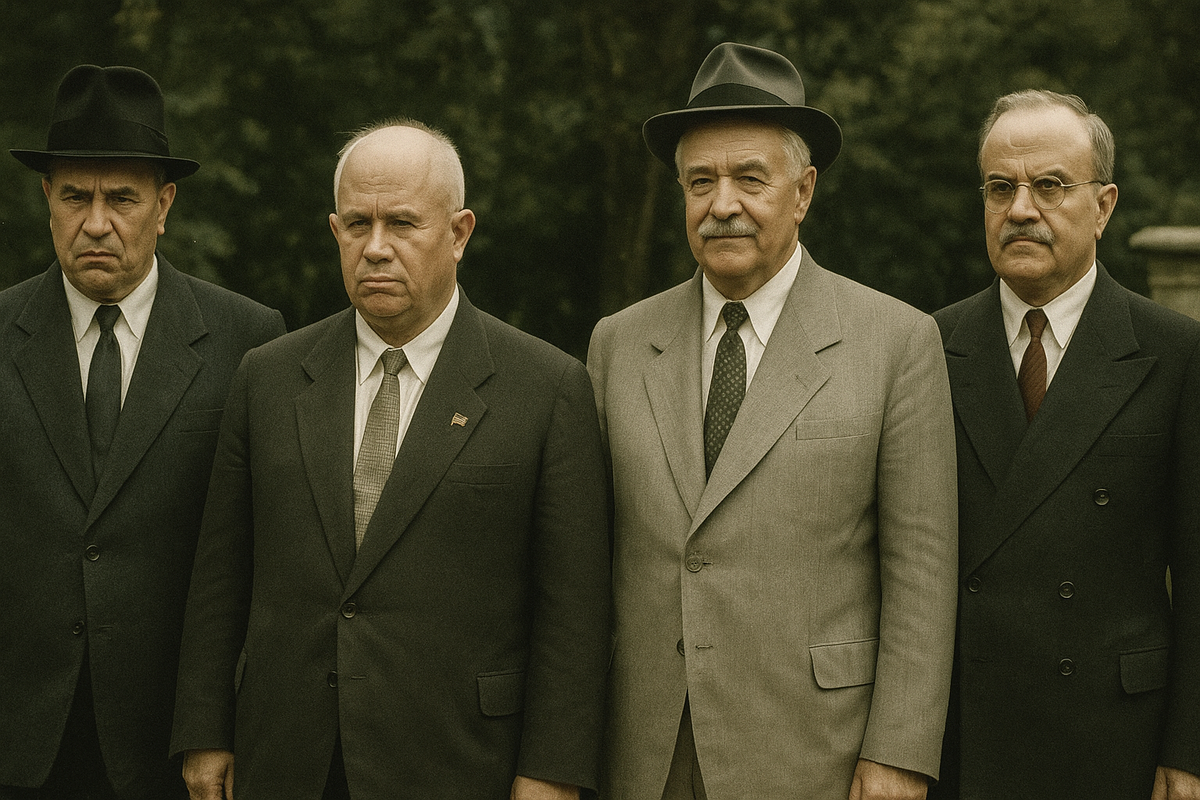
The photographs told the story Time's words confirmed: group shots of the Soviet delegation at Geneva showed staged unity masking mutual suspicion. Images of Bulganin reviewing parades or meeting with Tito captured the gap between ceremonial power and actual control.
This was Cold War journalism at its finest—translating the opacity of Kremlin politics into something ordinary Americans could grasp, without dumbing it down.
Key Themes in Time's Coverage
The Chummy Commissar
Bulganin portrayed as affable and approachable, but ultimately more diplomat than dictator—a man whose charm masked his irrelevance in the real power struggle.
Khrushchev Rising
Not yet the undisputed Soviet leader, but already showing signs of becoming Stalin's true successor through Party control and political maneuvering.
The Geneva Stage
How the Soviets used the summit to project a new image of cooperation while pursuing hardline policies that would keep Europe divided.
Two Plans for Europe
The West's proposal for free elections and German reunification versus the Soviet plan to maintain communist influence and division.
Why This Issue Matters
For collectors and historians, the July 25, 1955 Time Magazine is more than nostalgia. It's a primary source that documents the precise moment when the post-Stalin succession was still unresolved, when Geneva represented both genuine hope and calculated propaganda, when the world's most secretive government was being decoded in real time by American reporters working with fragments of information and educated guesswork.
Within two years, Khrushchev would deliver his Secret Speech and begin dismantling Stalin's cult of personality. Within five, Bulganin would be expelled from power entirely. Within a decade, Khrushchev himself would be ousted. But in July 1955, all of that was still unwritten. Time captured the uncertainty, the danger, and the possibility that defined the nuclear age's first diplomatic opening.
The issue also reveals how Americans understood their adversaries in 1955—before détente, before the Cuban Missile Crisis, before Vietnam. The tone is wary but not hysterical, analytical but not academic. Time treated Soviet leaders as rational actors pursuing their own interests, not cartoon villains or ideological automatons. That perspective shaped how a generation thought about the Cold War.
For collectors, this issue offers unique photography, sharp analysis, and the texture of mid-1950s journalism—a tangible artifact from the era when print magazines were America's primary window to the world. The cover, the layout, even the advertisements tell you something about what mattered in 1955.
Collector Significance
A Cold War Turning Point
The Geneva Summit was the first major diplomatic meeting of the nuclear age, marking a shift from pure confrontation to cautious dialogue between superpowers.
The Emergence of Khrushchev
Within two years he would deliver his "Secret Speech" denouncing Stalin and launch reforms that reshaped the USSR—this issue captures him on the cusp of power.
Bulganin's Fleeting Prominence
A reminder of how quickly Soviet leaders could rise and fall in the Kremlin's ruthless political environment—captured in real time before his inevitable decline.
Unique Photography and Analysis
Not just world leaders but the atmosphere of the mid-1950s Cold War—group portraits of the Soviet delegation, action images from Geneva, and Time's signature personality-driven profiles.
A Window, Not Just a Magazine
Before television news became ubiquitous, Time Magazine performed a function that's hard to appreciate now: it synthesized global events, translated foreign politics, and delivered context that made sense of chaos. The July 25, 1955 issue did exactly that for one of the Cold War's pivotal moments—the Geneva Summit and the Soviet succession crisis that would reshape global politics for decades.
Experience History As It Was Written
Browse thousands of original Time magazines from the 1930s to the 1970s. Each issue is a primary source, letting you experience history exactly as it was reported to the people who lived through it.
Browse Time Magazine Collection