
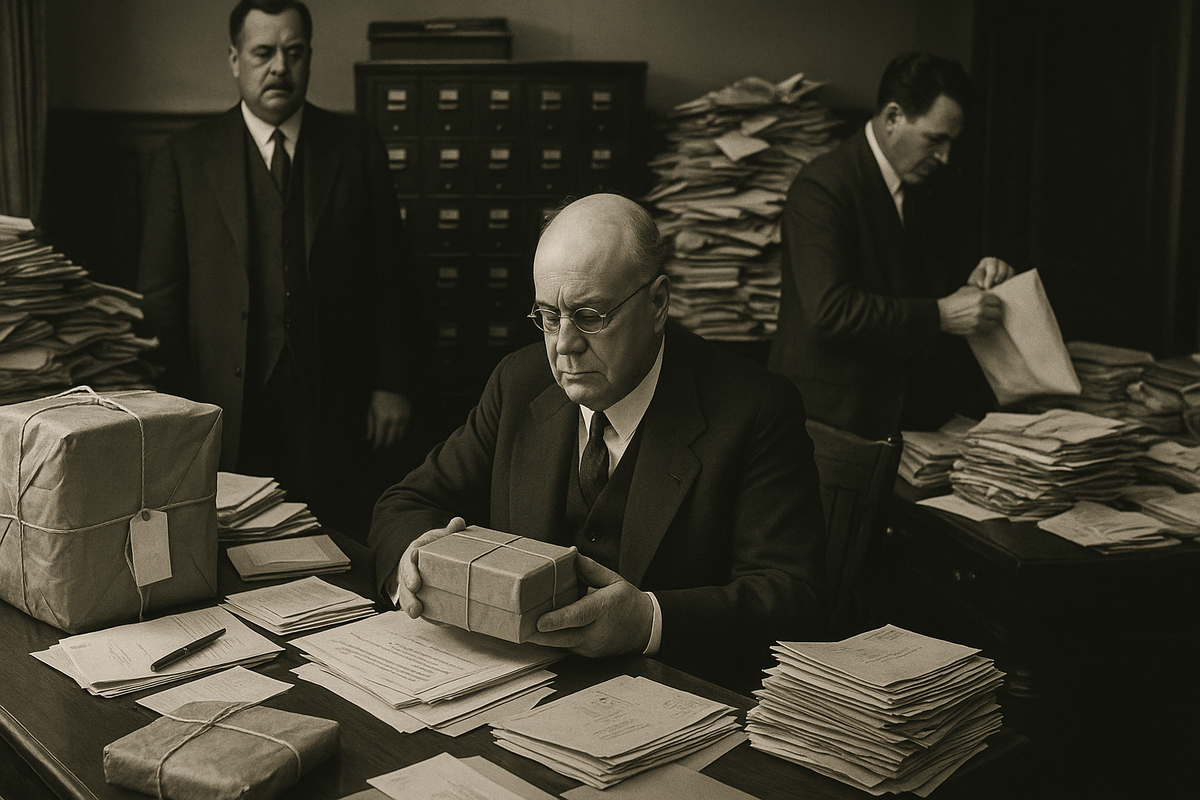
When the President's Mail Could Kill
Inside the Taft White House's Daily Battle with Bomb Threats—From the Memoirs of Ira R.T. Smith in The Saturday Evening Post, January 1, 1949
On an ordinary morning in 1912, Ira R.T. Smith stood at his desk in the White House, staring at a fountain pen.
It had arrived in the president's mail, elegantly packaged, seemingly innocuous. Smith's job—Chief of Mails across nine presidential administrations—had taught him one unshakable rule: nothing addressed to the president was ever truly innocuous. The pen could have been a gift from an admirer. Or it could explode the moment someone tested the nib.
This wasn't paranoia. It was precedent.
When Americans opened the January 1, 1949 issue of The Saturday Evening Post, they discovered Smith's extraordinary memoir series, "My Fifty Years in the White House," written with Joe Alex Morris. Part Three plunged readers into the presidency of William Howard Taft (1909–1913)—a administration remembered today for its judicial legacy and political inertia, but revealed here as something far more volatile: a pressure cooker of bureaucratic revolution, suffocating formality, and constant, invisible danger.
Smith didn't write history from the Situation Room. He wrote it from the mailroom, where democracy's messiest truths arrived daily in envelopes, packages, and occasionally, weapons.
Archive Details
Historical Figure: Ira R.T. Smith, Chief of Mails (White House, 1897–1948)
Issue Date: The Saturday Evening Post, January 1, 1949
Cover Artist: Constantin Alajálov
Archive Source: "My Fifty Years in the White House" (Part Three) by Ira R.T. Smith with Joe Alex Morris
Historical Period Covered: William Howard Taft Administration (1909–1913)
The Cold War Looks Backward
January 1949 was a hinge moment in American history. The nation had survived Depression and world war, but the atomic age had arrived, bringing with it a new kind of anxiety. Harry Truman occupied the White House. The Berlin Airlift had just ended. The Soviets would detonate their first nuclear weapon that August.
In this climate of Cold War dread, Smith's memoirs offered Americans something unexpected: proof that presidential vulnerability wasn't new. The threats had simply evolved from poisoned chocolates to plutonium.
Readers of the Post—still one of America's most influential publications—weren't looking for nostalgia. They wanted context. Smith gave them a measuring stick: How had the presidency changed from the horse-drawn carriages of William McKinley to the nuclear briefcase of Harry Truman? What had been gained in that transformation? What had been lost?
The Taft years, Smith revealed, were the turning point—the moment the presidency began its irreversible march from warm informality to cold efficiency.
The Man Who Saved Money and Lost His Soul
William Howard Taft remains one of history's most paradoxical presidents. Genial in private, stiff in public. Brilliant as a jurist, clumsy as a politician. A man who once proudly told Smith he'd managed to save $100,000 from his four-year presidential salary—an act of personal thrift that somehow captured his entire administration's character.
Where Theodore Roosevelt had filled the White House with kinetic energy—children sliding down banisters, impromptu wrestling matches, journalists shouting questions across the South Lawn—Taft brought order. And with order came coldness.
Smith, who had served under Roosevelt and witnessed the transition firsthand, didn't mince words. The "family atmosphere" that had defined earlier administrations evaporated under Taft. The White House became less a home and more a machine. Informal drop-ins gave way to scheduled appointments. Personal letters received bureaucratic responses. The presidency was professionalizing, and Smith—chief chronicler of its daily correspondence—watched the humanity drain from the office one memo at a time.
The architect of this transformation was Charles D. Norton, Taft's secretary and self-styled "efficiency expert." Norton streamlined operations, modernized filing systems, and imposed rigid protocols. He made the White House run better. He also made it feel worse.
The First Lady Who Pulled the Strings
But the most formidable force in the Taft White House wasn't Taft himself. It was Helen Herron Taft.
Smith's memoir—accompanied by photographs from a 1912 garden party—made clear what historians would later confirm: Mrs. Taft was the administration's true strategist. She shaped her husband's career, managed White House society, and wielded influence that extended far beyond ceremonial duties.
In an era when First Ladies were expected to smile, host, and defer, Helen Taft governed. The photographs in the Post captured her presence: poised, direct, unmistakably in command. Smith's prose filled in the rest—the private consultations, the calculated social maneuvers, the quiet but relentless ambition.
For readers in 1949, this revelation carried weight. Eleanor Roosevelt had just left the White House after twelve years of unprecedented political engagement. Bess Truman had deliberately retreated from public view. The role of the First Lady was being renegotiated in real time, and Smith's account proved the debate was decades old.
Death in a Box
Then there were the packages.
Smith's matter-of-fact descriptions of White House mail security were, for 1949 readers, chillingly familiar. Explosive fountain pens. Poisoned gifts. Unmarked boxes that required careful inspection before anyone dared open them. The threat of political violence had stalked every president Smith served, and Taft was no exception.
The Post reproduced photographs of these suspicious items—mundane objects transformed into potential weapons. A box. A letter. A pen. Each one a reminder that the presidency had always been a target, that the machinery of democracy operated under constant, quiet siege.
This wasn't sensationalism. It was documentation. Smith wrote without drama because the facts needed none. Someone had mailed a bomb to the president. Someone always did.
For Americans reading in 1949, the parallel was inescapable. The methods had changed—anarchists with mail-order explosives had given way to foreign agents with sophisticated weaponry—but the fundamental vulnerability remained. The presidency could never be fully protected. Only managed, monitored, and mourned when protection failed.
Key Revelations from Smith's Memoir
The Witness Who Bridged Generations
What gave Smith's memoir its unique authority was longevity. Fifty years in the White House meant he had served everyone from William McKinley through Franklin Roosevelt. He wasn't a historian reconstructing the past. He was the past, still living, still remembering.
His account of the Taft years wasn't filtered through academic analysis or political spin. It was direct testimony from the man who sorted the president's mail, opened his suspicious packages, and watched bureaucratic efficiency slowly smother presidential warmth.
The photographs accompanying the article reinforced this intimacy. Smith at his desk, surrounded by correspondence. Taft at a garden party, looking every bit the reluctant politician. Norton, the efficiency expert, staring into the camera with the confidence of a man remaking an institution.
These weren't publicity stills. They were working documents—the visual record of how the presidency actually functioned when no one important was watching.
The Artifact in Your Hands
Like Life magazine's wartime photojournalism or The New Yorker's midcentury reporting, Smith's White House memoirs transcend their original format. They aren't magazine content. They're time capsules—preserved testimony from an era when history moved more slowly and was documented with more care.
In a digital age where news is consumed and discarded in seconds, these printed pages insist on permanence. They were meant to be kept, reread, passed down. They were designed to outlast their moment.
And they have.
Why This Issue Endures
This isn't nostalgia. It's evidence. Every page is a window into how Americans understood their government, their presidents, and their precarious place in history.
Explore the Archive
If the Taft White House fascinates you, our collection spans the full sweep of 20th-century American life. From the 1900s through the 1970s, the original Saturday Evening Post documented the nation's politics, culture, and transformations in real time.
Browse The Saturday Evening Post Magazine CollectionWhether you're a collector, a historian, or someone preserving the memory of family who lived through these eras, these magazines offer something irreplaceable: unmediated access to history.
A Final Word
The January 1, 1949 Saturday Evening Post stands as one of the most revealing postwar issues ever published. Through Ira R.T. Smith's voice, readers gained access to a presidency rarely seen: not the public speeches or grand policy debates, but the daily machinery—the suspicious packages, the bureaucratic reforms, the warm but wary man at the center of it all.
Taft's White House was where the presidency began its long transformation from intimate institution to impersonal apparatus. Smith witnessed that shift from the only vantage point that mattered: the mailroom, where every threat, plea, and piece of American democracy arrived addressed to one man.
To hold this issue today is to hold that witness. To touch the paper is to touch the moment. And to read Smith's words is to understand that presidential power has always been inseparable from presidential vulnerability—that the job has never been safe, only necessary.
The bomb threats didn't start with the Cold War. They've been part of the presidency from the beginning.
Smith just had the courage to open the mail anyway.