
When America Looked Into the Abyss: Gay Talese, Spahn Ranch, and the Magazine That Documented the Death of the Dream
How Esquire's March 1970 issue captured the moment the 1960s died—and became one of journalism's most sought-after artifacts
In March 1970, readers who opened their mailbox copies of Esquire didn't just find another magazine. They found evidence.
Gay Talese's "Charlie Manson's Home on the Range" arrived six months after the Tate-LaBianca murders—close enough to the crime that Sharon Tate's blood still felt warm on the public consciousness, distant enough that Talese could do what crime reporters couldn't: stop cataloging horrors and start asking what they meant.
The result was not journalism. It was autopsy.
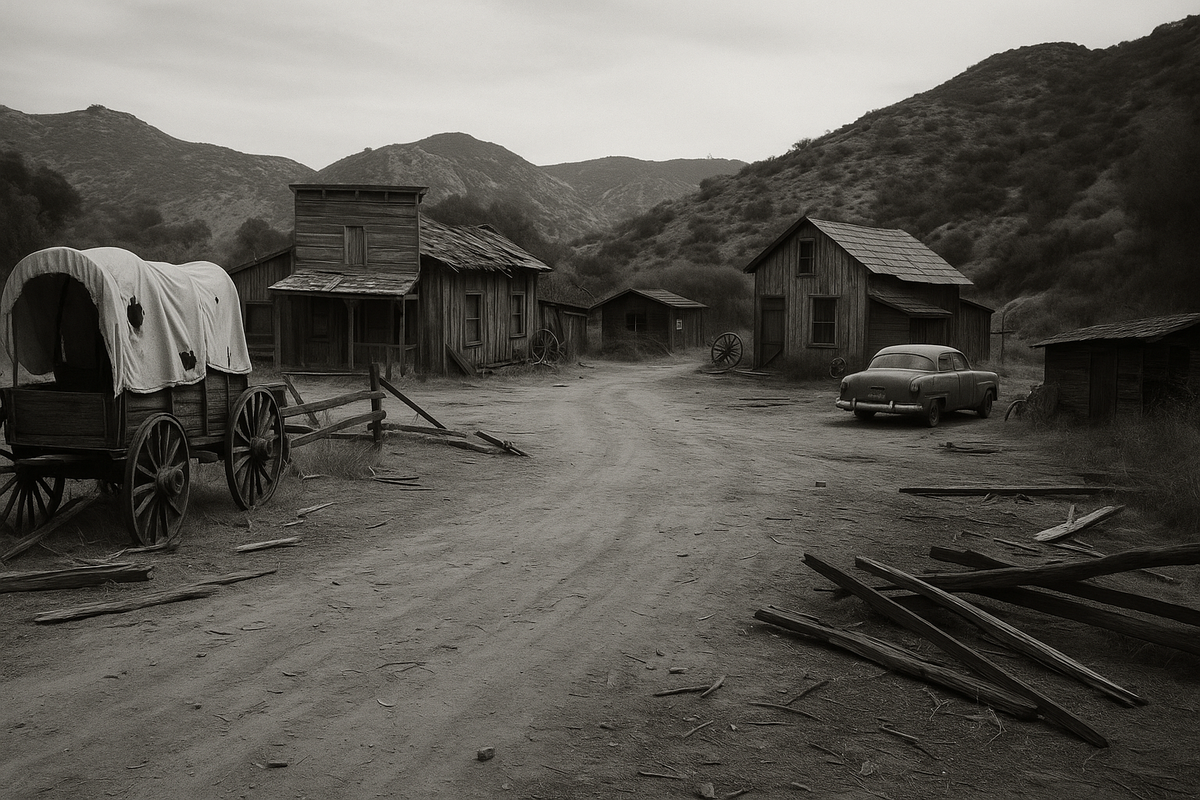
Talese traveled to Spahn Ranch, the rotting Western film set where Manson's "Family" had nested, and found something more unsettling than a crime scene. He found the symbolic graveyard of postwar American optimism—a place where Hollywood's cowboy mythology had decayed into cult pathology, where the Summer of Love had curdled into something unrecognizable.
For anyone trying to understand how the 1960s ended, this single magazine issue remains essential testimony.
The Murders That Broke the Covenant
August 1969 fractured the American psyche in ways that still haven't fully healed.
Sharon Tate—eight months pregnant, married to Roman Polanski, embodying California's gilded promise—was slaughtered alongside four others in a Benedict Canyon estate. The next night, Leno and Rosemary LaBianca suffered the same fate. When police arrested Charles Manson and his followers that December, they uncovered something more disturbing than the crimes themselves: the murders had been performed as ritual, as theater, as the logical endpoint of a countercultural philosophy twisted beyond recognition.
The timing was surgical. Vietnam had turned television into a nightly broadcast of American violence. The Democratic Convention in Chicago had devolved into police riots. Campus protests were metastasizing. The optimism of 1967—"If you're going to San Francisco, be sure to wear some flowers in your hair"—now sounded like a taunt.
By early 1970, when Talese's piece hit newsstands, the trial was underway and the cultural diagnosis was clear: something in the American experiment had gone catastrophically wrong. The counterculture hadn't liberated anyone. It had produced a murderous cult led by a failed musician who'd spent half his life in prison.
Talese understood that the real story wasn't Manson. It was the landscape that produced him.
Archive Details
Publication: Esquire Magazine
Issue Date: March 1970
Featured Article: "Charlie Manson's Home on the Range" by Gay Talese
Historical Context: Published six months after the Tate-LaBianca murders, during Manson's trial
Editorial Significance: Landmark example of New Journalism's cultural analysis approach
The New Journalism Gambit
Esquire in 1970 wasn't playing the same game as other men's magazines. While competitors served up Playmate knockoffs and liquor ads, editor Harold Hayes had transformed the publication into something closer to an American Partisan Review—a proving ground for writers who treated reportage as literature.
Gay Talese was one of Hayes's crown jewels. Alongside Tom Wolfe, Joan Didion, and Norman Mailer, Talese had pioneered what came to be called New Journalism: reporting that borrowed fiction's techniques—scene-setting, psychological interiority, ironic distance—while maintaining factual rigor. His 1966 profile of Frank Sinatra, "Frank Sinatra Has a Cold," had already demonstrated the method's power. The Manson piece would prove its range.
What made "Charlie Manson's Home on the Range" remarkable was its refusal to sensationalize. Talese didn't write about the murders themselves—those details were already tabloid currency. Instead, he examined the setting: Spahn Ranch as both literal location and American metaphor. The ranch had once hosted Western films, those sanitized fantasies of frontier justice and masculine heroism. Now it served as headquarters for a cult that murdered pregnant actresses and wrote messages in blood.
The collision of these two Americas—mythic and actual, cinematic and visceral—was Esquire's territory. Hayes published the piece not for shock value but as cultural archaeology, an attempt to understand what the Manson murders revealed about California, celebrity, violence, and the collapse of 1960s idealism.
The Visual Testimony
Esquire's March 1970 cover rejected the obvious move. No Manson mugshot, no swastika carved into his forehead, no exploitative imagery. The magazine's design philosophy—minimalist, sophisticated, resistant to tabloid instincts—positioned the content as analysis rather than spectacle.
Inside, the photographs did different work.
George Spahn appears in one image that has since become iconic: the blind, 80-year-old ranch owner sitting amid clutter, a Chihuahua perched in his lap, his face carrying the exhausted bewilderment of a man who'd rented his property to the apocalypse. He looks simultaneously innocent and complicit, a living embodiment of American obliviousness.
The ranch itself—captured in stark black-and-white—shows Hollywood's Western fantasy in terminal decay. These were the same hills where Gene Autry had ridden, where countless oaters had manufactured frontier mythology. Now they looked bombed-out, post-apocalyptic, haunted.
A small inset photograph of Sharon Tate and Roman Polanski—glamorous, young, alive—provided the emotional anchor. This wasn't abstract cultural criticism. Real people had died. The juxtaposition of Tate's radiant face against the ranch's desolation created a visual argument more powerful than any editorial could manage.
This was Esquire's genius: using design and photography not as illustration but as primary text, creating artifacts that would outlive the news cycle.
Talese's Method: The Ordinary Face of Apocalypse
The brilliance of "Charlie Manson's Home on the Range" lies in what Talese doesn't do. He refuses to make Manson mythic or demonic. Instead, he presents him as banal—a petty criminal, a failed artist, a manipulator working with available materials. The horror comes not from Manson's exceptionalism but from his ordinariness, from the ease with which he assembled followers in a moment of cultural vertigo.
Talese's focus on Spahn Ranch serves multiple functions. First, it's concrete reporting: this is where the Family lived, this is what the place looked like, this is who owned it. Second, it's symbolic archaeology: the ranch embodies the death of Hollywood's frontier mythology, the place where America's most seductive lies finally rotted through. Third, it's psychological landscape: by avoiding the murder scenes and focusing on the cult's home base, Talese makes readers confront not the crimes but the conditions that produced them.
The piece refuses easy answers. It doesn't blame drugs or rock music or permissiveness. Instead, it presents a California where every promise—stardom, freedom, enlightenment, reinvention—could curdle into its opposite. Where the movie industry's fantasy machinery sat adjacent to genuine madness. Where the counterculture's rejection of authority created vacuums that authoritarian personalities rushed to fill.
For Esquire's readers—largely male, largely educated, largely invested in postwar American prosperity—the message was unsettling: the system that had produced their comfort had also produced this.
The Cultural Landscape of Spahn Ranch
Talese's portrait of Spahn Ranch and the Manson era reveals layers of meaning that continue to resonate. The article captures:
The Permanence of Print
Digital archives can preserve text, but they can't preserve experience. The March 1970 Esquire exists as a physical object shaped by editorial decisions invisible to modern readers: the weight of the paper stock, the placement of advertisements (what products were pitched alongside stories of murder?), the smell of aging ink, the typography that marked this era of magazine design.
Vintage magazines are time capsules in the most literal sense. They don't just contain information about their era—they are their era, preserved exactly as contemporary readers encountered them. Every choice—from cover design to article placement to the ads between spreads—tells a story about what mattered, what sold, what audiences were presumed to want.
Esquire in its 1960s-70s golden age represented American masculinity trying to evolve beyond its midcentury certainties. The magazine published serious literature alongside fashion spreads, political commentary alongside grooming advice. It treated its readers as adults capable of handling ambiguity and darkness. The Manson piece epitomizes this editorial philosophy: refusing to turn away from American ugliness while maintaining literary sophistication.
This is why collectors prize these issues. They're not buying nostalgia. They're buying primary sources.
Why This Issue Endures
Published while Manson's trial was ongoing, it captures American response in real time—not filtered through decades of retrospective analysis but raw, immediate, still processing the shock.
Gay Talese's work is now taught in journalism programs as foundational text. Owning the original publication means possessing a primary source, not a reprinted anthology excerpt.
The photographs—particularly of George Spahn and the ranch—have been reproduced countless times, but the original magazine preserves them in their intended context.
The Manson murders remain one of the most analyzed crimes in American history. Every subsequent documentary traces back to contemporary sources like Talese's piece.
This issue serves as a hinge point—the moment when the 1960s officially died and the 1970s, with all their cynicism and disillusionment, began.
For collectors of 20th-century cultural artifacts, this isn't memorabilia. It's evidence of how America processed its own fracture.
Testimony
Gay Talese's "Charlie Manson's Home on the Range" accomplished what the best journalism always does: it made readers see differently. By focusing on place rather than perpetrator, on landscape rather than gore, on cultural conditions rather than individual pathology, Talese transformed a crime story into American tragedy.
The March 1970 Esquire didn't just report the Manson murders. It diagnosed what they meant—the collapse of 1960s utopianism, the dark side of California mythology, the ease with which liberation movements could be hijacked by authoritarian personalities. Reading it now, the piece feels prophetic about dynamics that would recur throughout American life: cult leaders exploiting cultural chaos, media turning criminals into celebrities, violence erupting from communities that promised transcendence.
This is what makes vintage magazines more than collectibles. They're witnesses. They were there when the dream died, and they remember exactly what it looked like.
For anyone who values primary sources, literary journalism, or understanding how America processes its own darkness, this issue isn't optional reading. It's foundational.
The magazine sits in collections and archives now, its pages yellowing but its testimony intact: this is what we saw, this is what we felt, this is how we tried to make sense of the senseless. In March 1970, Esquire held up a mirror to America at its breaking point.
The reflection is still worth studying.
Where History Lives
For those interested in acquiring this issue or exploring other landmarks of 20th-century American journalism, original Esquire magazines from the 1930s through 1970s remain available through specialized collections.
Whether you're building a true crime archive, studying the evolution of American media, or simply fascinated by the moment when counterculture dreams combusted into nightmare, these magazines offer something digital facsimiles can't: direct physical connection to the moment history happened.
Browse Esquire Magazine Collection