
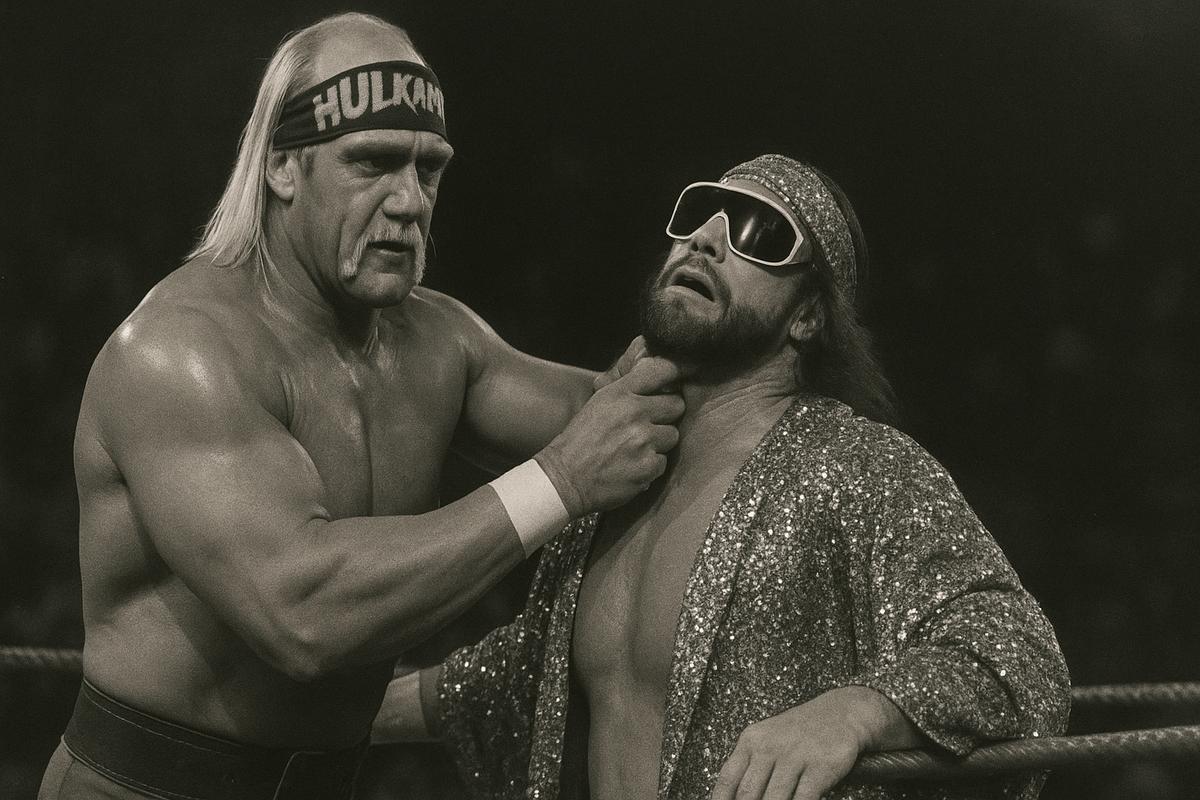
Hulk Hogan, Randy Savage, and the Bodyguard Question
When Friendship Changed Wrestling Forever
Three months before the Mega Powers exploded at WrestleMania V, Pro Wrestling Illustrated asked the question no one else dared to print: "Has Hogan Become Savage's Bodyguard?"
The February 1989 issue didn't just cover wrestling's hottest storyline—it dissected it. While WWF programming sold fans on the unshakable bond between Hulk Hogan and Randy "Macho Man" Savage, PWI's editors saw something else entirely: a champion being overshadowed by his supposed ally, a friendship built on fault lines, and a betrayal waiting to detonate.
For fans who bought that issue off newsstands in early 1989, the magazine felt like holding a secret. The tension was already there in every arena, simmering beneath the tag team victories and shared celebrations. PWI simply gave it a name.
Archive Details
Publication: Pro Wrestling Illustrated
Issue Date: February 1989
Feature Story: "Has Hogan Become Savage's Bodyguard?"
Historical Context: Published three months before WrestleMania V and the dissolution of the Mega Powers
Editorial Contributors: Assistant Editor Eddie Ellner
The Uneasy Alliance
By early 1989, Randy Savage stood at the peak of professional wrestling. He'd won the WWF World Heavyweight Championship at WrestleMania IV, dethroning Ted DiBiase in a tournament final that validated his years of relentless ambition. He had Miss Elizabeth at his side. He had the spotlight.
And yet, he also had Hulk Hogan.
Hogan wasn't holding a belt anymore, but he was everywhere—ringside for Savage's defenses, battling Andre the Giant on Savage's behalf, confronting DiBiase when the Million Dollar Man came calling. Savage's reign was never presented as solitary dominance. It was a partnership. The Mega Powers.
WWF framed this as loyalty. PWI's February 1989 feature asked whether it was something else entirely.
The article didn't pull punches. Assistant editor Eddie Ellner drew a direct comparison to Ric Flair's Four Horsemen era in the NWA—a champion who relied on enforcers, who needed protection to hold his title. For hardcore fans, the parallel was damning. Flair's critics had always questioned whether he could stand alone. Now PWI was asking the same about Savage.
Was the Macho Man truly the best wrestler in the world, or was he shielded by Hogan's larger-than-life presence?
The Magazine That Spoke What Fans Were Thinking
Pro Wrestling Illustrated occupied strange territory in 1989. It honored kayfabe, treating storylines as legitimate sport, yet it provided editorial commentary that WWF's own broadcasts would never touch. While Vince McMahon's announcers sold Hogan and Savage as unbreakable allies, PWI gave fans permission to doubt.
The "bodyguard" feature was critique disguised as sports journalism. It validated what fans were already whispering in arenas across the country: Hogan's constant presence wasn't just helping Savage—it was consuming him.
This mattered because fans in 1989 had no internet forums, no social media echo chambers. PWI was where debates happened. Its letters section, rankings, and features shaped how fans understood wrestling's narratives. When the magazine posed the bodyguard question, it gave voice to an anxiety that would define the Mega Powers' final months.
The article read like foreshadowing. Within weeks of publication, the storyline would begin its collapse—Savage's paranoia about Hogan and Elizabeth, the locker room confrontations, the shove heard around the wrestling world. By April, the two would meet at WrestleMania V in front of 20 million viewers on pay-per-view.
PWI saw it coming.
The Visual Archive
The February 1989 issue delivered PWI's signature aesthetic: high-contrast black-and-white photography, bold block-letter headlines, and a cover designed to grab attention in convenience stores and newsstands nationwide.
Inside, the Hogan-Savage feature was packed with action shots that told the story before readers hit the text. Savage in his glittering robe, arms outstretched in trademark flamboyance. Hogan grappling Bad News Brown by the beard, positioned as protector rather than competitor. Multiple images of Hogan confronting Andre the Giant and Ted DiBiase—not in his own feuds, but in defense of Savage's championship.
The captions reinforced the narrative. Hogan wasn't just wrestling alongside Savage; he was defending him, indirectly fighting his battles. This visual storytelling elevated PWI beyond simple event recaps. The magazine was building a case through images and editorial framing, giving fans the tools to recognize the cracks before the foundation split open.
Wrestling at a Crossroads
The February 1989 issue also captured professional wrestling at a pivotal moment. Vince McMahon's national expansion had crushed the old territorial system. Jim Crockett Promotions, World Class Championship Wrestling, and the AWA were all in decline or dissolution. The WWF dominated television, pay-per-view, and merchandising, with Hogan as the face of mainstream wrestling culture.
But Hogan wasn't champion anymore. That created a narrative problem: how to keep wrestling's biggest star relevant without the belt. The Mega Powers storyline solved that—Hogan remained center stage even during Savage's reign, his presence legitimizing the championship while simultaneously raising questions about who actually held the power.
PWI understood this tension better than most. While the magazine covered all promotions—NWA, AWA, and regional territories—it gave WWF the bulk of its attention because that's where the cultural momentum lived. The February 1989 issue reflected that reality: Hogan and Savage on the cover, Flair and the Horsemen as the NWA counterpoint, and a wrestling world increasingly polarized between McMahon's juggernaut and everything trying to survive in its wake.
The PWI Legacy
Pro Wrestling Illustrated became the standard for wrestling journalism by doing exactly what the February 1989 issue exemplified: treating the industry seriously without breaking its illusion. The magazine's rankings, interviews, and annual PWI 500 shaped how fans measured wrestlers' legacies. Even today, vintage issues are cited in documentaries and used as research tools by historians studying wrestling's evolution.
These magazines remain primary sources because they captured something official WWF material couldn't—the space between storyline and reality, where fans lived.
Why This Issue Matters to Collectors
The February 1989 Pro Wrestling Illustrated sits at the intersection of wrestling history and pop culture documentation. It's not just memorabilia—it's a primary source.
Historic Timing
Published months before the Mega Powers' implosion, the issue captured the storyline at its most volatile. Fans who bought it in early 1989 were reading analysis of a partnership that would define WWF's biggest angle of the decade—before the payoff happened.
Editorial Independence
Unlike WWF's promotional material, PWI provided critical perspective. The "bodyguard" article demonstrated the magazine's willingness to question storylines while respecting kayfabe, a balance that made PWI essential reading for fans who wanted more than corporate messaging.
Photography
The action shots of Hogan, Savage, Andre the Giant, Ted DiBiase, and Miss Elizabeth serve as a visual archive of the late-'80s WWF aesthetic. These images document not just the wrestlers, but the presentation style that made the era iconic.
Cultural Snapshot
For fans who lived through the Mega Powers saga, this issue is a direct link to how the storyline unfolded in real time. It preserves the fan experience—the speculation, the debate, the anticipation before the explosion.
Collectors and wrestling historians value these magazines because they document something television broadcasts can't: the fan perspective. PWI wasn't creating the story; it was interpreting it alongside its readers, providing the analytical framework that turned wrestling from entertainment into cultural conversation.
The Question That Defined an Era
The February 1989 Pro Wrestling Illustrated didn't just ask whether Hogan had become Savage's bodyguard. It asked who truly held power in wrestling's most celebrated partnership—and whether friendship could survive the spotlight.
Three months later, at WrestleMania V, the world got its answer.
Owning this issue today means holding a piece of that story: the moment when PWI saw the fracture before it became a chasm, when editorial insight met cultural phenomenon, and when one magazine question captured what millions of fans were already thinking.
Was Hogan a friend—or Savage's bodyguard?
The answer would change wrestling forever.
For Collectors and Historians
If you're studying the Mega Powers era, this issue is essential. It documents the narrative tension that made Hogan versus Savage one of wrestling's greatest rivalries, captured at the moment before it reached its breaking point.
Browse Pro Wrestling Illustrated Magazine ColectionWhether you're a longtime fan, a collector building a wrestling archive, or a researcher exploring late-'80s pop culture, vintage PWI issues offer something modern content can't replicate: the experience of history as fans first encountered it.