
Death of a Narc
When Time Magazine Exposed the Assassination That Defined the Drug War
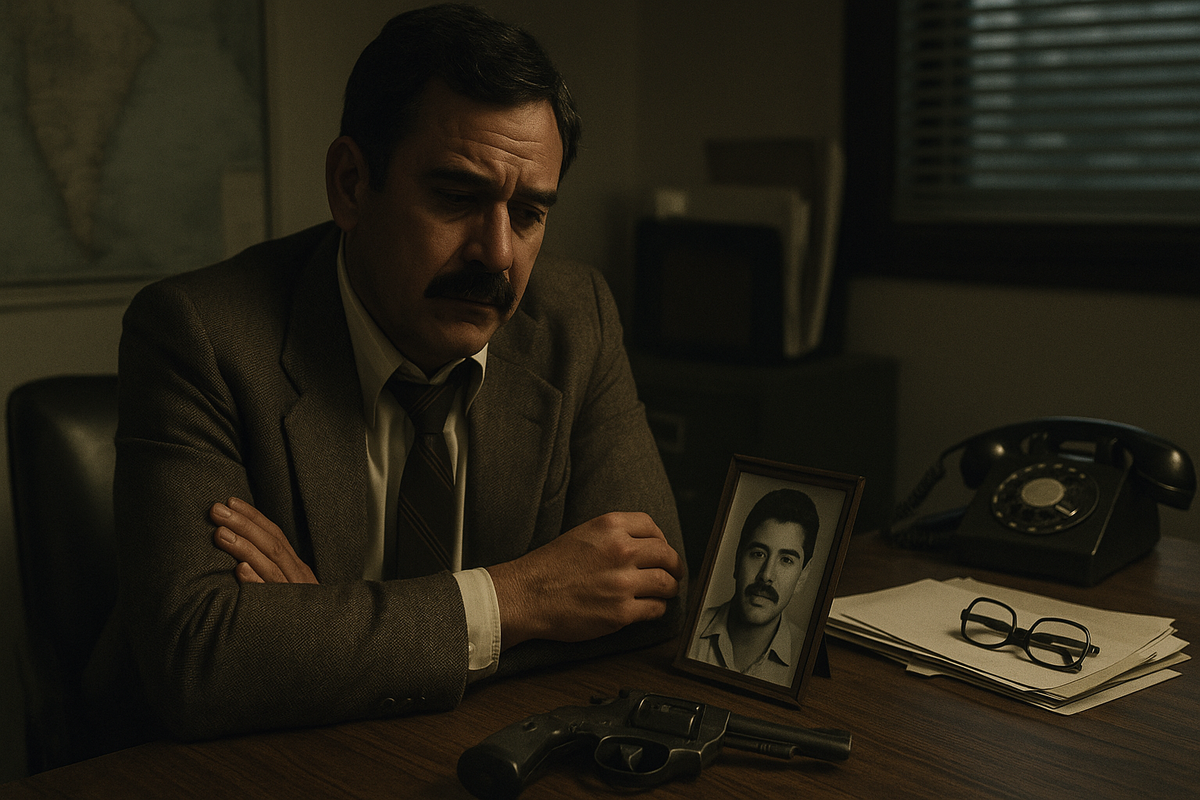
On November 7, 1988, Americans opened their mailboxes to find a Time Magazine cover that didn't offer them hope, triumph, or celebrity. Instead, they found a stark headline—"Death of a Narc"—and beneath it, an illustration of a bound, faceless figure bowed in shadow. No photograph. No name visible. Just the silent weight of violence.
Inside, investigative reporter Elaine Shannon had assembled something rare in American journalism: a forensic chronicle of how a U.S. federal agent was kidnapped, tortured for thirty hours, and murdered—not by rogue criminals, but with the complicity of Mexican officials at the highest levels of government. This wasn't just a crime story. It was an indictment of two nations' failures, and a brutal education in what the War on Drugs actually cost the men and women fighting it.
Three years after DEA agent Enrique "Kiki" Camarena disappeared outside the U.S. consulate in Guadalajara, Time delivered the reckoning Americans hadn't been given: names, tapes, corruption maps, and the chilling truth that Camarena's death had been orchestrated not in secret, but in plain view of authorities who chose to look away.
This issue remains one of the most historically significant—and haunting—magazines of the 1980s.
Archive Details
Historical Figure: Enrique "Kiki" Camarena, DEA Special Agent
Issue Date: November 7, 1988
Archive Source: Time Magazine
Reporter: Elaine Shannon
Cultural Legacy: Red Ribbon Week, established 1985
The Agent Who Went Too Far
By 1985, Enrique Camarena had become a problem for the Guadalajara Cartel. Stationed in Mexico's second-largest city, the former Marine and seasoned DEA operative had done what few American agents dared: he'd penetrated cartel networks, mapped their operations, and gathered intelligence that led to the destruction of thousands of tons of marijuana at a massive plantation in 1984. The raid was a public humiliation for Miguel Ángel Félix Gallardo, Ernesto Fonseca Carrillo, and Rafael Caro Quintero—the three men who controlled Mexico's most powerful trafficking organization.
On February 7, 1985, Camarena left the consulate to meet his wife for lunch. He never arrived. Witnesses saw him forced into a car in broad daylight. What followed was thirty hours of torture, captured on audio tapes that would later surface in the investigation. His body was found a month later, buried on a ranch outside the city.
The Mexican government claimed it was investigating. The DEA knew better.
The Tapes, The Corruption, The Cover-Up
Shannon's reporting in the November 7, 1988 issue pulled back the curtain on what investigators had quietly known: Camarena's abduction and murder had not occurred despite Mexican law enforcement—it had occurred with their assistance. The so-called "telltale tapes" recovered during the investigation implicated members of the Mexican Federal Judicial Police and figures within the Attorney General's office. Cartel leaders had been shielded, evidence tampered with, and American officials stonewalled at every turn.
Time didn't soften the blow. Shannon's prose was clinical, methodical, and damning. She profiled both "The Good Guys"—Camarena, fellow DEA agents like Jaime Kuykendall—and "The Bad Guys," naming Félix Gallardo, Fonseca Carrillo, and Caro Quintero with the precision of a federal indictment. Maps showed cartel zones of control. Timelines reconstructed the conspiracy. Sidebars detailed the February 1988 raid on a ranch tied to Caro Quintero's network, where violence had erupted yet again.
The message was unmistakable: corruption wasn't incidental to the drug war. It was the drug war.
The Visual Weight of Silence
Time's editorial team understood that words alone couldn't carry the horror of what had happened to Camarena. They commissioned illustrative artwork instead of relying on photographs—an unusual choice that gave the issue a symbolic, almost allegorical power.
The cover figure, bound and bowed, became an icon of martyrdom. Inside, readers encountered close-up paintings of shadowed hands and obscured faces, evoking conspiracy and the erasure of truth. One spread featured maps of Mexico marked with bust sites and cartel strongholds, transforming geography into a battlefield diagram. These weren't decorative choices. They were editorial arguments rendered in ink and shadow.
In an era before 24-hour cable news and true crime podcasts, Time's visual storytelling gave the Camarena case a visceral immediacy that transcended the page. You didn't just read about the murder. You felt the suffocation of it.
Investigative Authority
Elaine Shannon's reporting combined meticulous sourcing with narrative drive, setting the standard for cartel journalism.
Visual Symbolism
Illustrated covers and shadow paintings elevated the story beyond reportage into cultural commentary.
Systemic Exposure
The "telltale tapes" revealed corruption at the highest levels of Mexican law enforcement.
Cultural Legacy
Red Ribbon Week transformed Camarena's sacrifice into an annual national prevention movement.
A Legacy Written in Red Ribbons
The murder of Kiki Camarena didn't end with his burial. In 1985, his hometown of Calexico, California began wearing red ribbons in his memory, sparking what would become Red Ribbon Week—now the nation's oldest and largest drug prevention campaign, observed annually in schools across America. Every October, millions of students participate in a tradition born from one agent's refusal to back down.
Time's 1988 feature became part of that legacy. It wasn't just journalism—it was testimony. For DEA agents, it validated what they'd known but couldn't prove. For the American public, it shattered any illusion that the War on Drugs was being fought on equal terms. And for the families of agents serving in hostile territories, it was a grim reminder of the bargain their loved ones had made.
Decades later, the Camarena case still reverberates. The Netflix series Narcos: Mexico dramatized his story. Investigations continue into whether the CIA knew more than it admitted. And collectors, historians, and true crime researchers return again and again to this single issue of Time—not as nostalgia, but as primary source material for understanding how the drug war became America's longest conflict.
A Time Capsule of Late '80s America
To hold the November 7, 1988 issue of Time is to hold a moment when America was forced to confront uncomfortable truths: that its drug war was failing, that foreign allies were complicit in trafficking, and that the men and women sent to fight cartels were doing so without the protection of the governments they served.
Shannon's reporting didn't solve the case. It didn't bring Camarena back. But it ensured his death wouldn't be sanitized, forgotten, or turned into a convenient talking point. It demanded accountability in an era when such demands were rarely met.
For collectors, it's more than a magazine. It's evidence.
Why Collectors Seek This Issue
Historical Gravitas
The most comprehensive contemporary account of the Camarena murder published in a mainstream outlet, written by Elaine Shannon, who would go on to author Desperados, the definitive book on DEA operations in Latin America.
Cultural Artifact
The issue helped cement Camarena's status as a folk hero and martyr, directly influencing Red Ribbon Week's expansion into a national movement.
Visual Distinction
The illustrated cover and internal artwork make it instantly recognizable and aesthetically striking—important for collectors who prize both content and design.
Ongoing Relevance
As cartel violence and U.S.-Mexico border politics remain front-page news, this issue serves as historical context for today's debates.
Explore the Era That Shaped Modern Journalism
Browse our full collection of original Time magazines—from the 1930s through the 1990s—and discover how America's most influential newsweekly chronicled wars, scandals, cultural revolutions, and the figures who defined their time.
Browse Time Magazine Collection