
When Jackie Kennedy Said Goodbye: The Photo Album That Closed Camelot
How Ladies' Home Journal became the keeper of America's most intimate presidential memories
In December 1968, Jacqueline Kennedy did something she had never done before and would never do again: she opened her private albums to America.
The pages of Ladies' Home Journal that month carried a feature titled "Jacqueline Kennedy's Memories: From a Very Private Photo Album"—rare photographs drawn from her own collection, many unseen by the public. For readers who had watched her bury a president, raise two children under unimaginable scrutiny, and navigate five years of national mourning, this was not merely a nostalgic portrait gallery. It was a deliberate act of closure.
Only months earlier, Jackie had remarried—this time to Aristotle Onassis, the Greek shipping magnate whose wealth and worldliness stood in stark contrast to the youthful idealism of the Kennedy years. The American public, which had claimed her as their eternal First Lady, felt the sting of abandonment. This photo essay was her answer: a final, intimate offering before she stepped beyond their reach.
What she gave them was Camelot on her own terms.
Archive Details
Historical Figure: Jacqueline Kennedy Onassis
Issue Date: December 1968
Archive Source: Ladies' Home Journal
Feature Title: "Jacqueline Kennedy's Memories: From a Very Private Photo Album"
A Nation Searching for Lost Innocence
By late 1968, America had fractured. The Vietnam War ground on without resolution. Cities burned after the assassination of Martin Luther King Jr. in April. Robert F. Kennedy was murdered in June, his campaign for the presidency cut short in a Los Angeles hotel kitchen. The optimism that had defined the early 1960s—the space race, the Peace Corps, the New Frontier—felt like ancient history.
Against this backdrop, the Kennedy presidency had already calcified into myth. The term "Camelot" originated in Jackie's own 1963 interview with Life magazine, conducted one week after the assassination. She had invoked the Lerner and Loewe musical, describing her husband's administration as "one brief shining moment." The metaphor stuck because it answered a need: Americans wanted to believe they had lost something golden, not simply a politician with mixed legislative success and Cold War entanglements.
Ladies' Home Journal—then one of the three most influential women's magazines in America—understood this cultural hunger. Its December 1968 feature was not marketed as political retrospective. It was framed as family history, domestic memory, the kind of intimate storytelling that had always been the magazine's forte. For millions of women who opened that issue, Jackie's photographs were not just about the Kennedys. They were about what gets preserved when everything else falls apart.
The Architecture of an Heirloom
The presentation was deliberate. Ladies' Home Journal arranged Jackie's photographs to resemble a cherished family album—the kind passed down through generations, its pages worn at the edges from repeated viewing.
The images themselves told a story of ascent, joy, and shadow:
Engagement photos from 1953 showed Jackie and Jack on the lawn at Hyannis Port, young and unguarded, before the machinery of politics reshaped them into public property.
Wedding portraits captured Jackie beside her mother Janet Auchincloss, her sister Lee Radziwill, and Rose Kennedy—a visual merger of two dynastic families, the Bouviers and the Kennedys, whose union would shape a decade.
Family life at Glen Ora, the Virginia estate the Kennedys leased during the White House years, revealed the pastoral fantasy they cultivated: children, horses, the illusion of normalcy. One photograph showed the family posed alongside the pony Leprechaun, a scene of domestic charm that belied the Cold War crises unfolding beyond the frame.
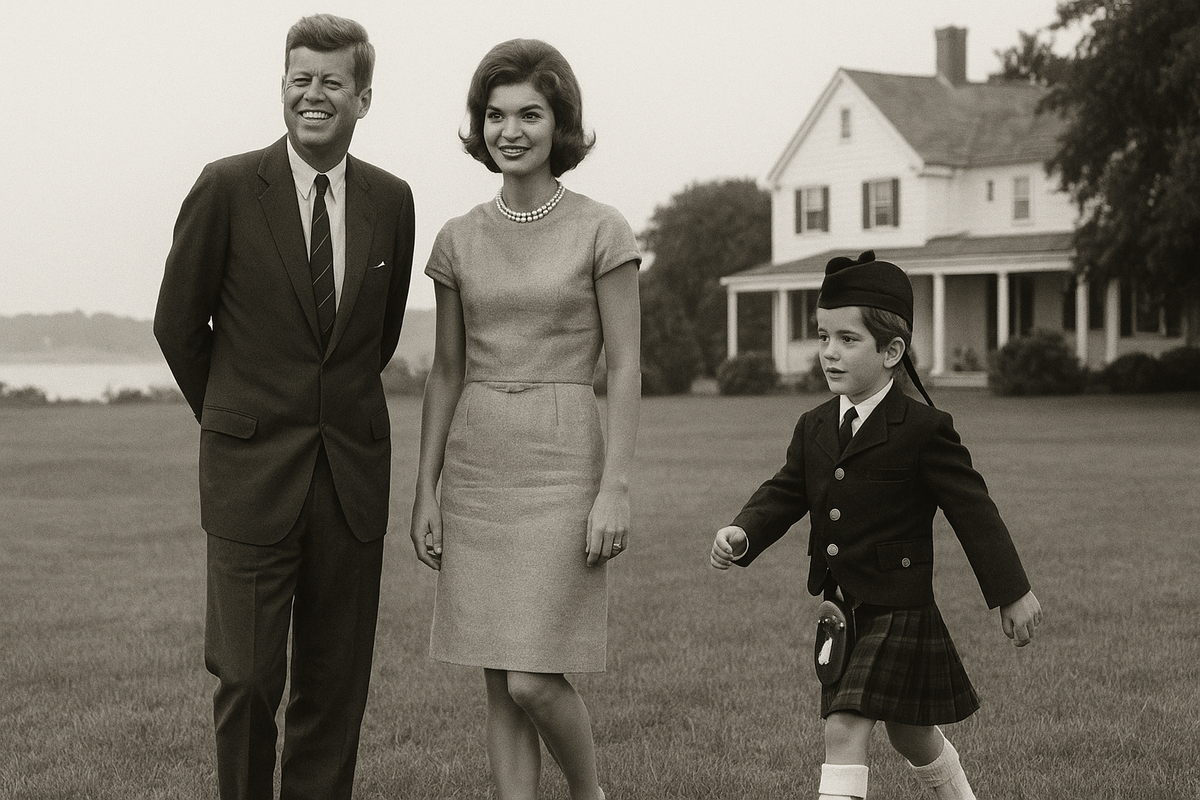
John Jr. dressed as a Scottish guardsman, all innocence and costume play, reminded readers of the humor and lightness Jackie worked to preserve inside the pressure cooker of 1600 Pennsylvania Avenue.
And then, the image that carried the most weight: John Jr. following his father in stride, captioned "like father, like son." It was a photograph of continuity rendered unbearable by assassination—a small boy who would grow up without the man he was learning to imitate.
Unlike Time or Newsweek, which archived the Kennedy years through policy debates and Cold War poker, Ladies' Home Journal transformed these photographs into a narrative of home and memory. The effect was powerful precisely because it was not grandiose. Readers were not being lectured about history. They were being invited into the Kennedy family's private world—and invited to mourn it as they would their own.
The Photographs as Cultural Architecture
Each image Jackie selected carried deliberate symbolic freight. Together, they constructed a version of the Kennedy presidency designed to endure:
Camelot as Gospel
Jackie herself had written the scripture. In her 1963 Life interview, she quoted from the musical: "Don't let it be forgot, that once there was a spot, for one brief, shining moment that was Camelot." The photographs in Ladies' Home Journal were her visual concordance.
Youth as Ideology
The images emphasized vitality: John and Jackie with their children, playing, riding, laughing. They projected a vision of politics infused with domestic warmth, a sharp contrast to the gray-suited, committee-room governance that preceded them.
Legacy Through Lineage
Scenes like John Jr. imitating his father reinforced the Kennedy mystique as intergenerational drama. Even in death, the name would carry forward.
Myth Over Record
By choosing which photographs to share, Jackie shaped collective memory. Americans would remember the Kennedy years not as a series of legislative battles or foreign policy gambles, but as a story of hope, beauty, and tragic loss.
A Dignified Exit
Coming months after her remarriage to Onassis, the feature functioned as farewell. Jackie was stepping out of the role Americans had assigned her—grieving widow, keeper of the flame—and reclaiming her own life. The photo album was her parting gift.
The Power of Presentation
The genius of the Ladies' Home Journal feature was its refusal to argue. It simply presented, allowing readers to construct their own emotional narratives around images that felt both historical and intensely personal.
Ladies' Home Journal as Cultural Curator
This single issue demonstrates why Ladies' Home Journal was far more than a collection of recipes and fashion spreads. It was one of the few national platforms that successfully bridged domestic life, cultural iconography, and historical memory—and did so in a voice that spoke directly to American women.
Through Jackie Kennedy's photographs, the Journal reminded its readers that history is not only about wars and elections. It is also about home, marriage, childhood, family rituals—the intimate architecture of life that magazines helped preserve when nothing else would.
Why This Issue Matters to Collectors
Historical Pivot Point
Published at a moment when America was reflecting on loss and transition, it captures Jackie Kennedy's own framing of the era she helped define.
Exclusive Primary Source
The photographs came directly from Jackie's private collection. No other publication had access to these images, making this issue a unique archival document.
Kennedy Market Demand
Publications tied to the Kennedy family command premium prices among collectors. Issues that humanize rather than politicize the family—that show them as people, not symbols—are especially prized.
Enduring Camelot Narrative
The myth Jackie constructed remains one of the most potent in American cultural history. This magazine represents ground zero for that myth-making in visual form.
Mid-Century Design Quality
Ladies' Home Journal in 1968 still employed high-quality printing and thoughtful layout design, making it a beautiful object independent of its historical content.
Owning this issue is not simply about possessing a magazine. It is about holding a deliberate act of memory—an artifact that captures both the construction of myth and the human need to believe in it.
Explore the Archive
Vintage magazines remain among the most accessible and authentic artifacts of 20th-century cultural history. They allow you to trace shifts in values, aesthetics, and national identity as they were first experienced—not as they were later retold.
From the 1930s through the 1970s, you can follow decades of women's lives, fashion, literature, and social transformation captured in real time. For collectors, historians, or families preserving their heritage, these magazines are not just reading material. They are time capsules—voices from the past that continue to shape how we remember who we were.
Browse Ladies' Home Journal Magazine CollectionThe December 1968 issue of Ladies' Home Journal stands as one of the most important Kennedy-era publications. By sharing her private photo album, Jacqueline Kennedy gave Americans a final glimpse of Camelot and ensured that her version of the story would be the one that endured.
To hold this issue today is to hold the moment when history became myth—when Jackie Kennedy's grace and editorial precision guaranteed that Camelot would never be forgotten.