
The Billboard That Threatened a Generation
How Rolling Stone's 1969 marijuana exposé documented the opening shots of America's War on Drugs
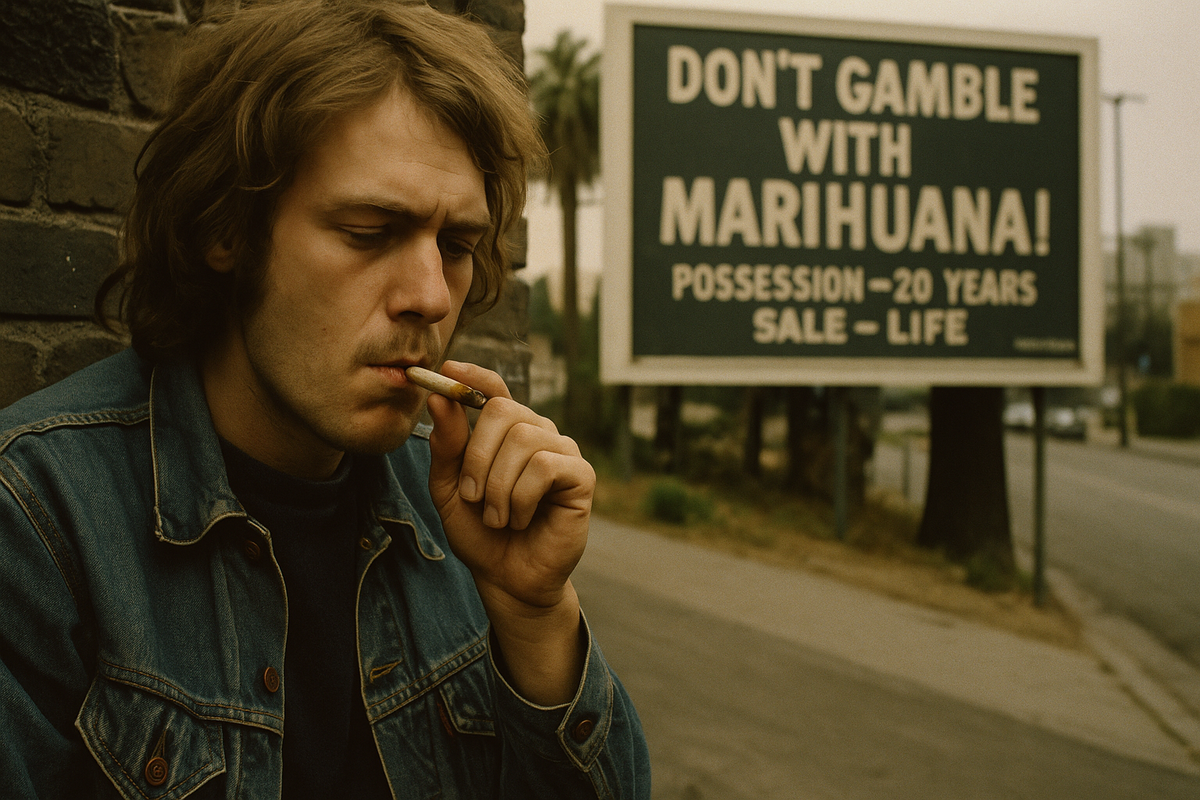
"Possession: 20 Years! Sale: Life!" The words glared from a Nevada highway billboard in the summer of 1969, a state-sanctioned threat aimed squarely at the hundreds of thousands of young Americans who had just returned from Woodstock's muddy fields. For readers of Rolling Stone that August, the message was clear: your government considered you a criminal.
On page 6 of the August 23, 1969 issue, journalists Ben Fong-Torres and Geoffrey Link published what would become one of the magazine's defining pieces of cultural reportage: "U.S. Dope Crisis: Who's Holding?" It wasn't a moral panic piece written by establishment journalists clutching their pearls. It was street-level intelligence—prices, supply routes, border seizures, and the real stakes of a drug war that was just beginning to bare its teeth.
This wasn't Rolling Stone covering music. This was Rolling Stone covering the world that music couldn't exist without.
The Price of Freedom: $15 to $50 Per Lid
While mainstream newspapers buried drug stories in the crime section, Fong-Torres and Link reported marijuana like a commodity desk analyst tracking wheat futures. The article mapped America's underground cannabis economy with forensic precision:
San Francisco, the counterculture's spiritual capital, saw prices spike to $50 a lid—artificial scarcity driven by border crackdowns.
Los Angeles, closer to Mexican entry points, offered better deals but higher arrest rates. Proximity to supply meant proximity to law enforcement.
Detroit, Denver, New York—each city got its own profile, showing how supply chains determined not just price, but risk, quality, and availability.
The piece explained the mechanics: Mexican-U.S. patrols were seizing tons of marijuana before it crossed the border. Diplomatic tensions with Mexico weren't just foreign policy—they were directly affecting what college students could buy on Friday night. The article even broke down quality tiers, distinguishing "good Mexican" from inferior imports, treating cannabis with the consumer sophistication usually reserved for wine or coffee.
This was economic reporting dressed in countercultural clothing. And it was revolutionary.
Archive Details
Publication: Rolling Stone Magazine
Issue Date: August 23, 1969
Article: "U.S. Dope Crisis: Who's Holding?"
Authors: Ben Fong-Torres and Geoffrey Link
Historical Context: Published days after Woodstock, during the early escalation of the War on Drugs
Why This Article Mattered
In 1969, marijuana wasn't simply a drug. It was a political declaration. Smoking pot meant rejecting the Vietnam War, suburban conformity, and the authority of a generation that had built the atom bomb and couldn't explain why. For young Americans, cannabis was as much a part of identity as the music they listened to—the Grateful Dead, Jimi Hendrix, Jefferson Airplane.
For the establishment, it represented the end of civilization.
The Las Vegas billboard captured this schism perfectly. Life in prison for selling a plant that was already ubiquitous on college campuses. Twenty years for possession of something as common as a Doors album. The gap between law and reality had become a chasm, and Rolling Stone was documenting it in real time.
Fong-Torres and Link understood something that mainstream journalism missed: their readers didn't need lectures about morality. They needed information. How much does it cost? Where's it scarce? What are the actual penalties? The article answered these questions without judgment, with the same matter-of-fact tone you'd use to explain how to change a tire.
That approach—treating readers as adults navigating a hostile legal landscape—set Rolling Stone apart from every other publication in America.
The Paradox of August 1969
The timing of this issue is almost too perfect to be accidental. Woodstock had ended just days earlier. Half a million people had gathered on a farm in upstate New York to celebrate music, peace, and pharmaceutical experimentation. The photographs showed mud, joy, and communal euphoria. The aftermath showed something else: a government preparing for war against its own youth.
This Rolling Stone issue captured both sides of that moment. The triumph of Woodstock. The shadow of the drug war billboard. The ecstasy and the prosecution. Cultural historians call these moments "inflection points"—when a society's contradictions become too obvious to ignore.
Ben Fong-Torres, who would go on to become one of rock journalism's most important voices, was there to document it. Not as propaganda. Not as advocacy. As witness.
Border Enforcement
Mexican-U.S. patrols were seizing tons of marijuana before it could reach American streets, creating artificial scarcity and driving prices upward.
Market Economics
From $15 a lid in Los Angeles to $50 in San Francisco, the underground market's inflation reflected law enforcement pressure and supply chain disruption.
Geographic Intelligence
Detroit, Denver, and New York were profiled alongside coastal cities, showing how supply chains shaped youth habits nationwide.
Cultural Paradox
While politicians painted marijuana as a scourge, its use was already entrenched in the counterculture—creating an unbridgeable gap between law and reality.
Generational Warfare
Parents, politicians, and law enforcement versus students, artists, and musicians—marijuana became the frontline of a broader cultural conflict.
Propaganda vs. Reality
The billboard declaring "Possession: 20 Years! Sale: Life!" showed how extreme the establishment's message had become—and how disconnected from youth experience.
What This Issue Reveals About Rolling Stone's Evolution
Founded in 1967 by Jann Wenner and music critic Ralph J. Gleason, Rolling Stone began as a counterculture newspaper that took rock music seriously when no one else would. But by 1969, it had evolved into something more ambitious: a cultural intelligence service.
The "U.S. Dope Crisis" article proved that covering music meant covering everything around music—politics, law enforcement, economics, generational warfare. You couldn't write about the Grateful Dead without understanding why their fans were being arrested. You couldn't review Abbey Road without acknowledging that listening to it while high could land you in Nevada state prison for two decades.
This wasn't "gonzo journalism" yet—Hunter S. Thompson wouldn't arrive until 1970—but it was gonzo in spirit. It treated the counterculture as a legitimate beat, worthy of serious reporting.
The Long Shadow of 1969
Today, marijuana is legal in much of the United States. Public opinion has reversed so completely that those Nevada billboards now seem like artifacts from a different country. But the echoes remain. The War on Drugs that Rolling Stone documented in its infancy would go on to incarcerate millions, disproportionately targeting communities of color, and shaping American criminal justice for generations.
This issue reminds us what was at stake. Not just freedom to get high, but freedom to define your own identity against a government that viewed dissent as disease.
For historians, music lovers, and anyone interested in how media shapes—and reflects—social change, this issue is essential reading. It shows how a magazine born from the counterculture became its chronicler, its defender, and its memory.
Why Collectors Prize This Issue
Historical Proximity to Woodstock
Published in the immediate aftermath of the festival, it captures the cultural temperature before nostalgia could sanitize the memory.
Ben Fong-Torres's Byline
One of the magazine's most important journalists, whose work would define rock criticism for decades.
Primary Source Documentation
Early drug war reporting is rare in mainstream publications. This issue serves as an unfiltered record of how marijuana prohibition shaped youth culture.
Visual Iconography
The Nevada anti-marijuana billboard photograph stands as one of the most powerful images of drug war propaganda from the era.
Cultural Battlefield Artifact
This isn't just a magazine. It's evidence of a generational civil war.
Pivotal Moment
This represents Rolling Stone at its purest form—no longer just a music rag, not yet the celebrity glossy it would become in the '80s.
Add This to Your Collection
If you're building a serious archive of 20th-century American culture, the August 23, 1969 issue of Rolling Stone belongs on your shelf. It's not just about marijuana or music—it's about the collision of youth, power, and the right to live differently.
Browse Rolling Stone Magazine CollectionFrom Woodstock to Watergate, from the Summer of Love to the fall of Nixon, every issue tells a story. This one tells the story of a generation that refused to be threatened into silence—even when the billboard promised life behind bars.