
The Pencil Behind the Wire
How a British POW Smuggled Truth Into American Homes
On April 14, 1941, Americans opened their mailboxes and found something the Nazi regime never intended them to see.
Tucked inside that week's Life Magazine—between advertisements for Camel cigarettes and Chevrolet sedans—was a collection of pencil sketches drawn by a man living behind barbed wire. Lieutenant John Fessenden Watton of the Border Regiment, a former advertising man turned prisoner of war, had documented daily life inside Oflag VII C, a German officers' camp in Bavaria. His drawings had somehow crossed enemy lines, passed through neutral channels, and landed on kitchen tables across America.
For readers still eight months from Pearl Harbor, these weren't just illustrations. They were intelligence. A warning. A glimpse of what might await their own sons if the war crossed the Atlantic.
And they were among the first visual evidence the outside world had ever seen of life inside a Nazi prison camp.
Archive Details
Featured Artist: Lieutenant John Fessenden Watton, Border Regiment
Issue Date: April 14, 1941
Location: Oflag VII C, Bavaria, Germany
Historical Context: Eight months before Pearl Harbor
Britain Broken, But Not Silent
By spring 1941, Britain was losing.
France had collapsed the year before. The Blitz was pulverizing London nightly. Churchill's rhetoric about never surrendering couldn't change the math: thousands of British soldiers had already been captured during the fall of France, including much of the storied 51st Highland Division. They'd been marched into Germany and locked inside converted castles, barracks, and fortresses scattered across the Reich.
The United States watched from a careful distance. Neutrality was official policy. Intervention was political suicide. But Life Magazine—the most powerful photojournalism platform in America—had always understood something its competitors missed: images bypass debate. They make abstract wars personal.
When photographs couldn't be obtained, Life did something unprecedented. It published a prisoner's sketches instead.
Why Drawings, Not Photographs?
Life had built its reputation on photography. Since its 1936 launch, the magazine had sent shooters into disaster zones, operating rooms, and battlefields. Its pages spoke in visual evidence, not artistic interpretation.
But German POW camps in 1941 were photographic black holes. No journalist could enter. No camera could be smuggled in. The Red Cross inspected camps occasionally, but their reports were bureaucratic, not visual. Nazi authorities controlled every image that left the wire.
So when Watton's sketches reached Life's editors—likely through Red Cross mail channels or Swiss intermediaries—they became something more valuable than photographs. They were testimony. Drawn by a man who slept in the bunks, ate the meals, and watched the guards pace above the exercise yard.
For American families, the sketches transformed "prisoners of war" from a radio news abstraction into men who looked like their brothers. Officers who shaved in cold water. Chaplains who conducted services in rooms the size of closets. Soldiers who played cards to kill time while the war raged on without them.
Life understood: this wasn't just a story. It was a document.
Inside the Issue: What Americans Saw
The April 14, 1941 cover bore the weight of global conflict—war imagery that refused to look away. Inside, the "British War Prisoners" feature occupied prime real estate, each drawing paired with captions that decoded camp life for readers who had never imagined it.
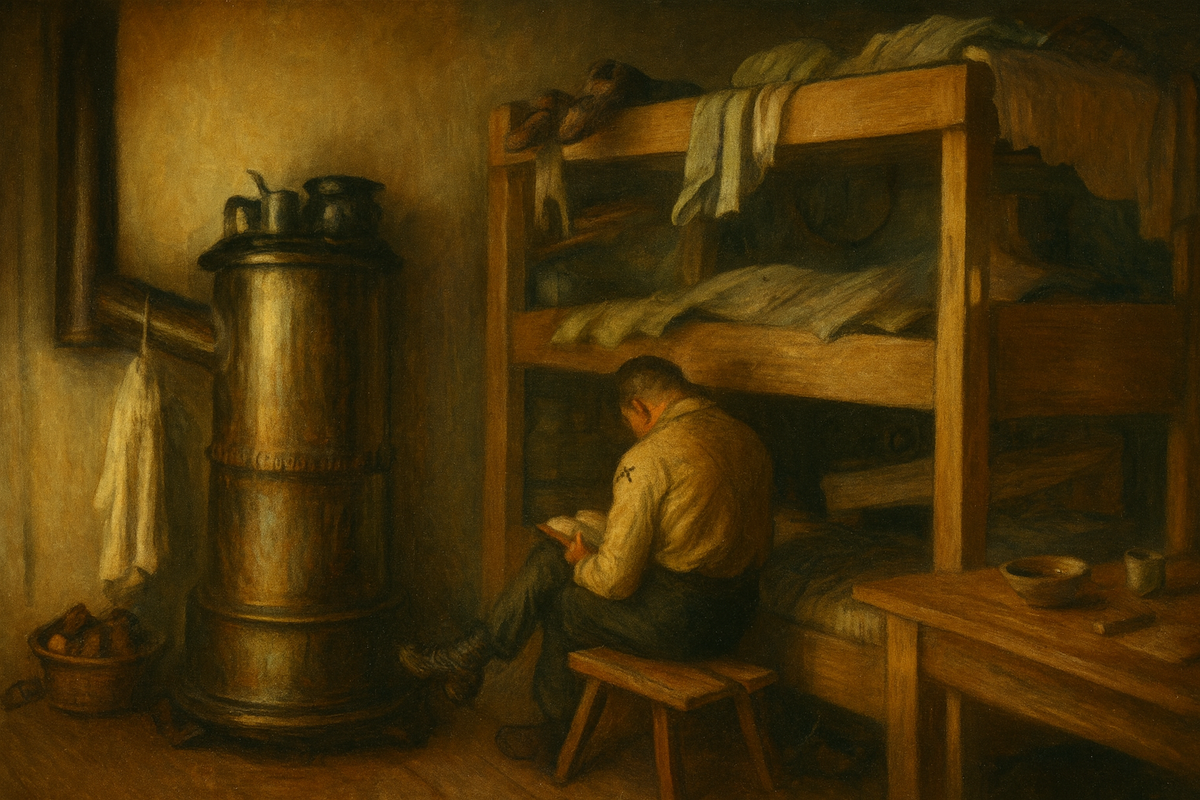
The Bunkroom
Men crammed around an iron stove, bunks stacked to the ceiling. Watton's lines captured the claustrophobia, the endless waiting. This was war after the guns stopped—just cold, boredom, and proximity to strangers who became brothers by necessity.
The Padre
A regimental chaplain conducting services in a tiny room with a makeshift stained-glass window. Even stripped of rank and freedom, the prisoners clung to ritual. Faith survived captivity better than hope.
The Bar
In a surreal twist, German authorities permitted an "excellent bar" inside the officers' camp, funded by allowances and parcels from home. Watton sketched men drinking away the hours in a space that felt stolen from another life—normal, almost civilized, utterly wrong.
Meals and Parcels
The captions revealed a logistical miracle: by early 1941, British prisoners were receiving 48,000 parcels per week from home. Red Cross packages bulging with tinned meat, chocolate, cigarettes. Without them, German rations alone would have meant slow starvation.
Exercise Grounds
Prisoners walked circuits in castle courtyards, always under watch. Watton drew a guard positioned above the yard, rifle resting on the parapet. The message was clear: movement was permitted, escape was not.
Portraits of the Captive
The most haunting drawings were Watton's portraits—Captain T. Shanks, Lieutenant D. Crichton, Major Robert Challoner, M.C. These weren't propaganda sketches of stoic heroes. They were faces. Tired, enduring, human.
Together, the sketches built a layered truth: captivity was monotony punctuated by small dignities. It was faith and boredom, resilience and quiet despair. It was surviving when there was nothing left to do but survive.
Why This Issue Still Matters
Historical Timing: Published eight months before Pearl Harbor, this issue captures America in its last moment of neutrality. Readers absorbed these images as observers, not yet participants. That makes it a rare artifact of pre-war consciousness—evidence of how Americans understood the conflict before it became their own.
Unique Content: No other major American publication ran anything like this in 1941. Watton's sketches remain one of the only primary-source visual records of early German POW camp conditions to reach American audiences during the war. They're not illustrations of history. They are history.
Cultural Resonance: For families in 1941, the article delivered contradictory comfort. The prisoners weren't being tortured—but they were gone, locked away indefinitely. The sketches made captivity real in a way War Department telegrams never could. That tension gives the issue its lasting emotional weight.
Collector Demand: Wartime Life issues remain among the most sought-after in the magazine collecting world, especially those tied to underreported milestones. This issue is prized not for its cover or its celebrity profiles, but for its documentary power—the story no one else told, captured in pencil by a man who had no other way to speak.
Holding this issue today means holding a primary source. Evidence created behind enemy lines, smuggled past censors, and delivered into American homes before the bombs fell on Hawaii.
The Enduring Power of Wartime Life
Life didn't just report World War II. It archived it.
While newspapers were discarded daily and radio broadcasts vanished into static, Life issues were saved. Clipped. Stored in attics and basements. They were too important to throw away. Families revisited them after the war, looking for the moments they'd lived through, the faces they'd recognized, the history they'd survived.
Today, these magazines function as physical witnesses. They let us study not only what happened, but how it was understood in real time—before outcomes were certain, before narratives were sanitized, before memory softened the edges.
The April 14, 1941 issue does something rarer still: it preserves the voice of a man who couldn't speak freely. Watton's drawings smuggled truth past barriers designed to prevent exactly that. His pencil lines became a form of resistance, quiet but permanent.
Collector Significance
Historical Timing
Published eight months before Pearl Harbor, this issue captures America in its last moment of neutrality—a rare artifact of pre-war consciousness.
Unique Content
One of the only primary-source visual records of early German POW camp conditions to reach American audiences during the war.
Cultural Resonance
The sketches made captivity real in a way War Department telegrams never could, delivering both reassurance and unease to American families.
Documentary Power
Evidence created behind enemy lines, smuggled past censors, and delivered into American homes—a primary source you can hold in your hands.
For Collectors and Historians
Whether you're building a military history collection, researching POW experiences, or honoring a family member who served, original Life magazines like this one are more than reading material. They're artifacts. Pieces of the past you can hold without glass cases or museum guards.
This issue offers something even most archives can't provide: context. The ads, the other articles, the cultural ephemera surrounding Watton's sketches—all of it shows what else Americans were thinking about that week. What else competed for their attention. How the war fit into their daily lives before it consumed everything.
From the 1930s through the 1970s, Life documented entire decades of American and global history. War, culture, art, politics, celebrity, everyday life—all captured in photographs and stories that still resonate. Our collection spans thousands of original issues, each one a window into a specific moment that will never come again.
Explore the Collection
Discover thousands of original Life magazines from the 1930s through the 1970s. Each issue is a window into history—authentic, preserved, and ready to hold.
Browse Life Magazine CollectionFinal Thoughts
The April 14, 1941 issue of Life Magazine stands as one of the most historically significant wartime publications of its era—not because it covered a major battle, but because it revealed what happened after the battle was lost.
Lieutenant John Fessenden Watton's sketches gave American readers their first intimate look at German prison camps. They showed monotony and faith, boredom and resilience, men enduring captivity while the world outside the wire tore itself apart.
For families in 1941, it was a sobering preview. For collectors today, it's both historical record and cultural artifact, as urgent now as it was eight decades ago.
These are voices from the past, speaking across time. And thanks to Life's commitment to visual truth, they're still speaking.