
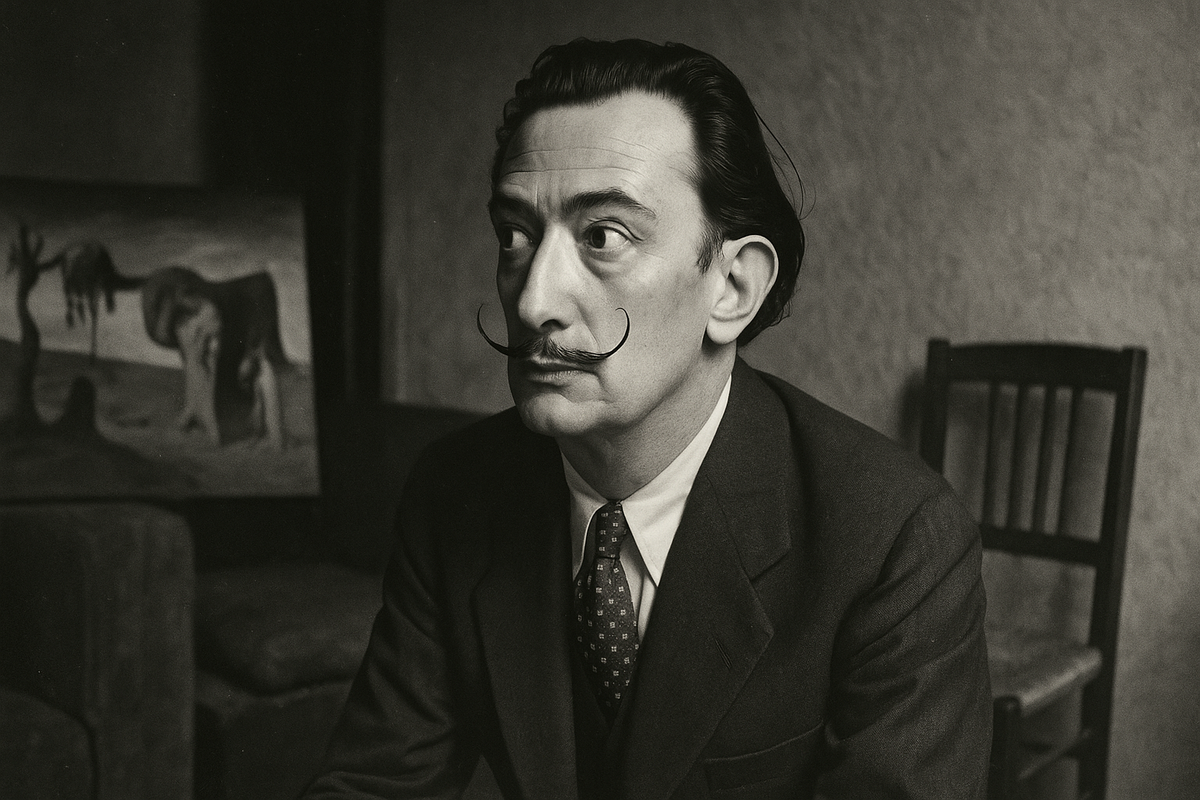
The Last Summer Before the World Burned
Inside The New Yorker's July 1, 1939 Profile of Salvador Dalí—When Surrealism Met Catastrophe
Two months before Hitler's armies crossed into Poland, American readers opened their mail to find Salvador Dalí staring back at them.
The date was July 1, 1939. The publication was The New Yorker. And tucked inside its pages was "A Dream Walking"—a profile that would become one of the most incisive portraits of surrealism's most notorious showman ever committed to print.
This wasn't mere celebrity journalism. It was a document of cultural reckoning, published at the precise moment when the dreamlike and the nightmarish had begun to merge in ways no one wanted to acknowledge.
Archive Details
Historical Figure: Salvador Dalí
Issue Date: July 1, 1939
Profile Title: "A Dream Walking"
Cover Artist: W. C. Cotton
Historical Context: Published two months before the invasion of Poland and the start of World War II
When Surrealism Met Catastrophe
Spain lay in ruins. Dalí's homeland had just emerged from a civil war that served as dress rehearsal for the mechanized slaughter to come. Europe's diplomats still clung to the fantasy of peace, even as the continent's artists had long since abandoned realism for something darker, stranger, more true.
Surrealism—André Breton's project to fuse dream and reality into liberating "super-reality"—had spent the 1920s as a radical fringe movement. By 1939, it had become the aesthetic language of an age that could no longer trust its own sanity.
And Salvador Dalí, with his theatrical mustache and melting clocks, had become its most recognizable ambassador. Also its most controversial.
The New Yorker understood what it had. The Profiles section specialized in capturing figures at their cultural apex, and Dalí in the summer of 1939 was approaching supernova. His New York exhibitions drew crowds that spilled onto the sidewalks. Department stores commissioned his window displays. The press couldn't decide whether he was genius or charlatan, so they covered him as both.
The magazine's timing proved prophetic. Within weeks, the world would fracture. But in that brief window before the fracture, The New Yorker captured something essential about what modernism had become—and what it was trying to tell us.
The Showman and the Symbols
"A Dream Walking" delivered Dalí in full spectacle. Readers encountered a man who had erased the boundary between art and performance so completely that even his lectures became absurdist theater:
The Diving Helmet Incident
Dalí delivered a lecture encased in a deep-sea diving helmet, nearly suffocating before assistants could wrench it free. Performance art or suicide attempt? With Dalí, the line blurred deliberately.
The Water Taxi Proposal
For the 1939 World's Fair, he envisioned a taxi filled with water and mermaids. It captured his method perfectly—take the mundane, flood it with the unconscious, present the result as inevitable.
The Shopping Expeditions
Dalí prowled New York hunting for props: mannequins, antique bathtubs, fragments of Victorian excess. Each object became raw material for installations that transformed gallery spaces into waking dreams.
Accommodations of Desire
This phrase—Dalí's own—described his visual vocabulary of lions' heads, barren deserts, distorted figures. These weren't random symbols. They were childhood terrors transmuted through surrealist alchemy.
The New Yorker's genius lay in its tone: amused detachment laced with genuine fascination. The magazine treated Dalí as both ridiculous and essential, which was precisely correct. His absurdity wasn't decoration. It was diagnosis.
The Surrealist Civil War
By 1939, Dalí had committed surrealism's cardinal sin: commercial success.
André Breton—the movement's pope—had expelled him in all but name. The charge? Selling out. Betraying revolutionary principles for American celebrity and dollars. Breton coined a contemptuous anagram of Dalí's name: "Avida Dollars." Greedy for money.
Dalí's response was characteristically shameless. He denied nothing. He wanted fame, wealth, spectacle. He wanted surrealism in department store windows and magazine covers, not locked in Parisian galleries where only initiates could decode it.
The split revealed a fundamental tension. Could radical art survive mass culture? Or would mass culture inevitably domesticate it, strip away its revolutionary edge, turn it into another consumer product?
The New Yorker profiled Dalí at the height of this conflict, capturing a figure who embodied modernism's contradictions. He was simultaneously avant-garde provocateur and shameless self-promoter, artistic revolutionary and commercial opportunist, European sophisticate and American celebrity.
He was, in other words, perfectly positioned for the cultural moment. And perfectly positioned to be misunderstood by everyone.
A Magazine for the Edge of History
The July 1, 1939 issue presented itself with characteristic understatement. W. C. Cotton's cover illustration showed elegantly dressed New Yorkers watching fireworks from a balcony—sophisticated, witty, restrained. The visual opposite of Dalí's surrealist explosions.
But place that cover next to the Dalí profile and the irony sharpens. The New Yorker understood spectacle. It simply preferred a more refined delivery system.
Inside, the magazine offered its signature blend: Profiles pieces that captured cultural figures with novelistic depth, "Talk of the Town" dispatches that treated Manhattan as the center of civilization (which, in 1939, it arguably was), short fiction and poetry that assumed readers had both taste and attention spans, cartoons whose sly humor had already become synonymous with the magazine's identity, and cultural commentary that connected highbrow art to the absurdities of daily life without condescension.
This approach had made The New Yorker essential. In a media landscape dominated by newspapers chasing headlines and newsreels delivering visual fragments, it offered something increasingly rare: context, interpretation, wit deployed in service of understanding rather than mockery.
The magazine had become what its founder Harold Ross intended—a publication for people who believed that intelligence and humor weren't mutually exclusive.
The Mirror That Survived
More than eight decades later, "A Dream Walking" retains its power because The New Yorker recognized something crucial: Dalí's absurdity wasn't escapism. It was confrontation.
His melting clocks and barren landscapes, his theatrical stunts and shameless self-promotion—all of it reflected the irrational forces reshaping the world. Fascism was surrealism made political. Modern warfare was surrealism made lethal. The collapse of old certainties was surrealism made historical fact.
Dalí understood this even if he couldn't articulate it clearly. His art worked because it abandoned realism for a higher fidelity—emotional truth, psychological truth, the truth of dreams that reveal what daylight obscures.
The New Yorker captured him perfectly: not as artist or charlatan, but as both simultaneously. A man who embodied his era's contradictions so completely that he became indispensable to understanding it.
The profile remains relevant because we still live in that tension. We still struggle to distinguish between authentic vision and calculated provocation, between art that challenges and spectacle that merely entertains.
Dalí knew the distinction didn't matter. Or perhaps more accurately: he knew that treating the distinction as absolute was itself a form of denial.
Why Collectors Hunt This Issue
Historical Inflection Point
This issue captures the final summer before World War II—a moment when Western culture still believed in the possibility of normalcy, even as the evidence mounted against it. Documents from this narrow window carry unusual weight.
The Dalí Profile in Real Time
Articles written about major artists during their peak fame, before history has rendered its verdict, possess a different quality than retrospective analysis. They capture the confusion, the controversy, the uncertainty about whether we're witnessing genius or fraud.
W. C. Cotton's Cover Art
The fireworks scene exemplifies The New Yorker's visual identity—sophisticated without pretension, clever without obvious cleverness. Cotton's covers from this era are increasingly sought after as standalone art objects.
Cultural Archaeology
This issue documents how Americans first encountered surrealism not through gallery visits but through mass-market magazines. It's evidence of how radical ideas migrate from avant-garde movements to mainstream consciousness.
Explore the Archive
For collectors, cultural historians, and anyone drawn to the intersection of art and history, the July 1, 1939 issue of The New Yorker represents more than vintage journalism. It's an artifact of consciousness—evidence of how one publication tried to make sense of a world coming apart.
Browse The New Yorker Magazine CollectionWhether you're pursuing Dalí, surrealism, or the cultural mood of pre-war America, issues like this transcend collectibles. They're historical testimony, preserved in ink and paper.
The July 1, 1939 New Yorker remains one of the most revealing documents of late 1930s cultural life. By profiling Salvador Dalí at peak notoriety, it created a permanent record of both the man and the moment—a surreal glimpse that, decades later, reads less like eccentricity and more like prophecy.
Holding this issue means holding proof that even facing catastrophe, art retains its power to unsettle, provoke, and endure.