
The Vault Door Swings Open: How Forbes' January 1, 1975 Issue Captured the Moment Corporate America Stopped Bluffing
When the old math came back, it came back hard—and only the companies with cash survived.
When Americans picked up the January 1, 1975 issue of Forbes Magazine, they weren't reading financial news. They were reading an obituary for an entire economic philosophy.
The cover feature, "The Old Math Is Back," was brutal in its clarity: the companies that had spent the 1960s gorging on debt and sneering at cash reserves were now either dead or begging for mercy. What mattered in 1975 wasn't vision or growth projections. It was liquidity. The simplest, oldest question in business had returned with lethal force: How much cash do you have in the bank?
For executives who'd spent a decade being told that cash was "lazy" and leverage was "sophisticated," this was more than a market correction. It was a reckoning.
Archive Details
Publication: Forbes Magazine
Issue Date: January 1, 1975
Feature Title: "The Old Math Is Back"
Historical Context: Published at the peak of the 1973-74 recession, the worst economic collapse since the Great Depression
Archive Significance: Documents the exact moment American business abandoned debt-driven growth and rediscovered balance sheet discipline
The Wreckage Behind the Story
The Forbes feature didn't emerge from theory. It was written in the smoking ruins of the worst economic collapse since the Great Depression.
Between 1973 and 1974, the Dow Jones Industrial Average lost nearly half its value—a steeper fall than anything the postwar generation had witnessed. OPEC's oil embargo had quadrupled energy costs overnight, crushing profit margins across every sector. Inflation was raging while growth stagnated, shattering the Keynesian models that had governed policy for three decades. Economists had a new word for it: stagflation.
But the deepest damage wasn't in the headlines. It was on corporate balance sheets.
Throughout the 1960s, CFOs had been taught that debt was efficient capital and cash hoarding was amateur-hour thinking. Borrow against future growth. Leverage up. Keep moving. By 1974, that orthodoxy had produced a generation of overleveraged corporations that couldn't survive even a mild downturn—let alone the catastrophe they were facing.
Penn Central had collapsed into the largest bankruptcy in U.S. history. Kaiser Aluminum was hemorrhaging. Even blue-chip names were scrambling to meet debt payments. The companies that survived weren't the ones with the best growth stories. They were the ones with cash.
Forbes Holds the Mirror
By 1975, Forbes had established itself as the magazine that didn't just report numbers—it decoded what those numbers meant for power, survival, and strategy. Unlike daily financial newspapers, Forbes specialized in connecting balance sheets to cultural moments. It told you not just what happened, but why it mattered.
"The Old Math Is Back" was peak Forbes: hard data delivered with narrative force.
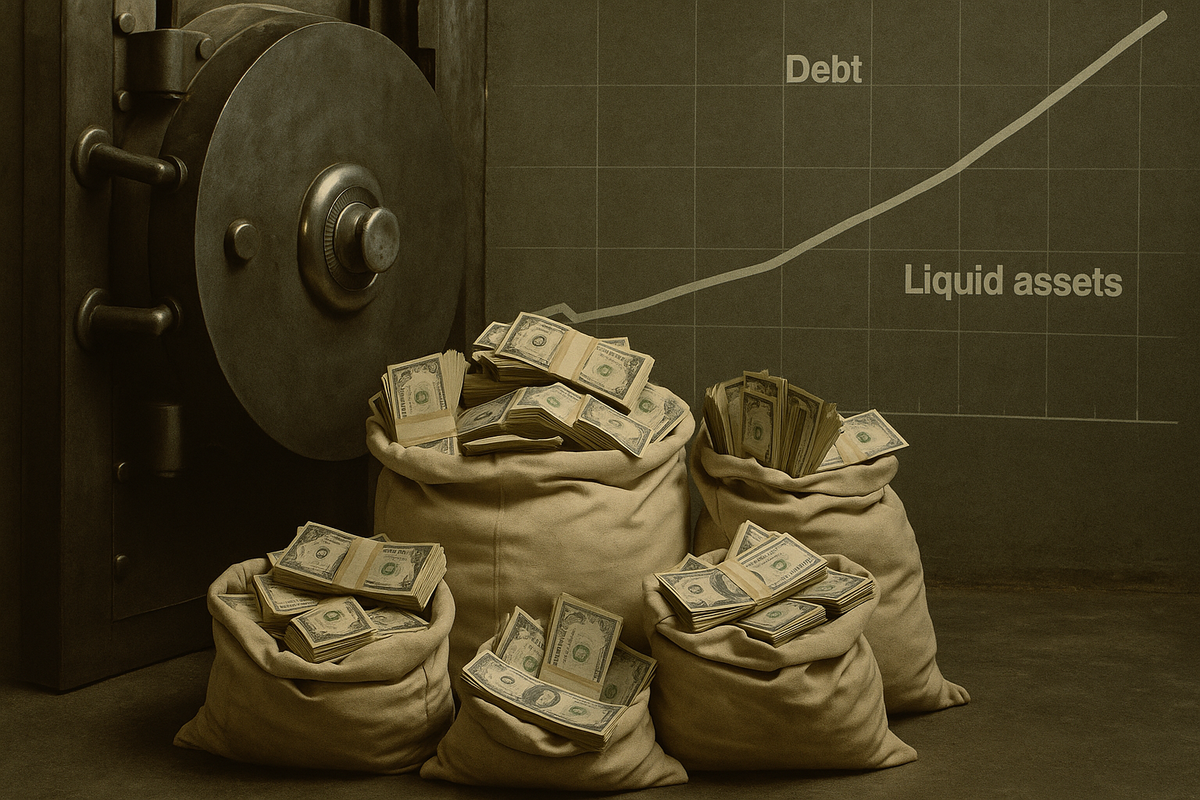
The magazine's art direction made the message unforgettable. The feature opened with an image of a vault safe overflowing with cash bags—a visual thesis statement. The same cash that had been dismissed as inefficient in 1969 was now the most valuable asset a corporation could possess.
Inside, infographics hammered the point home. One chart, titled "The Over-Burdened Balance Sheet," tracked how corporate debt had more than doubled relative to equity since the late 1960s. Another mapped the surge in liabilities against shrinking liquid assets. For readers scanning these pages in early 1975, the subtext was inescapable: the clever guys were wrong, and the cautious guys won.
What the Article Actually Said
The feature dismantled the financial fashion of the previous decade with surgical precision.
The Echo of 1975
The feature's central insight remains uncomfortably relevant: financial orthodoxy is fragile, and what looks sophisticated during a boom often looks suicidal during a bust.
The cycle repeats because memory fades. Every generation of executives rediscovers leverage, rebrands it as innovation, and learns the same lesson their predecessors did. Cash isn't exciting. But cash is what you need when the vault door slams shut.
Why This Issue Still Matters
Explore the Archive
If you want to examine this issue—or others like it—you can browse the full collection of original Forbes magazines. From the 1920s through the 1980s, Forbes chronicled every major economic boom, bust, and turning point. These aren't reproductions or digital scans. They're the physical artifacts—the actual pages executives and investors held while deciding what to do next.
Browse Forbes Magazine Collection