
Chanel's Final Act: How Vogue Transformed Death Into Legacy
Cecil Beaton's haunting tribute and the February 1971 issue that turned obituary into consecration
On January 10, 1971, Gabrielle "Coco" Chanel died in her suite at the Ritz. Five weeks later, readers opened their February 15th issue of Vogue to find something unexpected: not an obituary, but a séance.
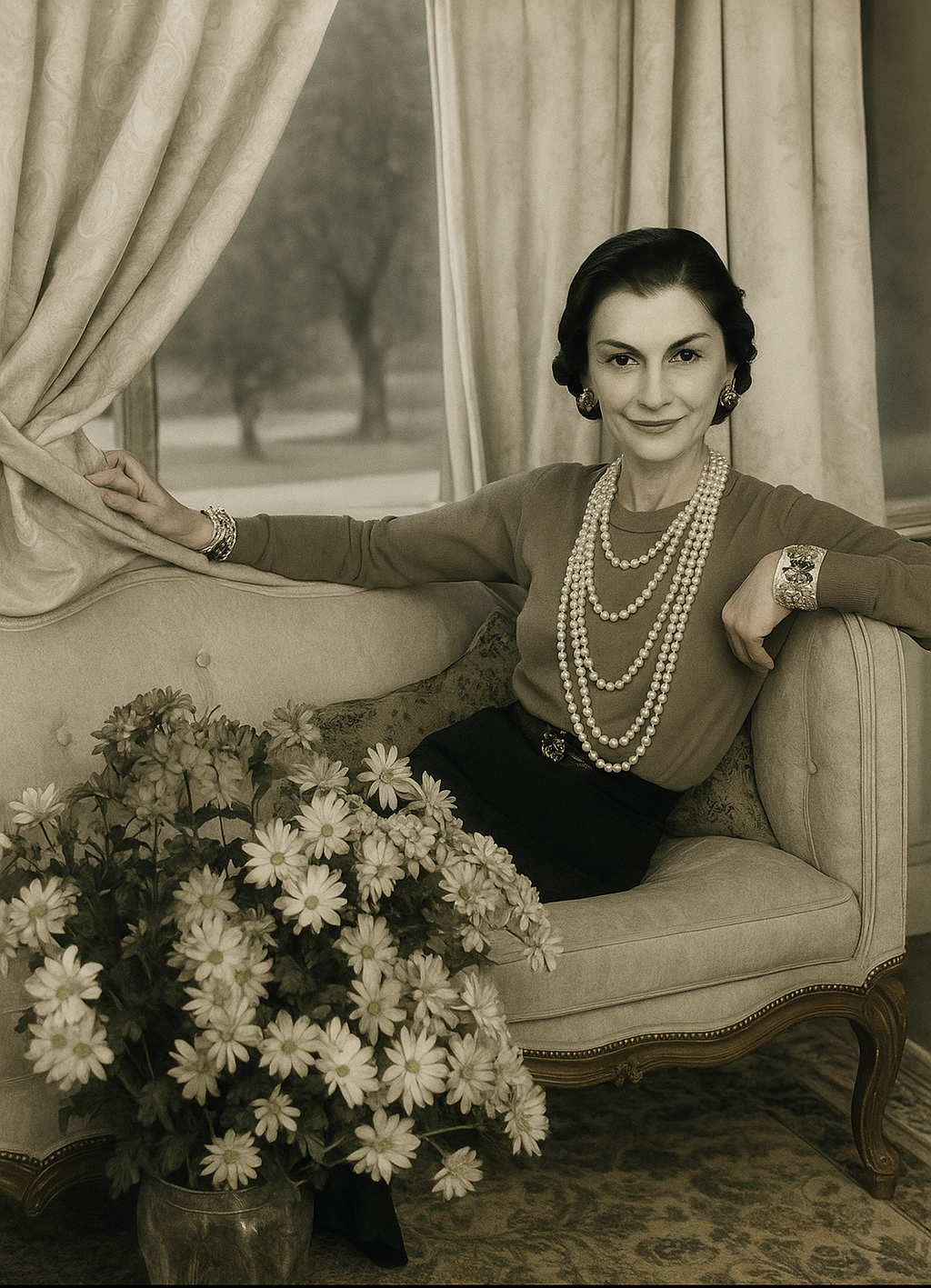
Cecil Beaton's photographs didn't memorialize Chanel—they conjured her. A hand emerging from behind a curtain. The mirrored staircase of Rue Cambon, empty but watchful. Her Paris apartment, dense with books and bronzes, as if she'd merely stepped out for a fitting. The woman was gone. Her presence had multiplied.
This wasn't sentiment. It was strategy. And it revealed how Vogue, at the peak of Diana Vreeland's editorial reign, understood something the fashion world was still learning: Chanel's death wasn't an ending. It was the beginning of her transformation from designer into doctrine.
Archive Details
Historical Figure: Gabrielle "Coco" Chanel (1883–1971)
Issue Date: February 15, 1971
Archive Source: Vogue Magazine
Photographer: Cecil Beaton
Editor-in-Chief: Diana Vreeland
Cultural Context: Published five weeks after Chanel's death, during the transition from her minimalist discipline to the expressive fashion of the 1970s
The Discipline That Outlived Her
Chanel had built her empire on refusal. She refused corsets, refused excess, refused the idea that elegance required suffering. By 1971, that philosophy looked almost quaint. Yves Saint Laurent was draping women in Moroccan opulence. Halston was turning Studio 54 into a runway. The '70s wanted more—more color, more drama, more self-expression.
Chanel had given them less. And won.
The little black dress. Jersey fabric treated like couture. Quilted handbags with chain straps. Chanel No. 5, bottled in geometry. These weren't just products—they were arguments. They said: a woman doesn't need ornamentation to command a room. She needs clarity.
Vogue understood that in 1971, this message wasn't nostalgic. It was prophetic. The second wave of feminism was cresting, and women were rejecting the idea that their bodies existed for decoration. Chanel had been saying this since 1910. The world was finally catching up.
Beaton's Ghostwork
Cecil Beaton knew how to photograph absence. His Chanel tribute is a masterclass in what's not shown.
The hand behind the curtain: Chanel the hidden observer, watching her shows from the mirrored staircase, never taking a bow. The empty Rue Cambon salon: her ghost still presiding over fittings. The apartment interior: intellect made visible through objects—not fashion sketches, but sculpture, literature, cultivated taste.
Beaton wasn't documenting a life. He was staging a haunting. And Vogue gave him the space to do it—full spreads, minimal text, photographs that demanded silence from the reader. This was editorial confidence at its zenith. The magazine trusted its audience to understand: you don't explain Chanel. You let her linger.
The visual grammar was deliberate. Partial views. Reflected surfaces. Interiors without people. Beaton presented Chanel the way she'd presented herself—elusive, disciplined, everywhere and nowhere. It's why the spread still holds power. You can't look away from something that refuses to fully appear.
What Vogue Knew (That Fashion Didn't Yet)
This tribute arrived at a pivot point. The designers who would define the '70s—Saint Laurent, Halston, Diane von Furstenberg—were ascending. Chanel's aesthetic seemed to belong to an earlier, more restrained era.
But Vogue made a bet: Chanel wasn't the past. She was the template.
The magazine framed her death as a cultural reckoning, not a fashion footnote. It described her as sweeping women "out of the eighteenth century straight into the twentieth"—a statement that positioned her not as a designer but as an architect of modernity itself. The discipline she practiced wasn't about austerity. It was about intelligence. And intelligence, Vogue suggested, never goes out of style.
This was smart archival work. By the time readers opened this issue, Chanel's legend was already hardening into myth. Vogue captured the moment just before—when she was still recently alive, still remembered as exacting and difficult and sharp, not yet softened into icon status. The tribute preserves something raw: how her absence was felt, not just noted.
Deep Dive: What Makes This Issue Essential
The Hand Behind the Curtain
Beaton's photograph of Chanel's hand emerging from fabric symbolized her lifelong position as hidden observer—watching her shows unseen from the mirrored staircase, never taking a bow.
Empty Rue Cambon
The famous mirrored staircase photographed without its mistress became an icon of discipline—the space where Chanel judged every collection with exacting standards.
Intellect Made Visible
Her Paris apartment revealed through books, bronzes, and curated objects—not fashion sketches, but the cultural foundations that informed her aesthetic philosophy.
Vreeland's Editorial Vision
Diana Vreeland gave Beaton full spreads with minimal text, trusting readers to absorb meaning through visual poetry—a bold move that defined peak Vogue.
Timing as Strategy
Published just five weeks after her death, the issue captured raw grief and immediate cultural reckoning before retrospective analysis could flatten the moment.
Liberation Philosophy
Vogue positioned Chanel as sweeping women "out of the eighteenth century straight into the twentieth"—not just a designer, but an architect of female modernity.
Why This Issue Commands Its Price
Historical Timing
Published five weeks after her death, it's the first major visual farewell—before retrospectives, before museum exhibitions, before the endless Chanel hagiography industry took hold.
Beaton + Chanel
Two titanic egos, collaborating posthumously. Beaton's theatricality meets Chanel's minimalism, and somehow it works. This pairing alone makes the issue significant.
Cultural Inflection Point
1971 sits between Chanel's reign and what came after. The issue documents the transition—acknowledging her influence while the fashion world was already moving elsewhere.
Diana Vreeland's Vogue
This is peak Vreeland-era editorial vision—bold, literary, unafraid of silence and space. Collectors recognize this period as Vogue at its most daring.
Demand for this issue remains consistent among museum archivists, fashion historians, and private collectors building Chanel libraries. It's not speculative. It's foundational.
What You're Actually Holding
This isn't a magazine. It's a witness statement.
Vintage Vogue issues from this era do something that no modern fashion publication can replicate: they show you how cultural shifts registered in real time. Not through retrospective analysis or academic distance, but through editorial choices made weeks after the event, when the outcome was still uncertain.
When you hold the February 15, 1971 issue, you're holding Vogue's argument about what Chanel meant—not what we've decided she means now, half a century later. The magazine is making its case to readers who remember when jersey was radical, when trousers on women sparked outrage, when Chanel No. 5 was new.
That immediacy is irreplaceable. The tribute isn't trying to explain Chanel's legacy. It's creating it, in real time, before history has decided what story to tell.
Your Collection Awaits
From the 1930s through the 1970s, Vogue documented every seismic shift in fashion, beauty, and cultural identity. Each issue is a primary source—the first draft of how we learned to see ourselves.
Browse Vogue Magazine CollectionWhether you're building a research library, studying mid-century visual culture, or simply drawn to Chanel's uncompromising vision, these magazines offer something digital archives can't: texture, weight, the smell of aging paper. History you can hold.
The Legacy She Left in Print
Cecil Beaton photographed an absence. Vogue published a manifesto. And Chanel, even in death, refused to disappear.
This issue doesn't memorialize. It insists. It says: discipline is permanent. Clarity outlasts trends. And the woman who taught modern women how to dress also taught them how to endure.
For collectors, it's more than a magazine. It's the moment fashion realized it had lost not just a designer, but its conscience.
And in the pages of Vogue, that conscience still presides—watching, exacting, impossible to ignore.