
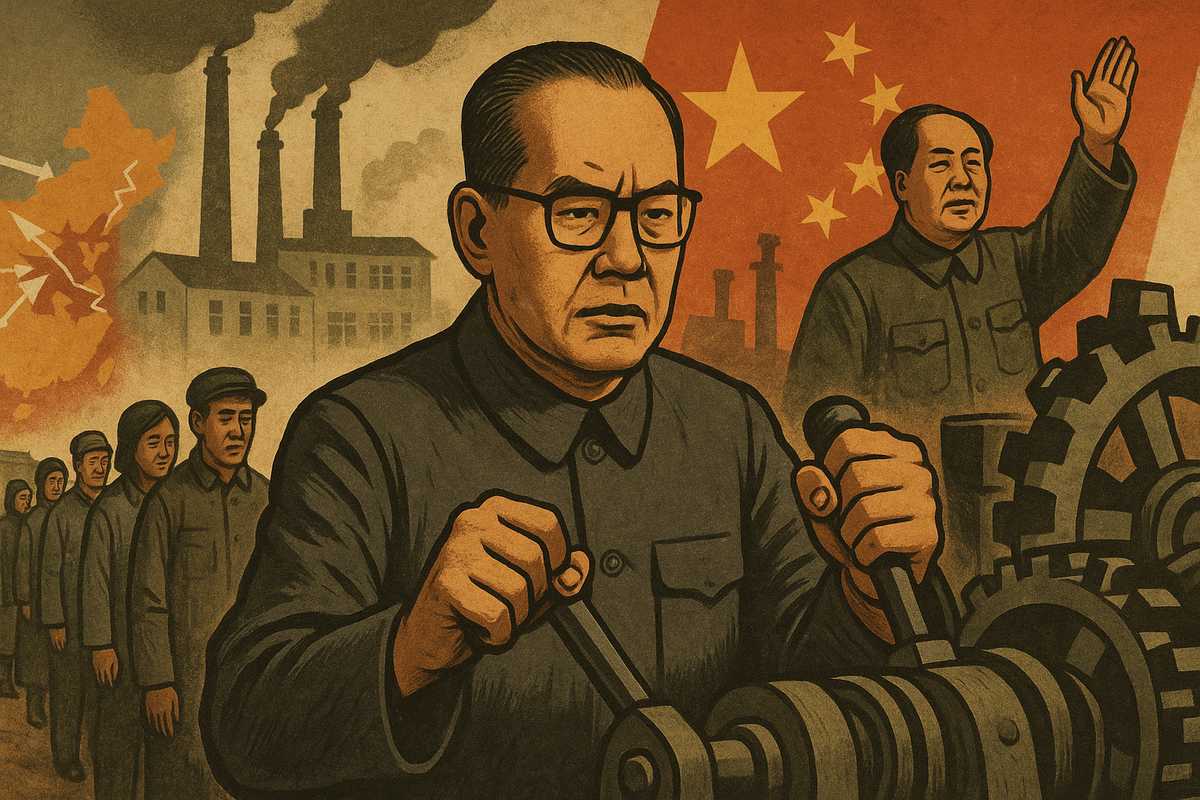
The Mechanical Man: Inside Mao's Machinery When the Great Leap Forward Began to Crumble
Time Magazine, October 12, 1959 — A Cold War portrait of Liu Shao-chi, the enforcer behind Mao's collapsing utopia
On October 12, 1959, American breakfast tables were confronted with an unsettling image: Mao Tse-tung and Nikita Khrushchev, grinning side by side on the cover of Time Magazine. Mao's smile was broad and confident. Khrushchev's looked nervous. Between them lay the question that would define the next decade of global politics: Was Communist China Moscow's greatest ally—or its most dangerous rival?
Inside, Time offered an answer Americans weren't expecting. The real story wasn't Mao. It was the man standing in his shadow: Liu Shao-chi, the regime's chief ideologue and organizational enforcer. Time called him the "mechanical man"—a cold, disciplined bureaucrat whose job was to transform Mao's utopian fever dreams into administrative reality, no matter the human cost.
What readers couldn't know in 1959 was that Liu's loyalty would prove insufficient. Within a decade, Mao would turn on him during the Cultural Revolution, and Liu would die in prison, disgraced and forgotten. But in October 1959, Liu Shao-chi stood at the height of his power, managing a disaster of historic proportions: the collapse of the Great Leap Forward.
Archive Metadata
Historical Figure: Liu Shao-chi, Chairman of the People's Republic of China (1959–1968)
Issue Date: October 12, 1959
Archive Source: Time Magazine, Original Print Edition
Historical Context: Great Leap Forward collapse, Tibetan uprising, Sino-Soviet tensions
The Great Leap Backward
By 1959, Mao's Great Leap Forward—launched just a year earlier to catapult China into industrial modernity—was failing spectacularly. The campaign had forced farmers into massive communes and demanded that villages across China build backyard steel furnaces to meet impossible production quotas. Official statistics initially claimed triumph. Reality told a different story.
Time laid it bare with a chart titled "The Big Fumble." Steel production had collapsed. The grain harvests were fiction. Cotton targets went unmet. What steel China did produce was often unusable slag from those village furnaces. Meanwhile, the farms—stripped of labor and tools to feed the industrial fantasy—were producing less food than before collectivization.
The human toll was already mounting, though the full scale wouldn't become clear for years. Famine was spreading. In Shanghai, Time documented long queues of citizens waiting for food—a stark contrast to America's postwar abundance. The photographs were damning: faces blank with exhaustion, bodies pressed together in patient desperation.
Yet even as the Great Leap crumbled internally, China's external posture remained aggressive. Chinese troops had crushed Tibet's 1959 uprising, forcing the Dalai Lama into exile. Border tensions with India were escalating in the Himalayas. Taiwan's offshore islands remained under threat. Beijing's propaganda broadcasts hammered U.S. allies across Asia with revolutionary rhetoric.
This was the paradox Time captured: a regime simultaneously faltering at home and flexing abroad, held together by men like Liu Shao-chi—functionaries who kept the machinery running even as it consumed lives.
Liu Shao-chi: The Party's Perfect Instrument
If Mao was the visionary dreamer, Liu Shao-chi was the blueprint executor. Time's portrait of Liu emphasized his almost mechanical efficiency: humorless, gray, ideologically rigid. Where Mao inspired through charisma and revolutionary rhetoric, Liu enforced through discipline and organizational precision.
Liu's biography read like a Communist hagiography. He had joined the party in the 1920s, survived the Long March, and spent decades building the bureaucratic infrastructure that would allow Mao's visions to become policy. By 1959, he stood as second-in-command—officially Mao's heir apparent.
But Time understood something crucial about Liu: his strength was also his vulnerability. Liu's entire identity rested on party loyalty and ideological correctness. He had subsumed his personality to the collective. He was, as Time put it, the "mechanical man"—a figure who embodied the Communist ideal of self-erasure for the revolution's sake.
What Liu couldn't see—what perhaps no one could see in 1959—was that this total loyalty would protect him from nothing. Mao's Cultural Revolution would demand new scapegoats, and Liu's very competence would mark him as dangerous. The mechanical man would be dismantled by the same system he had spent his life building.
Time's Cold War Classroom
By 1959, Time Magazine had perfected its role as America's visual interpreter of global affairs. The October 12 issue demonstrated this mastery through a combination of sharp prose, dramatic photography, and bold graphics designed to make complex geopolitics comprehensible at the kitchen table.
The visual storytelling was particularly striking. A map titled "Calendar of Aggression" traced China's military actions from Korea through Tibet, visually reinforcing Beijing's expansionist threat. The Shanghai food queues provided human faces to abstract policy failures. The Mao-Khrushchev cover distilled an entire geopolitical relationship into a single unsettling image.
Time's prose matched its visuals—brisk, metaphorical, occasionally cutting. The writing assumed an educated readership but never descended into academic density. This was journalism as education, delivered with the confidence of editors who believed Americans needed to understand the world, not merely be informed about it.
The Khrushchev state visit received particular attention. Though Moscow and Beijing were officially allied, Time detected the fractures. Khrushchev's nervous energy contrasted with Mao's revolutionary certainty. The Soviet leader was already questioning whether China was a partner or a liability. Within a few years, the Sino-Soviet split would shatter the Communist bloc and reshape the Cold War's entire architecture.
What This Issue Revealed
The Great Leap's Collapse
Time's charts documented China's industrial fantasy crumbling into famine and dysfunction—a story Beijing was desperately trying to suppress.
Liu Shao-chi's Authority
The feature spotlighted a figure who would dominate Chinese politics through the early 1960s before his catastrophic fall. Most Cold War coverage focused exclusively on Mao; this issue captured the bureaucratic machinery that made Mao's regime function.
The Moscow-Beijing Fracture
The Khrushchev coverage foreshadowed the Sino-Soviet split that would divide global Communism and ultimately benefit U.S. strategic interests.
American Cold War Perception
The issue serves as a perfect artifact of how Americans were taught to view Communist China—as simultaneously threatening and brittle, ideologically alien yet vulnerable to the same human failures that plagued all authoritarian systems.
Collector Significance
The October 12, 1959 Time Magazine represents a convergence of historical forces that makes it invaluable to serious collectors. It captured the Great Leap Forward at the precise moment of unraveling—early enough that Beijing was still claiming success, late enough that the evidence of disaster was undeniable. The Tibetan crisis and Sino-Soviet tensions added layers of geopolitical drama that would define the following decade.
For collectors of Cold War media, the Liu Shao-chi focus is particularly significant. While hundreds of magazines covered Mao, few dedicated substantial coverage to the bureaucratic enforcers who made the regime function. Liu's later purge and death during the Cultural Revolution adds tragic resonance—this issue captures him at his peak, unaware of the coming catastrophe.
The visual design elevates the issue beyond mere journalism. The maps, charts, and photography created a multi-layered narrative that remains striking sixty-five years later. For collectors, such design sophistication is as valuable as the reporting itself—these are magazines meant to be studied, not merely read.
This issue also represents Time at the height of its cultural authority. Before television dominated news consumption and long before the internet, weekly magazines like Time shaped how millions of Americans understood global events. To hold this issue is to hold a primary source of American Cold War consciousness.
Why It Endures
These magazines persist because they captured history at newspaper speed but with magazine depth. Unlike daily papers, forgotten within hours, or history books written with hindsight's clarity, these issues preserved the uncertainty and urgency of their moment. They show us not just what happened, but how it felt to watch events unfold without knowing their outcome.
The October 12, 1959 issue asked questions Americans couldn't yet answer: Would China's experiment succeed or collapse? Would Mao and Khrushchev hold together or fracture? Could the West compete with Communist fervor? Reading it now, knowing the answers, doesn't diminish its power—it amplifies it. We see the future casting shadows the original readers couldn't detect.
For families preserving mid-century history, these magazines offer something digital archives cannot: tactile continuity with the past. The paper, the advertisements, even the subscription cards tucked inside—all of it places you in 1959, sitting at a breakfast table, trying to make sense of a world that felt simultaneously modern and dangerously unstable.
Explore the Collection
Thousands of original Time magazines spanning the 1920s through the 1970s are available in our archive. From the Great Depression through Vietnam, from Hitler's rise to the Moon landing, you can trace entire decades of global history as Americans first encountered it.
Browse Time Magazine CollectionWhether you're a Cold War historian, a serious collector, or someone preserving family memory, these magazines offer direct access to the 20th century—not as history books tell it, but as it was lived, week by week, in American homes.