
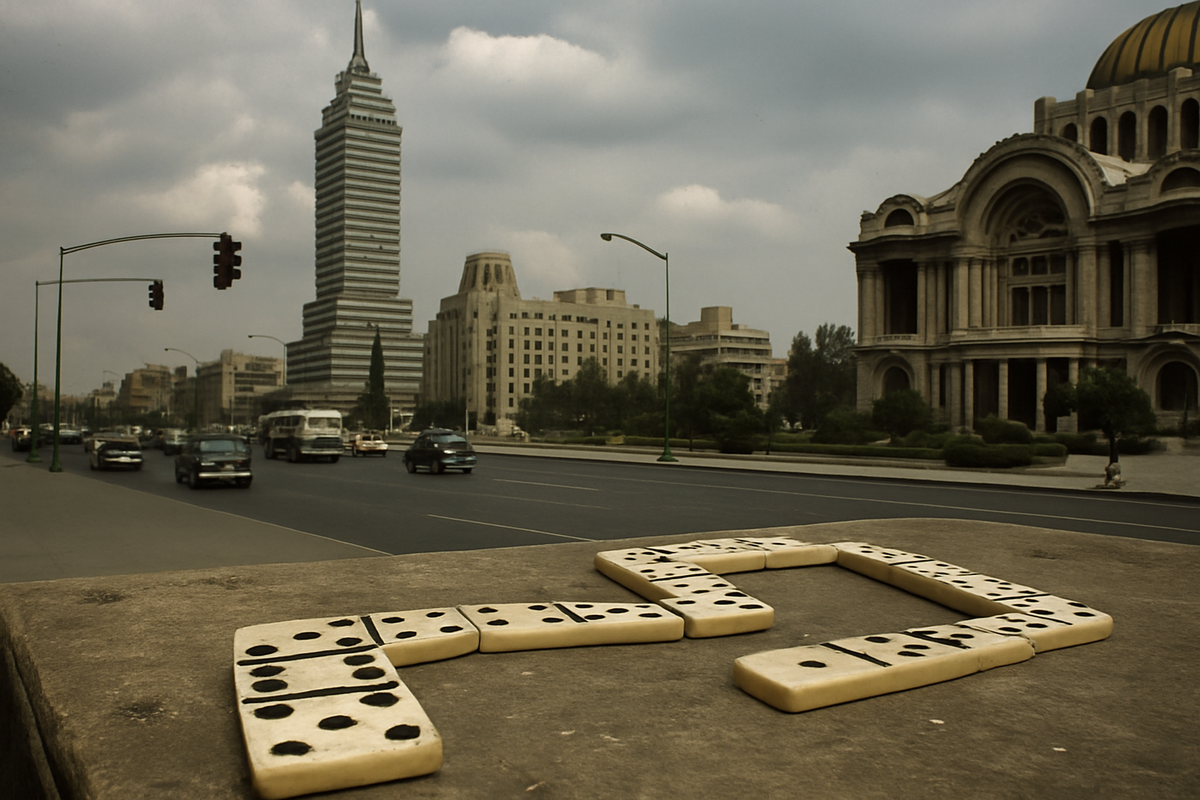
The Domino Player
How Time Magazine Introduced Americans to Mexico's Anti-Corruption Crusader in 1953
On a September morning in 1953, millions of Americans sat down to breakfast with a stranger on their coffee table.
His face stared out from the cover of Time Magazine—stern, unsmiling, framed by the magazine's iconic red border. Most readers had never heard his name. But the headline promised something rare in Cold War diplomacy: a Latin American leader who refused bribes, returned luxury cars, and declared war on the corrupt machinery of his own government.
His name was Adolfo Ruiz Cortines. And for one week that fall, Time made him the most important man in the Western Hemisphere.
Historical Archive
Featured Leader: President Adolfo Ruiz Cortines of Mexico
Publication Date: September 14, 1953
Magazine: Time Magazine
Cover Story: "The Domino Player"
Historical Context: Early Cold War, Post-Alemán Reform Era
Mexico at the Crossroads
The early 1950s were a hinge moment for Mexico. For decades, the Institutional Revolutionary Party (PRI) had maintained an iron grip on power—delivering stability after the chaos of the Mexican Revolution, yes, but also entrenching a system where graft and favoritism were the currency of governance.
President Miguel Alemán, who governed from 1946 to 1952, embodied the contradictions of the era. Under his watch, Mexico modernized at breakneck speed: highways unfurled across the countryside, factories rose in industrial corridors, and Mexico City swelled into a cosmopolitan capital. But Alemán's administration became synonymous with a darker legacy—enrichment schemes, sweetheart contracts, and an elite class that treated the national treasury as a private account.
When Ruiz Cortines assumed the presidency in December 1952, the question wasn't whether reform was needed. It was whether reform was even possible within a one-party state.
Time's Gambit: Selling Honesty as News
The September 14, 1953 issue didn't bury Ruiz Cortines in the foreign affairs section. It gave him the cover—a calculated editorial decision that signaled his importance to American strategic interests. In the early Cold War, Latin America wasn't just a neighbor; it was contested ground. Washington watched every shift in Mexico City, Moscow, and Havana with equal intensity.
Time framed Ruiz Cortines not as a revolutionary but as a corrective—a man whose presidency might prove that reform could coexist with continuity. The article, titled "The Domino Player," built its narrative around a central metaphor: Ruiz Cortines as the patient strategist, eschewing flashy gestures for calculated moves. Dominoes, after all, was Mexico's game—a pastime of working-class cantinas and presidential palaces alike. The metaphor worked because it was culturally specific and politically neutral. It suggested competence without threatening upheaval.
But the real brilliance of Time's coverage lay in its use of detail. The magazine didn't just report policy; it reported character. Ruiz Cortines refused a Cadillac sent by sycophants and sent it back to the dealer. He audited government contracts line by line. He lived modestly, avoided the cocktail circuit, and demanded that his cabinet do the same. These weren't just anecdotes—they were proof of concept. In a political culture built on patronage, austerity was radicalism.
The Five Pillars of the Ruiz Cortines Narrative
Time structured its profile around a series of contrasts, each designed to distance the new president from his predecessor:
The Modest President
Where Alemán had embraced the trappings of power, Ruiz Cortines rejected them. He turned down gifts, refused luxury perks, and insisted on living simply. For a country exhausted by elite excess, the symbolism was everything.
The Fight Against Corruption
Ruiz Cortines launched audits of government contracts, halted improper treasury payments, and pursued companies that defrauded the state. The reforms were modest in scale but radical in their willingness to challenge entrenched interests.
Breaking Monopolies
The president took on transport magnates and powerful industrialists who had carved up entire sectors of the economy. By refusing to protect monopolies, he earned public admiration—and elite resentment.
Modernization Without Malfeasance
Time showcased Mexico City's new buildings, expanding avenues, and growing economy, but emphasized that progress meant nothing if it came at the cost of integrity.
The Long Game
Ruiz Cortines was portrayed as cautious, deliberate, and strategic. He didn't promise overnight transformation. He promised something rarer: competence.
How Time Shaped American Perception
For American readers in 1953, Mexican politics were a cipher. The PRI's dominance was confusing; the institutional mechanics of one-party rule didn't map onto U.S. political experience. Time solved this problem by translating complexity into character study. It turned policy into personality.
The magazine's editorial style blended hard reporting with vivid storytelling. Photographs reinforced the narrative: one image showed Ruiz Cortines standing beside Alemán, a visual representation of the generational handoff. Another captured Mexico City's modern skyline, positioning the country as a work in progress—neither fully developed nor hopelessly backward.
This framing had consequences. By presenting Ruiz Cortines as a trustworthy reformer, Time reassured American policymakers that Mexico wasn't veering toward radicalism. By emphasizing his anti-corruption credentials, the magazine implied that Mexico's problems were solvable within the existing system. And by humanizing him—the domino player, the modest president—it made foreign policy feel personal.
The Cold War Subtext
Every line of the article carried an unspoken question: Which way will Mexico turn?
In 1953, the specter of communist influence loomed over Latin America. Washington's anxieties were sharpened by recent history—Jacobo Árbenz's land reforms in Guatemala, labor unrest across the region, and the persistent fear that economic instability would breed radicalism. Mexico's stability mattered not just for trade or diplomacy, but as a bulwark against ideological contagion.
Time's profile of Ruiz Cortines functioned as a form of soft propaganda. It reassured readers that Mexico, under competent leadership, would remain firmly in the Western camp. The emphasis on reform—rather than revolution—was deliberate. Ruiz Cortines wasn't Fidel Castro or even Lázaro Cárdenas. He was a technocrat, a manager, a man who played dominoes instead of chess.
A Magazine as History, Not Just About It
Vintage Time magazines are not passive relics. They are active documents—records of how events were interpreted, framed, and sold to the public in real time. The September 14, 1953 issue doesn't just tell us about Adolfo Ruiz Cortines. It tells us how Americans were taught to see him.
That distinction matters. History is written twice: once when it happens, and again when it's remembered. These magazines capture the first draft—unrevised, unedited by hindsight, still carrying the assumptions and anxieties of their moment.
For historians, they're indispensable. For collectors, they're beautiful. And for anyone interested in how media shapes power, they're instructive.
Why This Issue Matters to Collectors
Political Milestone
Documents the beginning of Ruiz Cortines' presidency, a significant chapter in Mexican history that remains understudied in American archives.
Cold War Artifact
Captures how U.S. media framed Latin American politics during a period of heightened ideological competition between Washington and Moscow.
Cultural Snapshot
Beyond the cover story, the issue contains mid-century advertising, photography of 1950s Mexico City, and reporting that reflects the concerns and blind spots of its era.
Rare Coverage
In-depth profiles of Mexican presidents were uncommon in mainstream American magazines. This wasn't filler—it was a statement of editorial priority.
Editorial Craftsmanship
The writing, layout, and photographic choices represent Time at the height of its influence, when newsmagazines shaped public opinion with unmatched authority.
Artifact of Change
Serves as a record of Mexico's transition from Alemán's corruption to Ruiz Cortines' reform agenda—a moment when the country stood between two futures.
Hold History in Your Hands
The story of Adolfo Ruiz Cortines—his quiet defiance, his anti-corruption crusade, his place in the Cold War imagination—lives in these pages. Explore our complete archive of original Time magazines spanning decades of history, culture, and transformation.
Browse Time Magazine Collection