
When Cybill Shepherd Looked Into the Camera and Changed Everything
How Vogue's March 1, 1972 issue documented the exact moment American style stopped performing and started living
March 1, 1972. A woman stares from the cover of Vogue—blonde, unadorned, completely present. No fantasy. No artifice. Just Cybill Shepherd, at 21, wearing her face like a declaration.
Inside, the feature that would define her reads like a manifesto: "Completely Modern—Cybill Shepherd." But this wasn't celebrity puff. This was Vogue under Grace Mirabella documenting the exact moment American style stopped performing and started living.
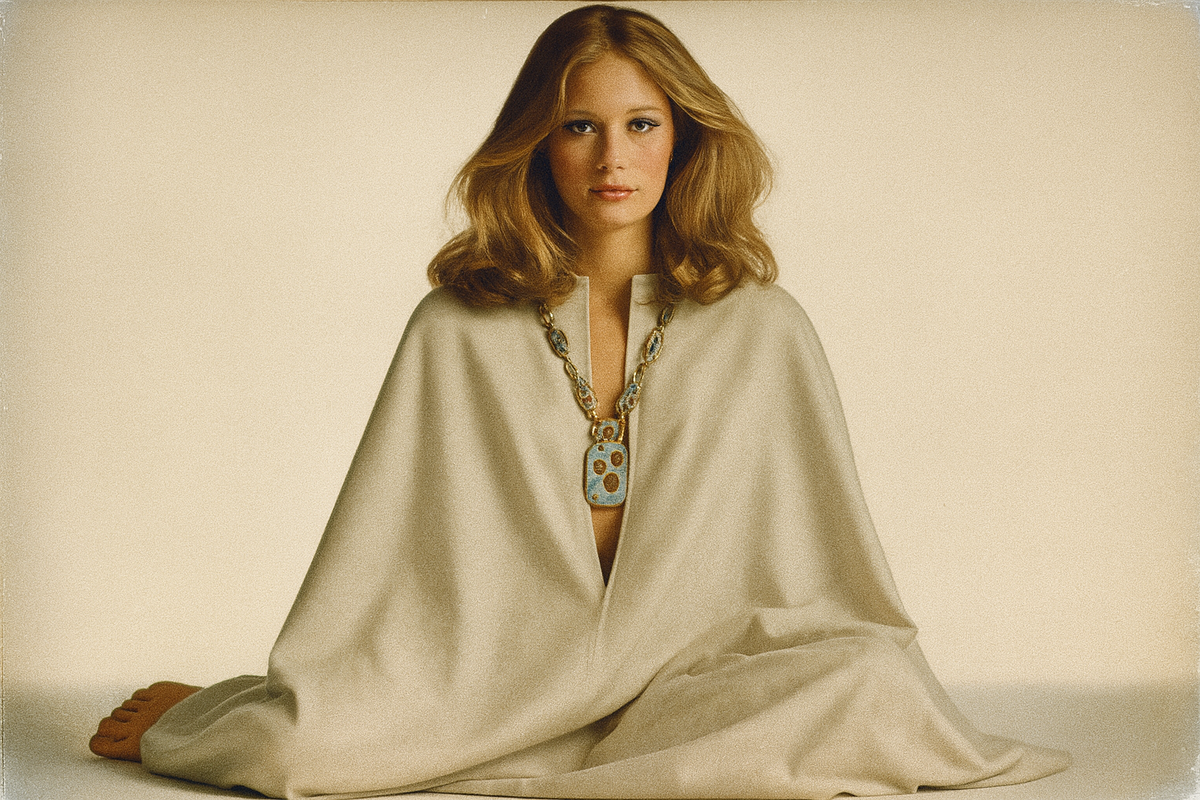
The styling told you everything. A pale Halston cashmere caftan—minimalist, expensive, effortless. A Bulgari necklace of diamonds, topazes, agates, and gold—geometric, bold, unapologetic. Natural hair. Minimal makeup. And Shepherd's own words, which landed like grenades in the perfection-obsessed world of women's magazines:
She avoided the "just-right, pulled-together look." Called it "awfully boring." Said comfort mattered most. Loved the costumes in The Last Picture Show because they were awkward but real.
This was heresy in 1972. This was also the future.
Archive Details
Featured Subject: Cybill Shepherd
Publication: Vogue (U.S. Edition)
Issue Date: March 1, 1972
Feature Title: "Completely Modern—Cybill Shepherd"
Designer Credits: Halston (cashmere caftan) • Bulgari (geometric necklace)
Editor-in-Chief: Grace Mirabella
The Collision of Three Revolutions
Understand what was happening in America that spring. The Equal Rights Amendment had just passed Congress. Women's liberation wasn't fringe—it was front page. The rigid silhouettes of the '50s and the mod costuming of the '60s were collapsing under the weight of a single question: Why are we dressing for anyone but ourselves?
Shepherd arrived at this crossroads with impeccable timing. Fresh from The Last Picture Show, she wasn't just an actress—she was a cultural barometer. Bogdanovich had cast her as small-town Texas royalty, all beauty and boredom and unspoken hunger. Vogue saw something bigger: a woman who could translate Hollywood glamour into livable style.
Halston understood this instinctively. His caftans weren't statements—they were solutions. Sleek, soft, constructed from fabrics that moved with you rather than against you. By dressing Shepherd in his work, Vogue wasn't showcasing couture. It was showcasing philosophy.
The Bulgari necklace complicated the simplicity perfectly. Heavy, sculptural, impossible to ignore—it said that "natural" didn't mean invisible. It meant powerful enough to choose your own armor.
What Vogue Actually Did
Grace Mirabella's Vogue gets less credit than it deserves. Diana Vreeland's tenure (1963-1971) gets the romance—the extravagance, the fantasy, the "more is more" ethos that made fashion mythological. But Mirabella, who took over in 1971, did something harder: she made Vogue relevant to women who actually lived in the world.
The March 1, 1972 issue was a test case. Instead of presenting Shepherd as untouchable stardom, the magazine gave readers access to her thinking. The photography—soft light, relaxed posture, direct gaze—refused to idealize. The text didn't gush; it listened. Shepherd talked about hating excessive polish, about valuing authenticity, about fashion as self-expression rather than social performance.
For readers used to being told how to look, this was oxygen.
Other magazines would have turned this into "Cybill's Beauty Secrets" or "How to Get Her Glow." Vogue positioned her as a cultural architect—someone building the aesthetic of a generation in real time.
The Deep Dive: Ten Themes That Defined the Feature
The Natural Revolution
Shepherd emphasized natural beauty, soft fabrics, and simple lines over contrived glamour—a radical statement in an era still clinging to perfection.
The Halston Aesthetic
Her pale cashmere caftan reflected Halston's minimalist vision, which would define American fashion throughout the 1970s.
The Bulgari Boldness
The geometric necklace symbolized strength and individuality—jewelry as statement rather than mere ornament.
Rejecting Perfection
Shepherd admitted she avoided the overly polished, "pulled-together" look, preferring authenticity over artifice.
Comfort as Power
She insisted that comfort was central to her style—a radical claim when women were still expected to dress for display.
Hollywood Authenticity
Referencing The Last Picture Show, Shepherd loved her costumes because they were awkward but real, mirroring her fashion philosophy.
The New Face of Beauty
Shepherd's natural hair and minimal makeup presented a different ideal than the highly stylized looks of the 1960s.
Fashion as Individuality
Vogue framed Shepherd not just as an actress but as a woman shaping her own image, aligning with broader feminist values.
Celebrity Influence
By spotlighting Shepherd, Vogue acknowledged the growing influence of Hollywood on fashion consciousness.
The Modern Woman
Above all, Shepherd embodied Vogue's message: the modern woman was stylish, confident, and unapologetically herself.
What Permanence Actually Means
There's a reason physical magazines from the '70s matter more now than they did then. In 1972, you read Vogue and threw it away. It was disposable luxury, next month's issue already en route.
But digital culture taught us what we lost. Images scroll past at light speed. Nothing accumulates weight. Nothing becomes reference material because nothing stays put long enough to be remembered.
Original magazines are the opposite of that amnesia. Every page holds the texture of its moment—the paper stock, the ad layouts, the typefaces that haven't been revived yet. You can't scroll through them. You have to sit with them.
For historians, these are primary sources. For enthusiasts, they're time machines. For collectors, they're investments in cultural memory.
The March 1, 1972 issue doesn't just show you what people wore. It shows you what they were becoming.
Why This Issue Became Archival Gold
Historical Resonance
Released at the apex of women's liberation, it documented the collision of feminism and fashion—not as opponents, but as co-conspirators in redefining modern femininity.
Celebrity at the Threshold
Shepherd was emerging, not established. This issue catches her before the fame calcified, when she was still dangerous and unfinished.
Designer Legacy
Halston and Bulgari were shaping the '70s in opposite directions—him through subtraction, them through addition. Seeing them combined on the same body, in the same spread, is a masterclass in tension.
Editorial Evolution
The photography here marks Vogue's turn away from Vreeland's operatic grandeur toward Mirabella's wearable modernism. You can see the magazine changing its mind about what women needed.
Market Demand
Issues spotlighting Hollywood icons in career-defining fashion moments consistently outperform generic editorial spreads. This one captures Shepherd, Halston, and Bulgari at their cultural zenith.
Narrative Completion
Collectors don't just want this issue. They need it to complete the narrative of how American style learned to exhale.
The Collection
If this moment in fashion history speaks to you, the archive goes deeper. We hold thousands of original Vogue issues spanning the 1930s through the 1970s—entire decades of cultural transformation, preserved in their original form.
You're not buying nostalgia. You're buying the first draft of history.
Browse Vogue Magazine CollectionThe Last Word
Cybill Shepherd in that pale caftan, wearing that impossible necklace, staring into the camera like she knew exactly what she was starting.
She probably didn't. Nobody ever does.
But Vogue understood. They gave her the cover, the feature, the space to be natural and bold simultaneously. They bet that American women were ready to stop performing perfection and start performing themselves.
They were right.
Fifty years later, the magazine that documented that gamble still exists—paper, ink, proof. That's why it matters. That's why it endures.
That's why you want to hold it in your hands.